
🔑 Key Takeaway
Talc’s cosmetic function comes from a specific combination of platelet morphology, moderate oil absorption, and grade-dependent dustiness behavior, not from being a mineral filler in general. Mica, kaolin, silica, and starch each reproduce only part of that combination, so substitution at a fixed formula ratio tends to shift binder demand, cake hardness, or airborne fines release. Qualifying a replacement means testing oil absorption, dustiness, moisture sorption, and pressed-cake compaction on the treated material, not reading a raw mineral spec sheet.
Talc’s regulatory position in the EU has moved from a watch item to a credible reformulation risk. ECHA’s Committee for Risk Assessment has recommended a harmonized classification of talc as a Category 1B carcinogen, but that opinion is not yet the final legally binding classification under the CLP Regulation. If the classification is formally adopted, Article 15 of the Cosmetics Regulation would generally prohibit its use in cosmetics unless the conditions for a specific derogation are met. Formulators of pressed powders, loose face powders, baby powder, and dry shampoo therefore have a practical reason to begin qualifying replacement fillers before the final regulatory outcome and application dates are known.
The instinct in reformulation is to treat this as a compositional swap: pull talc, insert a comparable mineral or starch at the same weight fraction, and rebalance the shade. That approach fails more often than it should, because talc’s performance in a pressed cake or loose powder is not a property of being “a mineral filler.” It comes from a specific set of particle-level characteristics, mainly a lamellar platelet shape, a moderate oil absorption value, and comparatively low dustiness at typical cosmetic particle sizes. Mica, kaolin, silica, and rice or corn starch each match some of that profile and miss the rest, and the mismatch shows up downstream as crumbly pressed cakes, altered payoff on application, or an unexpected rise in airborne fines during filling.
What Article 15 Actually Prohibits and Where the Timeline Stands
Article 15(2) of Regulation (EC) No 1223/2009 prohibits cosmetic use of substances classified as CMR 1A or 1B under Part 3 of Annex VI to the CLP Regulation, with a narrow derogation pathway available only where no suitable alternative exists, a specific use has been assessed as safe, and the substance is not itself banned under separate legislation. The European Commission’s overview of CMR substances in cosmetics describes the derogation criteria and the transitional periods that typically follow a new CMR classification once it is formally adopted into the CLP framework.
ECHA’s Committee for Risk Assessment has adopted an opinion supporting a harmonized Category 1B carcinogenic classification for talc. The opinion itself does not impose a cosmetics prohibition or establish a compliance date. Those consequences would follow only if the classification is formally adopted into Annex VI of the CLP Regulation and subsequently addressed under Article 15 of the Cosmetics Regulation. The regulatory direction therefore justifies alternative-filler qualification, but the final legal status and application timeline should not yet be presented as settled.
Why Talc Worked: The Platelet Baseline Alternatives Are Measured Against
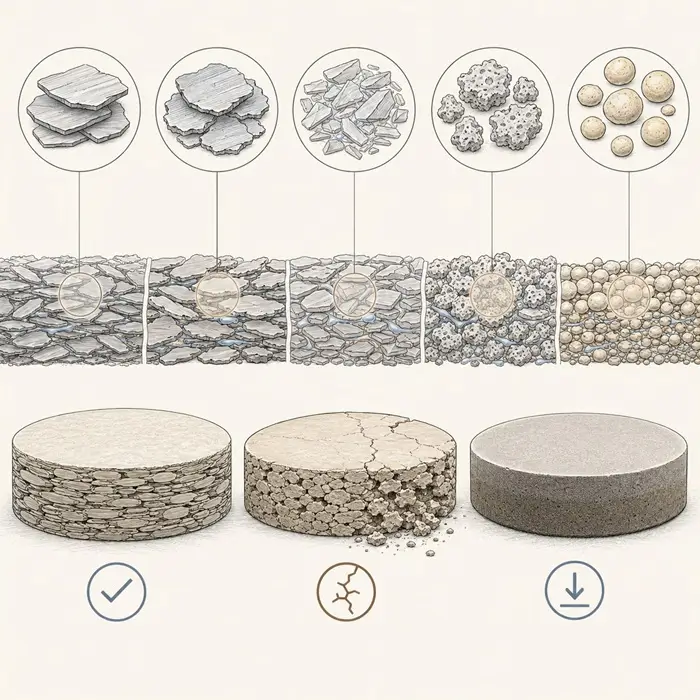
Talc is a hydrated magnesium silicate with a sheet, or lamellar, crystal structure. Individual platelets are thin, smooth-faced, and slide across each other with low interparticle friction, which is the mechanical basis for the skin slip and soft optical finish that cosmetic chemists associate with talc-based powders. That same platelet geometry gives talc a relatively low oil absorption value compared with rougher-surfaced or more porous fillers, because smooth, low-surface-area platelets need less liquid binder to wet out and bridge into a coherent pressed cake.
The practical consequence is that a talc-based pressed powder formula is balanced around a binder-to-filler ratio tuned to talc’s specific combination of particle shape, surface area, and packing behavior. Swapping in a filler with a different platelet aspect ratio, a rougher edge structure, or a higher surface area changes how that same binder level performs, independent of whether the replacement filler is chemically inert and cosmetically acceptable on its own.
The Candidate Alternatives and What Each One Brings
None of the commonly proposed replacements is a drop-in match for talc’s full property set. Each one reproduces part of the mechanism and requires compensating adjustments elsewhere in the formula.
Mica: Similar Shape, Different Edges
Mica, particularly sericite grades used in cosmetics, shares talc’s platy, lamellar structure and is the closest morphological analogue among the common alternatives. The difference sits at the particle edge and surface roughness: mica platelets typically fracture with less regular, higher-surface-area edges than talc’s smooth cleavage planes, which raises oil absorption relative to talc at an equivalent particle size. A formula rebalanced for talc’s binder demand will often under-saturate mica, producing a drier, more friable pressed cake unless the binder ratio or the mica’s surface treatment is adjusted. Particle size distribution and the proportion of fine edge fragments in a given mica lot are worth checking directly rather than assumed from a nominal D50, as discussed in the site’s guide to reading D10, D50, and D90 in process context.
Kaolin: Finer Particles, Higher Surface Area
Kaolin is also a platy phyllosilicate, but its native particle size is typically much finer than talc’s, which increases specific surface area and, with it, oil absorption and cohesion. Fine kaolin fractions can behave more like a cohesive powder than a free-flowing platelet filler, increasing the risk of clumping during blending and a harder, more brittle pressed cake at talc-tuned binder levels. Calcination and surface treatment are used industrially to modify kaolin’s particle shape and porosity, but the treated material’s flow and packing behavior needs its own characterization rather than being inferred from the untreated mineral’s data sheet.
Silica: A Flow Aid, Not a Bulk Filler Substitute
Amorphous silica, whether precipitated or fumed, has a fundamentally different particle geometry from talc: irregular or roughly spherical rather than platy, and often significantly more porous. Porous silica grades can have a very high oil absorption value, which makes them useful in small fractions for oil-control and mattifying claims but unsuitable as a full weight-for-weight talc replacement in a pressed cake, since even a modest inclusion level can absorb a disproportionate share of the available binder. Surface treatment, including silane or silicone coatings applied to host particles, changes how readily fine material separates and becomes airborne during handling; a study on the effect of silica surface treatment on the dustiness of industrial powders found that surface modification measurably shifted dustiness behavior relative to the untreated host material, which is the same logic that applies when silica-treated fillers are qualified for cosmetic use.
Rice and Corn Starch: A Different Mechanism for Skin Feel
Starch granules are roughly spherical to polygonal rather than platy, and rice starch granules in particular are much smaller than typical talc or mica platelets. The smooth skin feel starch delivers comes from granule rolling and a soft, dry touch rather than from platelet slip, which means it can match talc’s sensory profile through a different mechanism while still failing to match its flow and compaction behavior. Starch’s oil absorption is generally high relative to platy minerals because of granule surface characteristics, and its main formulation risk is moisture sensitivity: starch is hygroscopic, and moisture uptake during storage or in humid production environments increases interparticle cohesion and caking risk in ways talc does not exhibit at the same relative humidity. A review of bulk powder caking mechanisms outlines how moisture sorption drives cohesive bridging and caking onset in hygroscopic powders, which is the mechanism to test for before a starch-heavy reformulation is locked in.
Oil Absorption: The Binder-Demand Variable That Breaks Formulas
Pressed powder formulas rely on a liquid binder, typically an ester or silicone blend, to bridge filler particles into a cake that holds together under normal handling but releases pigment cleanly on application. Oil absorption value, measured by methods such as ASTM D281’s spatula rub-out procedure, quantifies how much liquid a given powder needs before it forms a coherent paste, and it is a reasonable proxy for how a filler will behave in a pressed binder system. As a practical rule of thumb, platy minerals with smooth, low-surface-area faces tend to sit at the lower end of the oil absorption range, while rougher-edged platelets, fine kaolin fractions, porous silica, and starch granules tend to require more binder for the same weight of filler. These are relative tendencies rather than fixed universal values, since oil absorption depends on the specific particle size, shape, and surface treatment of the actual lot being qualified, not the generic mineral class.
The formulation failure mode this produces is predictable: a binder level tuned for talc under-saturates a higher-oil-absorption replacement, and the pressed cake comes out dry, friable, and prone to crumbling or capping during shipping and consumer use. Reformulating around a new filler means re-measuring oil absorption on the actual treated material and adjusting binder content accordingly, rather than assuming the original ratio still applies.
Surface Treatment as the Real Equalizer
Much of the gap between an alternative filler’s raw mineralogy and talc’s cosmetic performance is closed at the particle surface rather than in the bulk material. Silicone treatments (dimethicone or methicone types), fatty acid esters, and lecithin coatings are commonly applied to mica, kaolin, and sometimes starch specifically to lower surface energy, reduce oil absorption toward talc-like levels, and improve slip. This means the qualification decision is really about the treated particle, not the base mineral: two lots of mica with identical nominal particle size distributions can behave very differently in a pressed formula if one carries a silicone surface treatment and the other does not.
It also means specification sheets that describe only particle size and chemical purity are insufficient for qualification. Flow, oil absorption, and compaction testing need to be run on the actual treated material intended for production, and repeated when the treatment supplier or coating level changes, since surface treatment is a process variable as much as a material one.
Dustiness: A Release Property the New Filler Must Not Reintroduce
Airborne particle release during handling is directly relevant here, since inhalation exposure is part of the broader scrutiny that talc has faced. A replacement filler that solves the CMR classification problem but generates more airborne fine particulate during weighing, blending, or filling than the talc it replaces has not solved the underlying handling risk, it has moved it. Dustiness is a release behavior, not something that can be inferred from particle size distribution alone; two powders with similar D50 values can differ substantially in how readily their fine fraction becomes airborne, depending on particle shape, surface energy, and moisture content.
Qualification testing should include a standardized dustiness method rather than relying on particle size specs as a proxy. The site’s comparison of EN 15051 and EN 17199-4 dustiness testing methods covers how these methods differ in what they actually measure and where each is appropriate, which matters when a starch or micronized mica alternative is being screened for a filling-line dustiness comparable to the outgoing talc.
Compaction Behavior in Pressed Powder Products
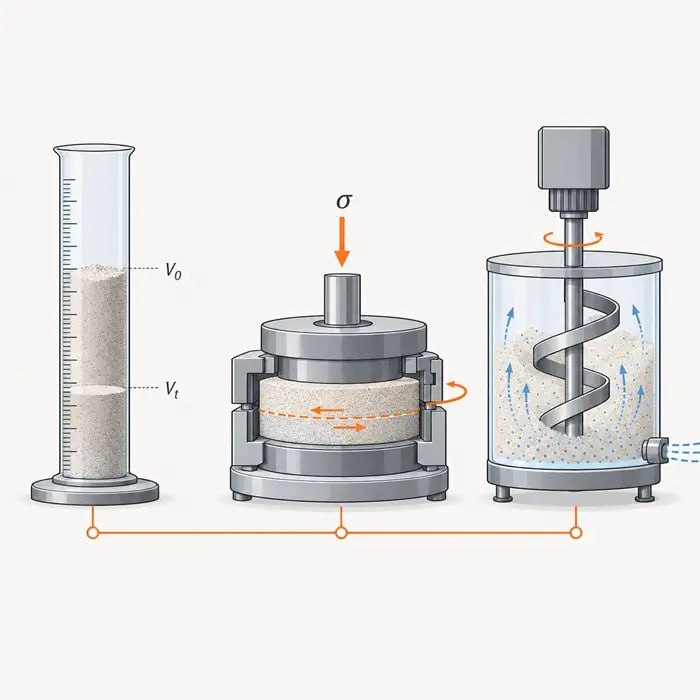
Platy particles like talc and mica compact by sliding and nesting against each other under pressing pressure, which produces a mechanically coherent cake at relatively modest compaction force. Granular starches and finer, more equant kaolin or silica particles behave more like a point-contact particulate bed, where consolidation depends more on binder bridging than on particle interlocking. At a pressing pressure tuned for talc’s platelet packing, a starch-heavy or silica-heavy reformulation can come out under-consolidated and crumbly or, if pressure is increased to compensate, develop cracking, delamination, or excessive hardness during pressing, ejection, shipping, or use.
Compaction behavior is downstream of the flow and packing properties that a pressed-cake formula depends on before pressing, so it helps to check the pre-press bulk powder’s flow character rather than jumping straight to trial pressing. Indices such as the Hausner ratio and Carr index and the packing behavior discussed in balancing packing density and powder flow give an early read on whether a candidate filler’s blend will consolidate differently from the talc-based formula before committing to a full pressing trial, and mechanical deformation behavior under load is covered in more depth in the site’s article on why powder deformation behavior matters under compression.
Qualification Testing Before Substitution, Not After
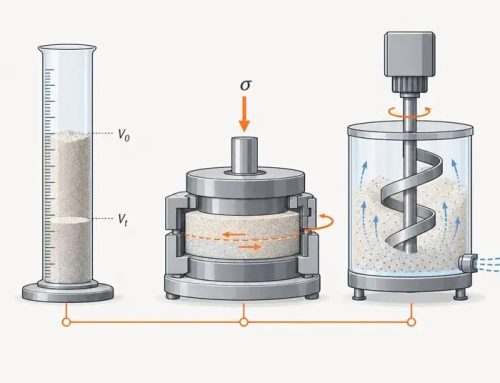
Treating a talc alternative as a formulation requalification rather than a raw material swap changes what gets tested and when. Particle size distribution needs checking on the actual treated lot, using the interpretation framework in the site’s guide to reading D10, D50, D90, and fines content in process context, since fines content specifically drives both oil absorption and dustiness. Oil absorption value should be measured directly on the candidate filler rather than assumed from its mineral class, since surface treatment and lot-to-lot particle shape variation both move this number. Dustiness needs a standardized method run on the treated material at the intended handling conditions, not inferred from particle size alone. For starch-containing formulas specifically, moisture sorption behavior should be assessed against the storage and use humidity range the product will see, following the approach outlined in the site’s guide to moisture control, dew point, water activity, and caking windows, and cross-checked against the general caking mechanisms in powder caking prevention testing methods. Finally, pressed cake mechanical performance, hardness, friability, and pick-up on application, needs its own trial at the production binder ratio before the candidate filler is locked into the formula, since none of the upstream powder tests fully predict compaction outcome on their own.