
Troubleshooting
Feeding, dosing and batching variation
Rate drift can originate in the feeder, the refill system, or the powder state presented to the inlet
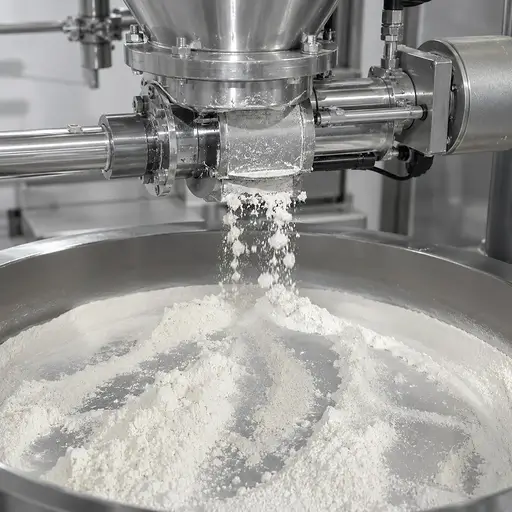
Separate steady-state error from refill transients, pulsation, starvation, and density drift. The same screw speed can deliver different mass when fill, aeration, compressibility, or segregation changes upstream.
Troubleshooting
Feeding, dosing and batching variation
Rate drift can originate in the feeder, the refill system, or the powder state presented to the inlet
Separate steady-state error from refill transients, pulsation, starvation, and density drift. The same screw speed can deliver different mass when fill, aeration, compressibility, or segregation changes upstream.




Find your route
Start with the observed failure, then add context
Separate steady-state error from refill transients, pulsation, starvation, and density drift. The same screw speed can deliver different mass when fill, aeration, compressibility, or segregation changes upstream.
- 1Observation
- 2Change or context
- 3Route
Step 1 What are you seeing?
Step 2 What changed, or when does it happen?
The same dosing symptom can come from feeder fill, upstream replenishment, powder aeration or density, segregation, or mechanical and control behavior. Use the event history to separate them.
Step 3 Your diagnostic route
Quick diagnostic comparison
Separate the leading routes before changing the process
Use the pattern and event history to select the first discriminating measurement. The table is a triage aid, not a substitute for reproducing the failed state.
Use the observed pattern and the change that preceded it to select the first discriminator. The pattern does not prove the mechanism.
| What you observe | What changed | Likely mechanism | Measurement that separates it |
|---|---|---|---|
| Rate shifts after refill | During refill, level change, or deaeration | Variable screw fill or compressibility and deaeration | Gravimetric trend across the refill cycle, followed by density and compressibility if mass per screw volume changes |
| Delivery pulses at a repeatable frequency | After screw, agitation, controller, or replenishment behavior changed | Mechanical or control periodicity, or intermittent hopper-to-feeder replenishment | Compare signal frequency with screw speed, agitation and refill events, while observing feeder-inlet level |
| The feeder runs but the inlet is not replenished | After storage or hopper-discharge behavior changed | Hopper-to-feeder starvation | Flow and replenishment: can the upstream hopper continuously supply the demanded rate? |
| Totals are repeatably high or low by material or batch | With a changed batch, PSD, composition, or recycle fraction | Segregation at refill, density change, or systematic screw-fill bias | Time-resolved composition and PSD sampling across refill; check bulk density if composition remains stable |
Use the measurement under the inlet, refill, powder-state, and machine conditions that produced the variation.
Likely mechanisms
Separate powder-state effects from feeder and refill behavior
The same rate error can come from changing screw fill, interrupted replenishment, retained air, segregation, or the machine and control system itself. Tie the pattern to refill state, inlet level, and signal frequency before changing the process.
Measurement routes
Measure the uncertainty, not just the feed-rate error
Start by overlaying the gravimetric trace with refill, screw, agitation, load-cell, and control events. Then use laboratory measurements to test the material-state explanation that remains plausible under the failed process condition.
Process context
Where the variation begins changes what to check first
Keep feeder inlet condition, upstream discharge, refill method, particle history, batch sequence, and control state attached to the diagnosis. A dosing symptom can be created well before the powder reaches the screw.
Go deeper
Guides and articles for feeding, dosing, and batching variation
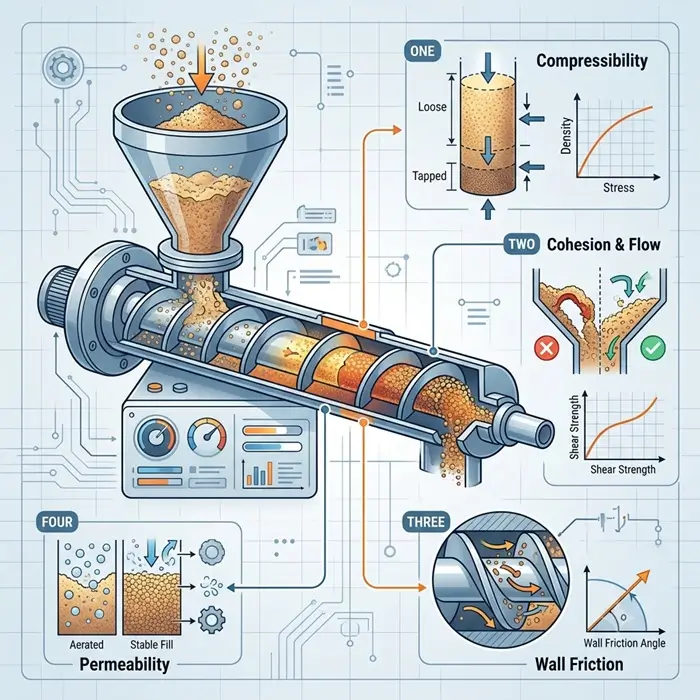
Use the deeper technical material to separate screw-fill effects, refill transients, aeration, and segregation before changing feeder hardware, control settings, or formulation.


FAQ
Feeding, dosing, and batching variation questions
Independent diagnostic support
Need the measurement, not just the guidance?
PowderTechnology.info works closely with Delft Solids Solutions, a contract research organization specializing in the physical behavior of powders and granules. DSS provides contract testing and characterization, with its laboratory working in accordance with ISO 17025. Contact Delft Solids Solutions.