
Troubleshooting

Dust and fines release

Visible dust can come from release propensity, entrainment, attrition, leakage, or capture failure
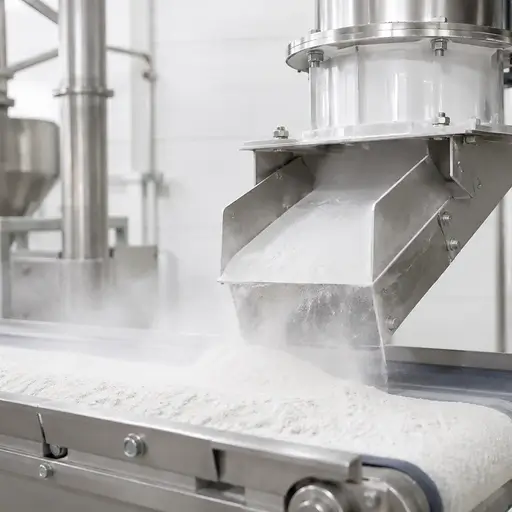
Illustration of dust and fines release in powder processing.

A fines result alone does not diagnose a dust problem. Locate where dust becomes airborne, distinguish fines already present from fines created in the process, and separate material dustiness from airflow and containment performance.

Troubleshooting

Dust and fines release

Visible dust can come from release propensity,
entrainment, attrition, leakage, or capture failure

A fines result alone does not diagnose a dust problem. Locate where dust becomes airborne,
distinguish fines already present from fines created in the process, and separate material
dustiness from airflow and containment performance.


By what you see

By what you see

A cloud appears at a transfer point; dust increases along the line; one connection leaks; or powder becomes dusty only when disturbed.

By what changed

By what changed

After transfer or conveying; after airflow, extraction, or humidity changed; or with changes in batch, PSD, composition, or recycle.

By likely mechanism

By likely mechanism

Intrinsic dustiness, Attrition-generated fines, Air displacement and entrainment, Containment or extraction failure.

By measurement route

By measurement route

Choose the measurement that most clearly separates the leading physical explanations under realistic process and operating conditions.

Find your route

Start with the observed failure, then add context

A fines result alone does not diagnose a dust problem. Locate where dust becomes airborne, distinguish fines already present from fines created in the process, and separate material dustiness from airflow and containment performance.

  1. 1Observation
  2. 2Change or context
  3. 3Route

Step 1  What are you seeing?

Step 2  What changed, or when does it happen?

The same dust symptom can arise from material release propensity, newly generated fines, displaced air, capture performance, or electrostatic effects. Use the event history to narrow the route.

Step 3  Your diagnostic route

Quick diagnostic comparison

Separate the leading routes before changing the process

Use the pattern and event history to select the first discriminating measurement. The table is a triage aid, not a substitute for reproducing the failed state.

Use the observed pattern and the change that preceded it to select the first discriminator. The pattern does not prove the mechanism.

What you observeWhat changedLikely mechanismMeasurement that separates it
A cloud appears at a drop or transfer pointAfter transfer pointsIntrinsic dustiness / air displacementDustiness propensity under a defined transfer energy, then air and pressure behavior if capture remains uncertain.
Dust increases along the lineAfter pneumatic conveying and receiversAttrition-generated finesParticle-size comparison before and after conveying: are fines being generated?
Dust escapes one connection or enclosureAfter airflow, extraction, filling, or venting changedAir displacement / containment or extraction failureAir and pressure behavior: is displaced air exceeding vent or capture capacity?
Powder is quiet at rest but dusty when disturbedChanged batch, PSD, handling energy, or humidityIntrinsic dustiness, with electrostatics as a possible modifierConditioned dustiness under the relevant handling energy; add charge testing if electrostatic effects are suspected.

Use the measurement under the material state and process conditions that produced the failure.

Likely mechanisms

Separate material release from process-generated dust

Visible dust is the endpoint of several different mechanisms. Determine whether the material is intrinsically easy to aerosolise, whether the process is creating new fines, or whether air movement, containment, or charge is controlling what escapes.

Intrinsic dustiness

The material already contains releasable fine fractions and becomes airborne when handling energy is applied.

Separate it with: a defined dustiness method that reproduces the relevant release mode.
Why dustiness is not just a fines number

Attrition-generated fines

Conveying, valves, milling, repeated handling, or granule breakage creates a new fine tail that was not present upstream.

Separate it with: particle size and morphology before and after the suspected operation, supported by attrition or strength testing.
Pneumatic conveying attrition

Air displacement and entrainment

Falling solids and vessel filling displace air. If that air carries available fines faster than the system can vent or capture them, a dust cloud appears.

Separate it with: air balance, pressure, fill rate, drop height, and capture performance under the failing condition.
Why dust control starts with powder behavior

Containment or extraction failure

A local leak, pressure imbalance, poor hood geometry, or insufficient extraction can turn a manageable material release into visible escape.

Separate it with: the same material and handling condition with enclosure, venting, and extraction variables checked separately.
Conveying & transfer context

Electrostatic suspension and adhesion

Charge can change particle release, wall deposition, agglomeration, filter loading, and how fines behave after contact and separation.

Separate it with: charge generation and decay under representative contact materials, humidity, and handling conditions.
Triboelectric charging and humidity

Diagnostic note

A fines percentage and a dustiness result answer different questions. Fines content describes the material’s size distribution. Dustiness measures how readily material becomes airborne under a defined handling mode. Compare both when the plant question is whether more fines were created or the same fines became easier to release.

Measurement routes

Measure the uncertainty, not the dust cloud

Dustiness, particle size, attrition resistance, air behavior, moisture, and electrostatics answer different diagnostic questions. Use the failed process state to decide which measurements need to be paired.

Release propensity and fine generation

Use this route when the key question is whether the powder was already dusty or became dustier because handling generated new fines.

Air movement and process release

Use this route when dust appears mainly during filling, transfer, receiver venting, or other operations that rapidly displace or entrain air.

Charge and environmental state

Use this route when deposition, suspension, filter behavior, humidity, or batch-to-batch environmental history changes the observed dust release.

Process context

Where the dust appears changes what to check first

Keep release energy, air displacement, residence time, impact history, containment, and environmental state attached to the diagnosis. The same powder can look clean in one operation and dusty in another.

01

Transfer points

Drop height, impact velocity, and enclosure volume determine how much handling energy and displaced air act on available fines.

02

Pneumatic conveying and receivers

Repeated impact can generate fines while receiver venting and filtration determine how much dust is released or captured.

03

Filling and packaging

Fill rate, drop height, bag or container venting, and enclosure geometry control displacement of dusty air.

04

Feeding and dosing

Feeder refill, agitation, screw action, and local extraction can release fines or generate additional attrition.

05

Size reduction and classification

Milling and classification deliberately create or separate fine fractions, so PSD and dustiness should be tracked together.

06

Housekeeping and reclaim

Deposited fines can be resuspended during cleaning, reclaim, or repeated disturbance and can spread beyond the original release point.

Go deeper

Guides and articles for dust and fines release

Use the deeper technical material to separate release propensity, fine generation, air movement, and plant control measures before changing equipment or formulation.

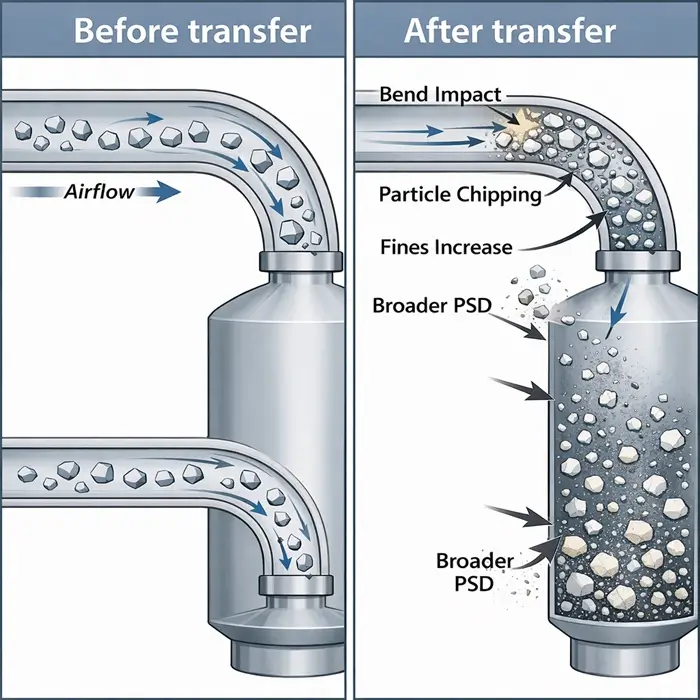
Technical illustration comparing powder fines content with dust release behavior

Powder Dustiness Is a Release Problem, Not a Fines Number

Why a particle-size result cannot by itself predict airborne release, and how handling mode changes what a dustiness test means.

Pneumatic conveying attrition and fines generation in powder handling

Pneumatic Conveying Attrition: Transfer Quietly Changes Powder

How conveying can create new fines through impact and abrasion, changing downstream dust behavior even when the feed material was acceptable.

Dust control in powder handling and transfer operations

Why Dust Control in Powder Handling Starts With Powder Behavior

Connects material release propensity with transfer energy, displaced air, enclosure, and capture so dust control is treated as a combined material-and-process problem.

Understand dustiness

Explore the Particle Behavior child to understand the variables that control dust release and airborne behavior.

Browse Dustiness articles

Browse published PTI articles covering dustiness, fines release, airborne dust, and related powder behavior.

Choose the right dustiness test

Compare the Test Methods used to quantify airborne release and interpret dustiness under defined conditions.

Conveying & transfer

Follow the Process & Equipment route when transfer energy, attrition, receivers, or displaced air drive the problem.

FAQ

Dust and fines release questions

No. Fines content describes how much material lies in a small-particle size range. Dustiness describes how readily particles become airborne under a defined handling mode. Two powders with similar particle-size distributions can therefore produce different dustiness results.
Handling energy, moisture state, cohesion, electrostatic charge, surface condition, agglomerate strength, and air movement can change release propensity without a large shift in the incoming particle-size distribution. The process itself can also create fines after the incoming sample was measured.
Compare representative material upstream and downstream of the suspected operation. Particle size and morphology can show whether a new fine fraction has appeared, while dustiness testing shows whether the material state has become easier to aerosolise. Use both when the distinction matters.
Start with where and when the dust becomes airborne. Use dustiness testing when material release propensity is the main uncertainty, particle-size and attrition measurements when new fines may be generated, air or pressure measurements when filling and venting dominate, and electrostatic or moisture methods when environmental state changes the release pattern.
Transfer and filling add impact energy and displace air. Available fines can become entrained in that moving air, and visible escape depends on enclosure, venting, extraction, drop height, fill rate, and capture performance as well as the material itself.
Yes. Charge can alter whether fines remain suspended, deposit on walls or filters, agglomerate, or detach after contact. Its importance depends on the material, contact surfaces, humidity, grounding, and handling history, so it should be tested under representative conditions when charge is a plausible mechanism.

Independent diagnostic support

Need the measurement, not just the guidance?

PowderTechnology.info works closely with Delft Solids Solutions, a contract research organization specializing in the physical behavior of powders and granules. DSS provides contract testing and characterization, with its laboratory working in accordance with ISO 17025. Contact Delft Solids Solutions.