
Troubleshooting
Forming and densification problems
Density, strength, defects, and ejection behavior depend on packing, air, friction, and bonding
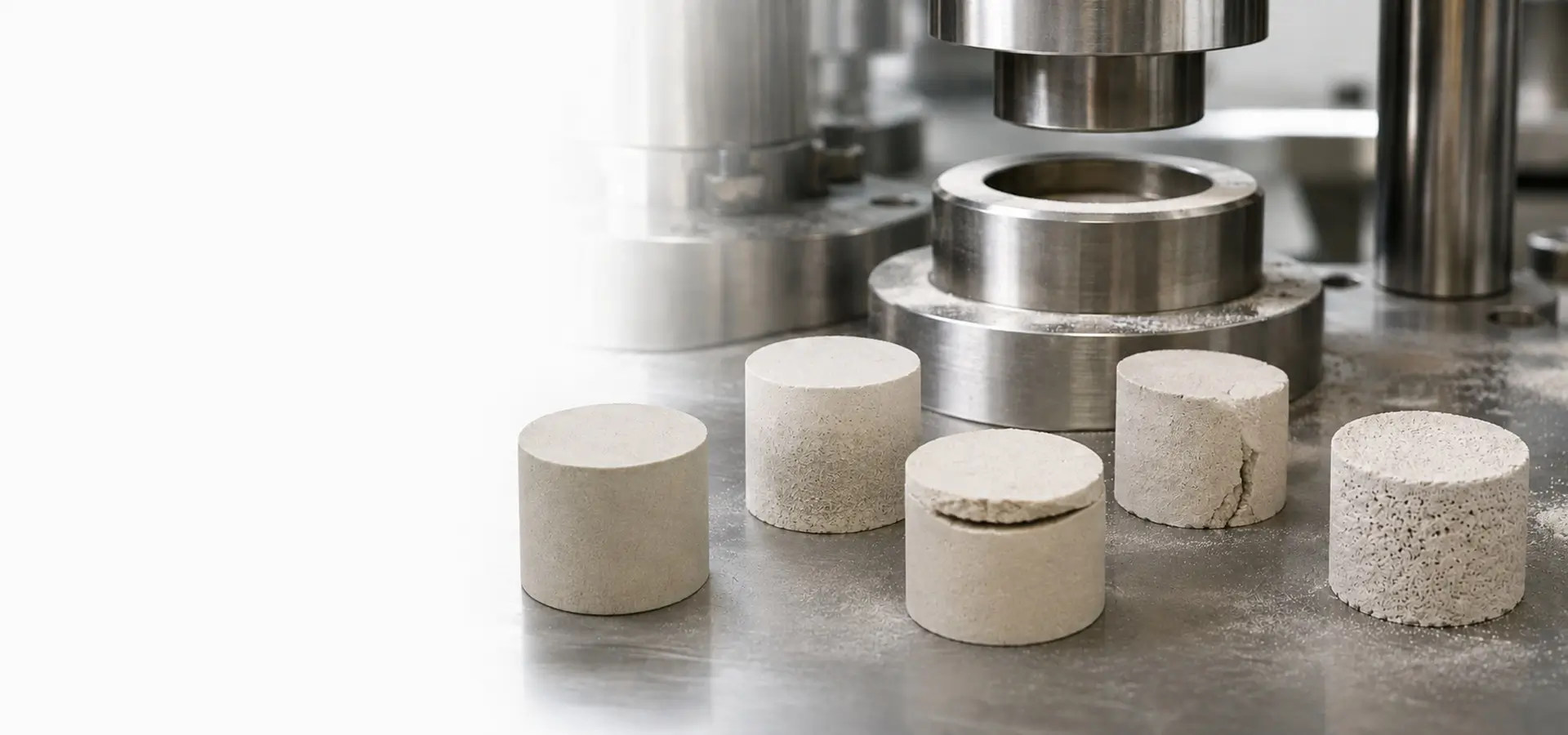
Begin with where the compact fails and whether the defect appears during fill, compression, pressure release, ejection, or later handling. Equal applied force does not guarantee equal local solid fraction.
Troubleshooting
Forming and densification
problems
Density, strength, defects, and ejection behavior
depend on packing, air, friction, and bonding
Begin with where the compact fails and whether the defect appears during fill,
compression, pressure release, ejection, or later handling.
Equal applied force does not guarantee equal local
solid fraction.




Find your route
Start with the observed failure, then add context
Begin with where the compact fails and whether the defect appears during fill, compression, pressure release, ejection, or later handling. Equal applied force does not guarantee equal local solid fraction.
- 1Observation
- 2Change or context
- 3Route
Step 1 What are you seeing?
Step 2 What changed, or when does it happen?
The same forming defect can arise from a different mechanism depending on powder preparation, die filling, press speed, dwell, lubrication, tooling condition, or a change in the material itself.
Step 3 Your diagnostic route
Quick diagnostic comparison
Separate the leading routes before changing the process
Use the pattern and event history to select the first discriminating measurement. The table is a triage aid, not a substitute for reproducing the failed state.
Use the observed pattern and the change that preceded it to select the first discriminator. The pattern does not prove the mechanism.
| What you observe | What changed | Likely mechanism | Measurement that separates it |
|---|---|---|---|
| Density varies across or through the compact | After powder preparation or die/mold filling changed | Nonuniform die filling or die-wall friction | Solid-fraction profile: map where density is gained or lost through the part |
| Layers split or cap after pressing | After press speed, dwell, or pressure-release conditions changed | Entrapped air or elastic recovery | Permeability plus compaction/decompression response under the failed press rate |
| Compact density is acceptable but strength is low | After batch, composition, lubrication, or powder preparation changed | Insufficient interparticle bonding | Strength versus solid fraction, with surface or binder-distribution analysis where needed |
| Cracking or sticking occurs during ejection | After lubrication, tooling condition, contact surface, or ejection settings changed | Die-wall friction or elastic recovery | Ejection force or wall friction, paired with post-ejection dimensional recovery |
Use the measurement under the material state and forming conditions that produced the failure.
Likely mechanisms
Separate filling, air, friction, recovery, and bonding
Each route links the observation to a physical cause, a discriminator, and the process implication.
Measurement routes
Measure the uncertainty, not the symptom
Use the measurement that best separates fill nonuniformity, trapped air, friction, elastic recovery, and insufficient bonding under the actual forming conditions.
Process context
Where the defect appears changes what to check first
Track the material from preparation through filling, compaction, pressure release, ejection, and downstream handling. The first reproducible shift narrows the mechanism much faster than press force alone.
Go deeper
Guides and articles for forming and densification problems
Use the deeper material to connect powder preparation, filling, densification, bonding, and downstream performance before changing press settings or formulation.


FAQ
Forming and densification questions
Independent diagnostic support
Need the measurement, not just the guidance?
PowderTechnology.info works closely with Delft Solids Solutions, a contract research organization specializing in the physical behavior of powders and granules. DSS provides contract testing and characterization, with its laboratory working in accordance with ISO 17025. Contact Delft Solids Solutions.