
Process & Equipment
Mixing & Blending
Select the mixing action and prove the delivered blend
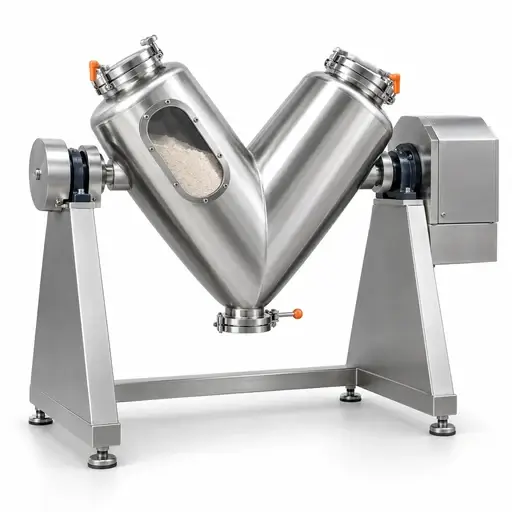
Choose powder mixing equipment around the required composition uniformity, production duty, and allowable material change. Compare mixing principles, define the operating window, and request evidence that the blend remains fit for use after discharge and transfer.
Process & Equipment
Mixing & Blending
Select the mixing action and prove
the delivered blend
Choose powder mixing equipment around the required composition uniformity,
production duty, and allowable material change. Compare mixing principles,
define the operating window, and request evidence that the blend remains fit
for use after discharge and transfer.




Jump to
Jump to a specific engineering decision, or follow the sections from process requirements through equipment selection and verification.
Key Takeaway
Define uniformity where the product is used
Select a mixer that redistributes the ingredients at the required scale while keeping particle damage, heat, and unwanted agglomeration within agreed limits. Specify composition targets, sample mass, and acceptance criteria before trials. Verify the working fill range, addition sequence, and mixing endpoint with representative materials, then confirm performance through discharge and downstream handling. A uniform average composition or a stable mixer signal alone does not establish a uniform delivered blend.
Start with the requirement
Define what the blend must achieve
Agree the product requirement and complete production cycle before comparing mixer sizes.
Powder constraints
Identify what resists redistribution
Characterize the ingredients as well as the final blend; one blended average can hide a difficult component.
Choose by application question
Start with the unresolved mixing decision
Match the required action to the material and the evidence that will demonstrate success.
Equipment principles
Choose the required material motion
Mixer names describe hardware; the design question is whether that hardware creates the required exchange throughout the working charge.
Vessel tumbling
V-blenders, double-cone blenders, and rotating bins redistribute material through repeated movement of the vessel and powder bed. They are candidates for powders that can rearrange under this action. Cohesive clusters may need a separate dispersive step. Any intensifier changes the local exposure and must be included in trials.
Driven circulation
Ribbon, paddle, ploughshare, and vertical screw arrangements move material with internal tools. Compare axial and radial exchange, end regions, tool clearances, and the usable fill range. A low average speed does not demonstrate low local stress at every contact.
Separate principle from production mode
Batch versus continuous operation is a second choice, not a mixing mechanism. Continuous equipment must combine adequate mixing action with reliable ingredient supply, residence-time behavior, and management of material during transitions.
Blend quality
Define uniformity before choosing the endpoint
A bulk average can meet the recipe while individual portions differ substantially.
Specify the observation scale
Record sample mass, number of samples, location or discharge fraction, collection method, and analytical method. Report mean concentration and variation together. A coefficient of variation alone can conceal a biased mean, and a large composite sample can hide local differences.
Control sampling error
Check whether a thief disturbs or preferentially collects the material. Where feasible, design representative stream cuts across discharge and retain time or mass-fraction identity. Assess analytical repeatability and sampling contribution before assigning observed variation entirely to the mixer.
Validate process monitoring
A local spectroscopic signal needs calibration and a justified relationship to the product requirement. A plateau can support endpoint control after validation; it does not independently prove that remote regions or the discharged product have the same composition.
Intensity and endpoint
Use enough action to mix without exceeding product limits
Define the useful interval between incomplete redistribution and unacceptable material change.
Match action to the task
Distribution and cluster breakup are different objectives. If deagglomeration is required, demonstrate that the applied action separates the relevant clusters. Check that the same exposure does not fracture primary particles, damage coatings, or create excess fines.
Qualify the operating range
\<p>Trial speed, working fill, time, and addition sequence together. Record torque or power and temperature as supporting process signals. Compare several justified endpoints against composition and material-quality measurements rather than assuming that longer mixing is always better.\</p>
Scale with a stated rationale
Equal rpm, tip speed, or energy per mass alone does not preserve every aspect of mixing. Document geometry, circulation, clearances, fill, and heat removal. Select the scale-up criterion for the dominant task and verify its limits at the intended scale.
Liquid addition
Distribute liquid without creating an unintended product
Treat liquid delivery and powder circulation as a coupled operation.
Define the target state
\<p>State whether liquid should coat, moisten, bind, or dissolve a component. If the desired result is granule growth or a suspension, define those product attributes explicitly rather than judging success only by blend uniformity.\</p>
Coordinate delivery and renewal
Specify addition location, spray or stream pattern, rate, liquid properties, and powder movement through the addition zone. Test whether material is renewed fast enough to prevent localized wet masses, deposits, or unincorporated liquid.
Verify the final distribution
Measure liquid or moisture distribution and particle-size change where relevant. Include hold time after addition, temperature, wall residue, and discharge behavior. A uniform total liquid dose does not prove uniform liquid distribution.
Continuous operation
Link feeder performance to the mixer response
Steady average ingredient rates are necessary but do not describe short-term composition at the outlet.
Characterize hold-up and residence time
Measure the residence-time distribution under representative throughput, speed, material, and tool configuration. Mean residence time alone does not show early exit or long retention. RTD describes transport history; it is not by itself a measurement of local mixture uniformity.
Assess disturbances
\<p>Test credible feeding fluctuations, refill events, and start/stop sequences. A mixer may attenuate some rapid variations but cannot correct a sustained recipe error. Define the outlet sampling interval around the scale that matters to the receiver.\</p>
Manage transitions
Specify how start-up, shutdown, recipe changes, and interrupted ingredient supply affect disposition of product. Use measured response and justified tracking assumptions to define segregation or diversion of transitional material. Coordinate with Feeding & Dosing.
Discharge and transfer
Preserve uniformity after mixing stops
The delivered blend includes what happens during emptying, buffering, and transfer.
Qualify the whole discharge
Sample appropriate early, middle, and late discharge fractions. Investigate retained ingredient-rich residues and account for dust collection losses. Complete emptying and uniform composition are separate acceptance questions.
Design the receiving interface
Assess drop height, air entrainment, pile formation, and the withdrawal pattern of the receiver. Limit opportunities for preferential movement without assuming that one conveying principle prevents segregation for every blend.
Verify at the point of use
Compare the mixer outlet with the location where the product is consumed or packed. Specify the allowed hold period and downstream handling sequence. Coordinate the interfaces with Storage & Discharge and Conveying & Transfer.
Selection comparison
Compare mixing principles and their boundaries
Use the required mixing action, material limitations, and complete duty to shortlist equipment.
Principle | Best fit | Critical powder inputs | Strength | Limitation and integration check |
|---|---|---|---|---|
| Tumble / bin blending | Redistribution of mobile powders; removable containers where useful | Flow, size/density contrast, cluster strength | Few internal moving tools; container-based handling options | Qualify fill and charging sequence; limited cluster breakup without additional tooling |
| Horizontal ribbon | Driven bulk circulation in a trough | Bulk density, cohesion, adhesion, abrasion | Axial and radial redistribution with enclosed operation | End regions, clearances, drive load, residue, and working fill require trials |
| Paddle / ploughshare | Active circulation; controlled additions where configured | Fragility, flow, liquid response, bulk density | Tool configuration can adapt circulation and dispersion | Local impact, heat, optional choppers, and discharge must be assessed |
| Vertical screw / conical | Circulation through a vertical vessel | Flow, adhesion, fragility, fill variability | Potential for a broad working range in suitable designs | Verify actual fill range, bottom exchange, retained product, and cleaning |
| Intensive / high-shear | Cluster breakup or controlled wet processing | Cluster strength, primary-particle strength, thermal and wetting response | Higher local action where dispersion is required | Risk of attrition, heating, and unintended granulation; verify product attributes |
| Continuous mixer | Sustained production with controlled ingredient supply | Feed variability, cohesion, segregation tendency | Integration with continuous upstream and downstream operations | A production mode using a chosen mixing mechanism; qualify RTD, hold-up, transients, and diversion |
Operating window
Specify the conditions that produce an acceptable blend
Record validated ranges and the action required when a condition falls outside them.
Variable | Define and monitor | Verify against |
|---|---|---|
| Working fill | Actual occupied volume and batch mass range | Circulation, dead regions, mixing time, and discharge |
| Speed and time | Tool/vessel speed; mixing stages and endpoint | Composition, damage, temperature, and reproducibility |
| Addition sequence | Ingredient order, preblend, late additions | Minor-component recovery and distribution |
| Liquid delivery | Amount, rate, location, viscosity, and temperature | Distribution, agglomeration, wall deposits, and final flow |
| Continuous operation | Ingredient rates, hold-up, configuration, RTD | Outlet composition at the required interval and transient disposition |
| Environment | Relevant temperature, humidity, and gas conditions | Material stability, adhesion, and repeatable processing |
| Discharge and hold | Emptying rate, buffer time, transfer sequence | Composition across the delivered batch and retained residue |
Data before design or scale-up
Request evidence that answers the selection question
Characterization supports the shortlist; representative mixer trials establish the process window.
Decision | Measurement route | Contribution | What still needs verification |
|---|---|---|---|
| Segregation and movement | Particle size and morphology | Ingredient contrasts and particle shape | Distribution during mixing and the actual downstream sequence |
| Working charge | Bulk density and packing | Mass-to-volume conversion in relevant states | Occupied volume and circulation at fill extremes |
| Loading and emptying | Powder flow and bulk mechanics | Cohesion and wall-contact constraints | Actual charging, mixing motion, and complete discharge |
| Particle preservation | Strength and attrition | Damage sensitivity and before/after comparison | Exposure in the selected mixer and full cycle |
| Liquid and surface response | Wettability and electrostatics; moisture response | Relevant wetting, adhesion, and conditioning behavior | Liquid distribution, deposits, and functional product change |
| Composition uniformity | Composition analysis | Selection of a suitable component-specific assay | Sampling design, sensitivity, recovery, uncertainty, and acceptance scale |
| Mixer performance | Representative batch or continuous trials | Endpoint, usable fill range, RTD where applicable | Scale-up rationale, installation differences, and commissioning |
Verification and acceptance
Agree numerical limits and a sampling plan
Define the criteria before trials and retain results from unsuccessful conditions as well as the chosen window.
Integration
Connect mixing to the complete production sequence
Specify the interface requirements and who will verify them.
When a problem already occurs
Use the diagnostic route
For an installed process with inconsistent composition, use Segregation and Blend Inconsistency. For damaged particles or unwanted lumps, use Attrition, Breakage and Wear or Caking and Hardened Beds. Use the diagnosis to specify the change that requires verification.
Go Deeper
Read the supporting technical articles
Explore mixing fundamentals, blend quality, and preservation of uniformity after mixing.


Technical FAQ
Mixing and blending questions
Use these boundaries when assessing equipment proposals and trial results.
Technical basis
Sources and scope
Use independent mixing and measurement references alongside representative equipment trials. Sector-specific requirements must be applied within their actual scope.
Use independent mixing and measurement references alongside representative equipment trials. Sector-specific requirements must be applied within their actual scope.
- Muzzio et al. (2003), Solids Mixing, in Handbook of Industrial Mixing: independent engineering treatment of mixture characterization, sampling, batch and continuous equipment, selection, and scale-up. Provides a technical framework rather than a universal acceptance criterion.
- Asachi et al. (2018), A review of current techniques for the evaluation of powder mixing: reviews composition and uniformity measurement techniques and their limitations; supports selection of an appropriate analytical and monitoring approach.
- Vanarase and Muzzio (2011), Effect of operating conditions and design parameters in a continuous powder mixer: experimental study relating mixer settings and configuration to discharge composition, residence-time behavior, and hold-up in a pharmaceutical mixture. Its tested operating conditions are not universal design limits.
- Jakubowska and Ciepluch (2021), Blend Segregation in Tablets Manufacturing and Its Effect on Drug Content Uniformity: review of segregation and content-uniformity risks in pharmaceutical handling; relevant mechanisms require application-specific assessment outside that context.
- amixon, Powder mixers: manufacturer guidance on material requirements, additions, cleaning, and process integration. Equipment claims require verification with the proposed formulation and duty.
Define the project acceptance protocol around the actual formulation, sample scale, operating range, and downstream handling. Generic flow tests, a manufacturer mixing-time claim, or a single uniformity number do not establish acceptance of the installed process.
Need the material data behind the design decision?
Define the formulation, uniformity requirement, and allowable particle change before commissioning characterization. Delft Solids Solutions can discuss the relevant testing scope. Contact the laboratory with the application and sample information; agree separately who will design and verify the mixing process.