
Test methods
Density, packing, porosity and surface area
Distinguish bulk state, solid volume, envelope volume, accessible pores, and internal surface
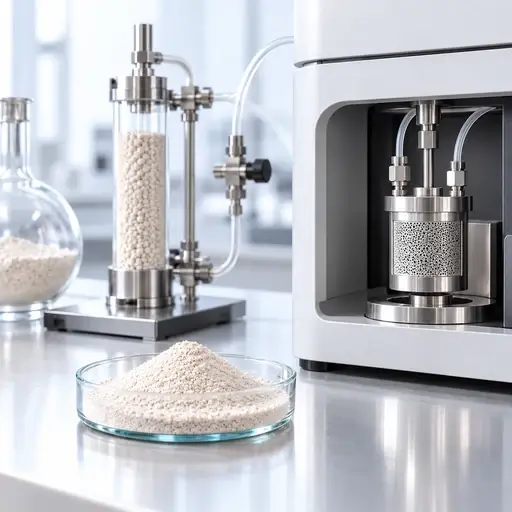
Density, packing, porosity, and surface area describe different levels of material structure. Select the method by whether the decision concerns a poured powder bed, a consolidated packing state, solid skeletal volume, external-envelope volume, accessible pore space, or probe-accessible internal surface.
Test methods
Density, packing, porosity
and surface area
Distinguish bulk state, solid volume, envelope volume,
accessible pores, and internal surface
Density, packing, porosity, and surface area describe different levels of material structure.
Select the method by whether the decision concerns a poured powder bed, a consolidated
packing state, solid skeletal volume, external-envelope volume, accessible pore space,
or probe-accessible internal surface.




Select a method
Go directly to the measurement route that matches the required material state
Each route leads to the measurement principle, sample state, preparation, output, limitation, method disagreement, decision context, and relevant standard.
 Loose or poured bulk densityControlled filling into a known receiving volume.
 Tapped densityRepeated mechanical tapping toward a reproducible packed state.
 Conditioned and aerated densityControlled conditioning or gas flow creates a defined loose bed state.
 Packing and compressibility responseBed volume is measured as controlled stress or displacement changes.
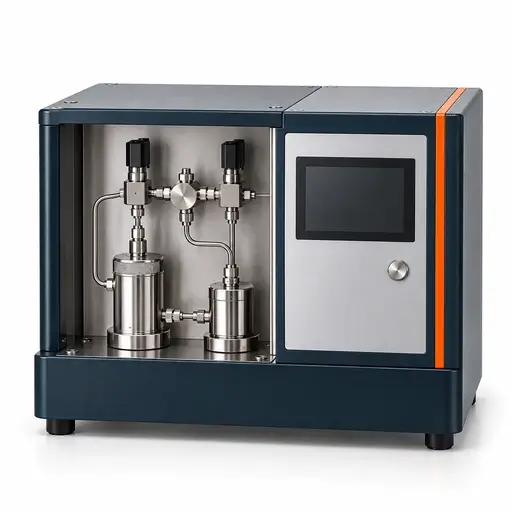 Skeletal density by gas pycnometryGas displacement determines the solid skeleton volume accessible to the measurement gas.
 Envelope densityExternal displacement defines the volume inside a particle or body envelope.
 Mercury intrusion porosimetryApplied pressure forces a non-wetting liquid into accessible pores.
 BET gas adsorptionAdsorbed gas quantity is related to probe-accessible specific surface area.
 Gas-adsorption pore-size analysisAdsorption and desorption behavior is modeled to estimate molecularly accessible pore structure.
 X-ray micro-CT porosityTomographic projections reconstruct three-dimensional attenuation and structure.
Core concept
Density states are not interchangeable
Bulk density includes the voids between particles and changes with filling, aeration, tapping, vibration, consolidation, and handling history. Skeletal density excludes open pores reached by the displacement gas but includes inaccessible closed pores. Envelope density uses the external boundary of a particle or body. Porosity is calculated only after the relevant volume definitions have been chosen.
Specific surface area and pore-size distribution add another boundary: the probe molecule or intruding liquid must reach the surface or pore being reported. Preparation, degassing, pressure range, contact angle, pore geometry, and analysis model therefore become part of the result.
Key takeaway
Choose the physical state before the instrument
Choose the method by the physical state and volume boundary required for the decision. Loose, tapped, conditioned, skeletal, and envelope density are not interchangeable; neither are total porosity, accessible pore volume, through-pore size, and probe-accessible surface area. Define sample history, preparation, measurement basis, accessible structure, and analysis model before comparing results or turning them into a material specification.
What controls it
Six decisions define a defensible structural measurement route
<p>Separate the physical state, accessible structure, and analysis assumptions before selecting or comparing methods.</p>
Selection and interpretation
The same word can describe different physical volumes
Separate the material state, volume boundary, accessible structure, probe, pressure or stress history, and calculation model before comparing reported values.
Measurement question | Primary route | Typical output | Critical boundary |
|---|---|---|---|
| What volume does a powder occupy after a defined filling or packing history? | Loose, tapped, conditioned, or compressibility testing | Bulk density, bed volume, or density-stress response | The preparation and stress history define the state |
| What is the solid skeleton volume accessible to a gas? | Gas pycnometry | Skeletal volume and density | Accessible open pores are treated differently from closed pores |
| What volume lies inside the external boundary of a particle or body? | Envelope density | Envelope volume and density | The displacement medium and boundary definition control surface penetration |
| What pore throats can a non-wetting liquid enter under pressure? | Mercury intrusion porosimetry | Intrusion volume and model-based throat-size distribution | Pressure, contact angle, network effects, and material deformation matter |
| What surface is accessible to an adsorptive gas? | BET gas adsorption | Specific surface area | Degassing, probe molecule, pressure range, and model validity matter |
| What molecularly accessible pore structure is inferred from adsorption? | Gas-adsorption pore-size analysis | Isotherm, pore volume, and model-based pore-size distribution | The selected model and pore geometry are not neutral assumptions |
| Which internal pores and defects are spatially resolved? | X-ray micro-CT | Three-dimensional resolved structure | Features below effective resolution remain unmeasured |
How to measure it
Select the method by the evidence the decision requires
The method sections below separate principle, sample state, preparation, output, limitation, disagreement, and decision use. Use the image selector above to jump directly to a method.
Test method 01
Loose or poured bulk density
<strong>Measurement principle:</strong> Controlled filling into a known receiving volume.
<strong>Suitable sample state:</strong> A representative dry powder in the agreed as-received or conditioned state.
<strong>Sample preparation:</strong> Control sampling, subdivision, funnel geometry, drop height, filling rate, leveling, vibration avoidance, humidity, and temperature.
Test method 02
Tapped density
Measurement principle: Repeated mechanical tapping toward a reproducible packed state.
Suitable sample state: Dry powder that can be loaded into a graduated cylinder without unacceptable loss or segregation.
Sample preparation: Control test mass, cylinder, tap height and frequency, tap count or endpoint, leveling, humidity, and fines loss.
Test method 03
Conditioned and aerated density
Measurement principle: Controlled conditioning or gas flow creates a defined loose bed state.
Suitable sample state: A powder bed prepared in a standardized low-stress or aerated condition.
Sample preparation: Control conditioning protocol, airflow, pressure, cell geometry, bed height, equilibration, temperature, and humidity.
Test method 04
Packing and compressibility response
Measurement principle: Bed volume is measured as controlled stress or displacement changes.
Suitable sample state: A representative powder bed loaded into a defined cell.
Sample preparation: Control initial filling, loading path, stress range, rate, hold time, unloading, wall friction, temperature, humidity, and repeat history.
Test method 05
Skeletal density by gas pycnometry
Measurement principle: Gas displacement determines the solid skeleton volume accessible to the measurement gas.
Suitable sample state: Dry solids, powders, granules, or porous bodies stable under the selected gas and pressure.
Sample preparation: Control drying or conditioning, degassing, sample mass, chamber fill, temperature, leaks, purge cycles, equilibration, and calibration.
Test method 06
Envelope density
Measurement principle: External displacement defines the volume inside a particle or body envelope.
Suitable sample state: Individual granules, porous particles, compacts, or irregular bodies that retain their structure during measurement.
Sample preparation: Control specimen selection, displacement medium, applied force, surface penetration, calibration, repeat loading, and sample damage.
Test method 07
Mercury intrusion porosimetry
Measurement principle: Applied pressure forces a non-wetting liquid into accessible pores.
Suitable sample state: A dry, stable porous solid or powder prepared for the instrument pressure range.
Sample preparation: Control drying, degassing, sample containment, penetrometer loading, pressure program, contact-angle and surface-tension assumptions, blank correction, and safety controls.
Test method 08
BET gas adsorption
Measurement principle: Adsorbed gas quantity is related to probe-accessible specific surface area.
Suitable sample state: A dry solid or powder stable under degassing and the selected adsorptive gas.
Sample preparation: Control sample mass, degassing temperature and time, vacuum or purge conditions, adsorptive, temperature, leak tightness, equilibrium criteria, and pressure range.
Test method 09
Gas-adsorption pore-size analysis
Measurement principle: Adsorption and desorption behavior is modeled to estimate molecularly accessible pore structure.
Suitable sample state: A degassed porous powder or solid stable under the selected adsorptive and temperature.
Sample preparation: Control pretreatment, adsorptive, pressure range, equilibrium criteria, free-space correction, saturation pressure, and the selected pore model.
Test method 10
X-ray micro-CT porosity
Measurement principle: Tomographic projections reconstruct three-dimensional attenuation and structure.
Suitable sample state: A representative particle, granule, compact, packed volume, or porous specimen with sufficient contrast.
Sample preparation: Control specimen size, immobilization, energy, exposure, projections, voxel size, reconstruction, artifact correction, segmentation, and representative volume.
Conditional routes
Use these only when the measurement question requires them
These routes are important in the right application, but they do not replace the ten primary family methods. Use one when its specific measured quantity matches the engineering or quality decision.
Liquid displacement
Use when the liquid is compatible, wetting and penetration are understood, and gas pycnometry is unsuitable.
Helium versus another pycnometry gas
Use a different gas only when accessibility, adsorption, diffusion, or material compatibility justifies it.
Capillary flow porometry
Use when connected through-pores and flow-limiting constrictions are the question, not total pore volume.
Small-angle scattering
Use when nanoscale structural length scales or interfaces are required and the scattering model is defensible.
Where it matters
Structural measurements become process and product constraints
The same material can occupy different volumes and expose different surfaces after filling, vibration, consolidation, degassing, or pore access.
Technical FAQ
Common questions when structural measurements disagree
Use these answers to identify which physical state, accessible structure, or model must be reconciled before accepting a result.
Go deeper
Three practical routes into pore and surface characterization
Continue into established PTI guidance on mercury intrusion, physical gas adsorption, and BET analysis of nanomaterials.


Technical basis / sources
Standards and supporting guidance
The references below support the principal density, porosity, and surface-area routes on this page. Keep the physical state and probe definition explicit because bulk, tapped, skeletal, and envelope density do not measure the same volume, and different porosity methods do not necessarily access the same structure.
- USP <616>: pharmaceutical procedures for bulk and tapped density. For non-pharmaceutical materials, use the applicable material- or sector-specific procedure rather than treating one preparation and tapping protocol as universal.
- ISO 12154:2014: determination of skeletal density by volumetric gas displacement using gas pycnometry.
- ISO 15901-1:2016: evaluation of pore-size distribution and porosity by mercury porosimetry.
- ISO 9277:2022: determination of specific surface area of solids by gas adsorption using the BET method.
- ISO 15901-2:2022: analysis of nanopores and pore-size distribution by gas adsorption.
Conditioned or aerated density, stress-dependent packing, envelope density, and micro-CT porosity require a validated procedure matched to the apparatus, material, and decision. State sample conditioning, preparation history, probe accessibility, pressure or stress path, analysis model, and resolution limits. A density-derived porosity, mercury-intrusion result, gas-adsorption result, and image-resolved porosity should not be treated as interchangeable without reconciling what each method can access.
Need the measurement, not just the guidance?
If the remaining uncertainty concerns bulk-density state, compressibility, skeletal or envelope density, porosity, pore-size distribution, accessible surface area, or disagreement between methods, select the measurement around the material state and process decision. PowderTechnology.info can help define the test sequence, sample conditions, and interpretation route before work is placed with a specialist laboratory. PTI works closely with Delft Solids Solutions, a contract research organization specializing in the physical behavior of powders and granules. Contact Delft Solids Solutions.