Table of contents

Powder caking remains one of the hardest flow problems to eliminate. It slows discharge and can block feeders. Cleaning needs rise, and in severe situations, production even has to stop. Many teams still see caking as a housekeeping task. It is not. The behaviour is driven by moisture, storage time, pressure, and temperature. At the particle level, caking starts when solid bridges develop. Water, slow deformation under load, or gradual chemical change can all create those bridges. Once they are present, the bulk stops behaving like a free-flowing powder. You either prevent the bridges, or you break them, and powder caking prevention becomes a design decision, not an afterthought.
Why powders cake and why it matters
Caked powder slows production and raises rework. It can lead to extra operator actions. In some cases, people create workarounds outside the SOP, which lowers safety.
Humidity makes caking worse in storage areas. Poorly insulated silos add to the problem. Long residence times increase consolidation. Recycled fine, moist, or still-warm material can push the powder over the edge.
These effects are not random. Each one moves the material nearer to its caking point. Keep conditions below that point if you want stable OEE.
The four main caking mechanisms
You can classify almost every case under four heads. That makes troubleshooting faster.
1. Moisture bridging
Moisture condenses between adjacent particles and creates a liquid bridge. When that bridge dries, it turns into a solid neck. Repeated condensation and drying make the structure stronger each time.
This behaviour is typical for salts, dairy powders, sugar, plant protein powders, and other hygroscopic mixes. It usually starts once the surrounding relative humidity rises above the critical value for that material.
2. Time and pressure caking
When powder remains in a tall silo for several days, the material at the bottom carries the full overburden. Under that constant load, contact points between particles deform and start to cold-weld or creep, so neighbouring particles very slowly merge. Given enough time, the whole section behaves like one cohesive, slab-like mass instead of a free-flowing bulk.
You see this most clearly in high silos with long residence times, but the same mechanism appears in IBCs that sit over a weekend, and in big bags stored on the floor without rotation.
3. Temperature cycling caking
Day and night temperatures change. The wall cools faster than the core. Air near the wall reaches dew point. Water condenses. Product at the wall cakes first.
You see vertical bands of caked material. The core is often fine. This pattern tells you the main driver is thermal, not formulation.
4. Chemical or phase change caking
Certain powders hydrate during storage. Others slowly oxidise. A third group can even recrystallise. Each of these pathways can create very strong bridges between particles, and vibration will not break them.
This behaviour shows up in fertilisers, selected metal powders, sensitive food ingredients, and fine chemicals. In those cases, correct packaging and tight climate control matter just as much as hopper design.
Reversible vs irreversible caking
Not every cake is permanent.
Reversible caking happens when the bridge is weak, or when it comes from free moisture. Gentle deagglomeration is often enough. Screening can also fix it.
Irreversible caking happens when solid bridges have formed. This can come from recrystallisation, hydration, or long term creep. Breaking this needs mechanical force or reprocessing. Prevention is the only smart option here.
Knowing which type you have helps you pick the right fix.
How to detect caking risk early
Powder caking testing methods
Plant observations are good. Lab tests make them objective. Below are the key tests to request from a solids lab like Delft Solids Solutions.
1. Shear testing at storage conditions
Ring shear or direct shear tests measure unconfined yield strength. That is the stress needed to make stored powder flow. Run tests at the humidity and temperature that match your plant. Run tests after several consolidation times, for example, 1 hour, 24 hours, 7 days.
Plot the flow function versus time. A falling curve means the powder gains strength during storage. You can now define the maximum safe storage time.
2. Dynamic powder rheometry
Dynamic tests show how flow changes when energy and moisture are applied. You can see the point where the flow index drops. That point must never be reached in storage. This is a good test for food and dairy powders.
3. Moisture sorption analysis (DVS) and the break point
DVS exposes a powder to stepwise relative humidity. The result is a sorption curve. At low humidity, the curve is flat. At a certain humidity, the curve rises sharply. That is the condensation or solution point.
That point is your design limit. You must store the powder below that humidity. If your storage area runs at 60 percent RH, and your DVS curve rises at 55 percent, you will get caking.
4. Numeric example
A dairy-based powder shows a sharp DVS rise at 55 percent RH at 20 °C. When the same material is stored for seven days at 60 percent RH, a shear test gives a flow function of 3.5, which is clearly in the cohesive range. At 45 percent RH, however, the flow function increases to 6, and the powder behaves much better. From these numbers, you can set practical rules: keep storage humidity below 50 percent RH, move the product within five days, and run it through mass flow hoppers for discharge. That turns caking control into a defined window instead of guesswork.
5. Sieve and lump quantification
Store samples for 3, 7, and 14 days at target RH. Sieve them. Weigh the lumps. Plot lump fraction versus time. You now have a caking curve. Production can link this to FIFO rules.
6. Creep or long dwell tests
Some products cake even when dry, simply because they sit under load. Run long dwell tests at stresses similar to a 15 to 20 metre silo. If the strength rises too much after 7 days, reduce storage height or reduce storage time.
Hopper design, wall friction, and stagnant zones
Saying “use mass flow” is not enough. Real design needs three things.
-
Wall friction test
Test your powder against the actual wall material or liner. This gives the wall friction angle. -
Hopper half angle selection
Use the wall friction angle to choose a hopper angle that promotes mass flow. If the hopper is too shallow, material will stop and cake. -
Outlet sizing
Cohesive powders need a larger outlet. If the outlet is too small, arches form. Arches increase residence time. Residence time increases caking.
If you see caking rings on the wall side, you likely have cold walls and high wall friction. A mass flow insert or a liner with lower friction can fix this.
Engineering fixes that work
1. Control humidity and temperature
Keep storage areas below the DVS break point. Dehumidify packaging and filling zones. Insulate silos to limit temperature swings. Seal bags while the product is still warm, so no moist air enters.
2. Limit storage time and head pressure
Do not store cohesive powders for weeks in tall silos. Use first in, first out. Split very tall silos into two shorter vessels. Reduce stagnant zones so product does not sit.
3. Improve discharge design
Use mass flow hoppers for cohesive powders. Avoid flat bottoms without live extraction. Use flow aids and air pads as support only. Do not let vibration be the main solution. Vibration can cause segregation in some blends.
4. Apply flow or anti caking agents
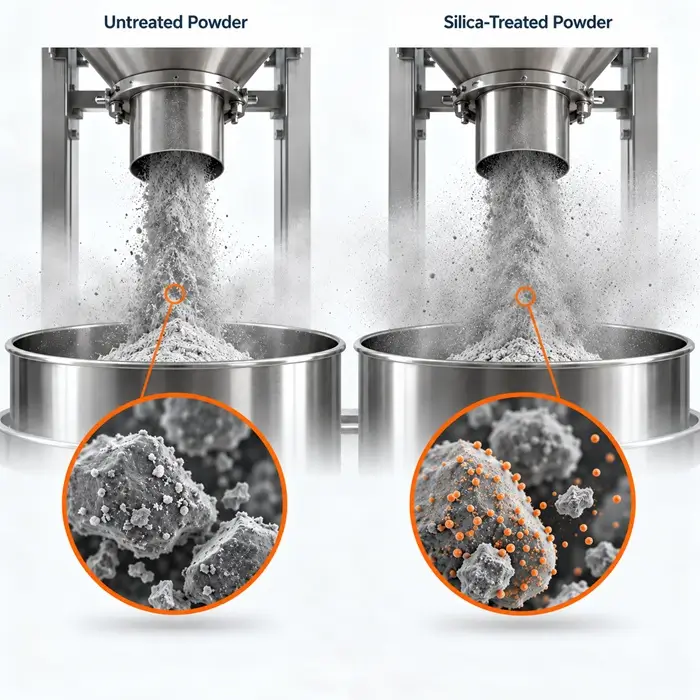
For some powders, a small dose of silica or other approved aid is enough. Apply it in line. Target only the grades that cake. Check compatibility with food, pharma, or AM processes before approval.
5. Monitor and document
Install temperature and RH loggers on silos. Link readings to batch numbers. When a batch cakes, you can show the spike. That makes the business case for HVAC and insulation.
Sector notes
Food and dairy
Often hygroscopic. Often heat sensitive. Keep storage short. Use lined bags. Keep RH below the DVS break. Run periodic lump counts.
Pharmaceutical
Caking affects tablet weight and capsule fill. Run shear tests at storage RH. Use mass flow hoppers. Define maximum hold time for intermediates.
Metal powders and AM feeds
Moisture and oxygen change surface energy. That changes flow and spreadability. Store dry. Store cool. Use sealed or inert packaging. Re test reclaimed powder before reuse.
Coating powders
Caking ruins spray patterns. Use climate controlled rooms. Avoid daily temperature swings near exterior walls.
FAQ powder caking prevention
What causes powder caking during storage?
Caking is usually caused by moisture condensation, by long storage under load, or by slow chemical change. Each of these creates bridges between particles. Once bridges are formed, the powder flows poorly.
How can I stop hygroscopic powders from caking?
Find the DVS break point. Keep RH and temperature below it. Reduce storage time. Use lined or sealed packaging. Add a flow aid if quality allows. Redesign the hopper to remove stagnant zones.
Check out these related articles

Advertisement
[the_ad id=”7029″]