
Test methods
Liquid-Phase and Dispersion Behavior
Separate incorporation, dispersion, separation, and recovery
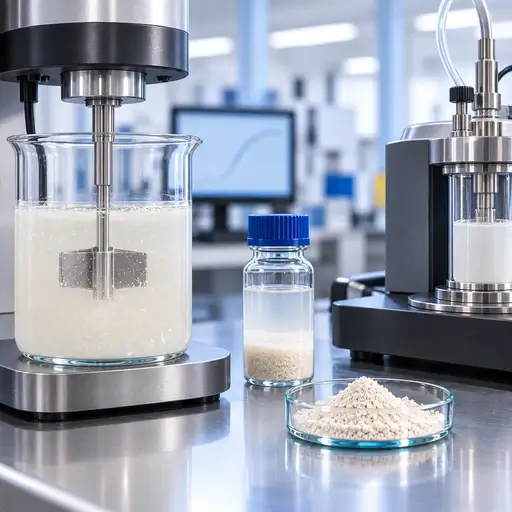
A powder entering a liquid can float, form persistent lumps, disperse into smaller units, settle, build a network, or form a sediment that will not redisperse. These outcomes require different tests. Choose the route by the preparation step, storage interval, and product performance that matter.
Test methods
Liquid-Phase and Dispersion Behavior
Separate incorporation, dispersion, separation,
and recovery
A powder entering a liquid can float, form persistent lumps, disperse into smaller units,
settle, build a network, or form a sediment that will not redisperse. These outcomes
require different tests. Choose the route by the preparation step, storage interval, and
product performance that matter.




Select a method
Choose the stage and response you need to measure
Seven routes separate liquid entry and preparation from physical change, flow behavior, and recovery after aging.
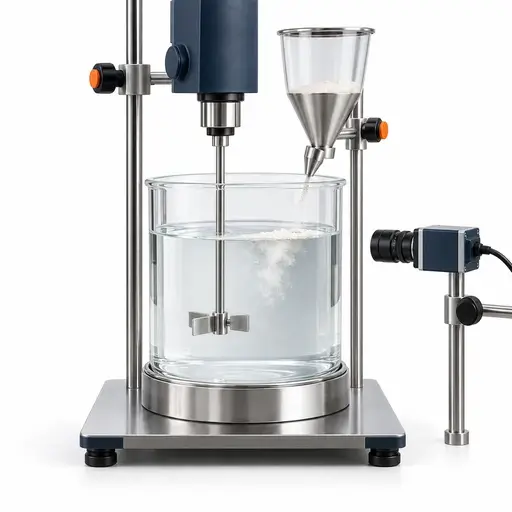
Wetting and incorporation
Powder is added to a defined liquid under controlled mixing while entry into the liquid and persistent surface material are observed.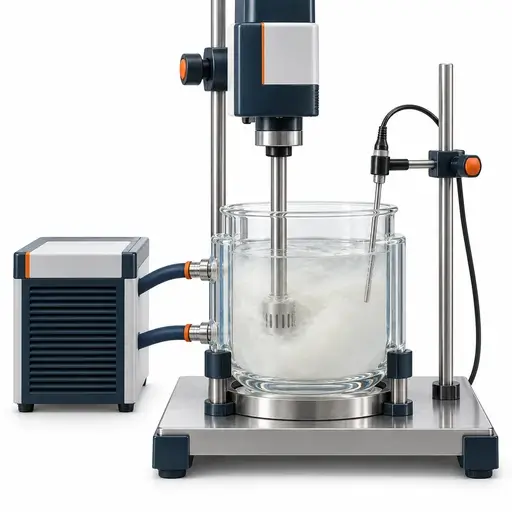
Controlled deagglomeration
A defined mixing or dispersion treatment is applied in steps and its effect is measured independently.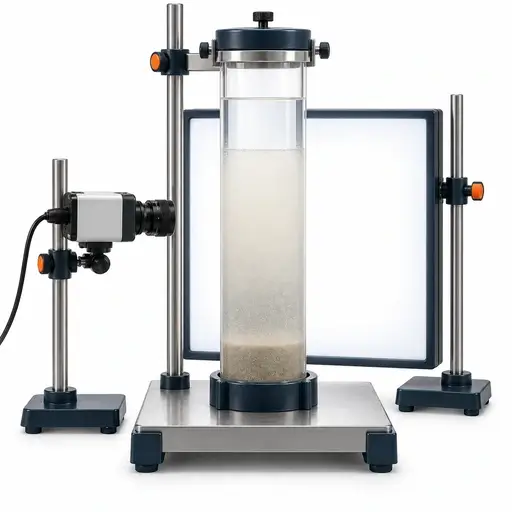
Gravitational sedimentation
A suspension is held under gravity while concentration distribution, interfaces, or sediment development are followed with time.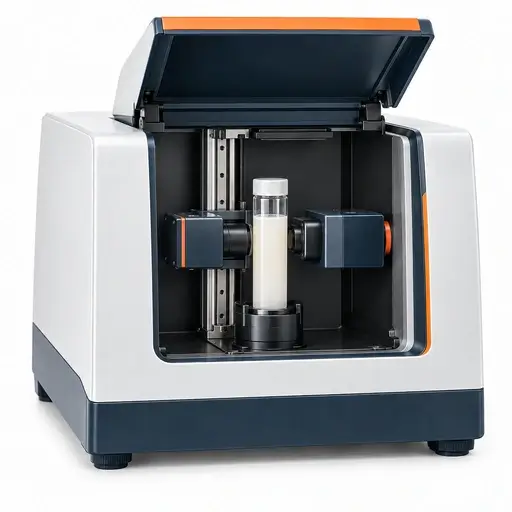
Multiple light scattering
Transmission and backscattering profiles are recorded along a sample to track physical changes with time.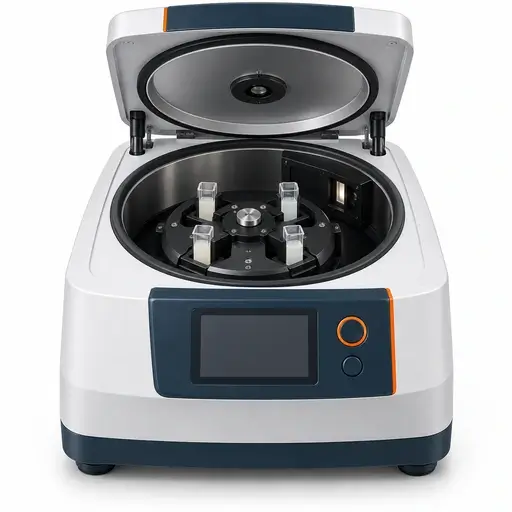
Analytical centrifugation
Optical profiles are monitored during centrifugation to follow separation under a defined acceleration field.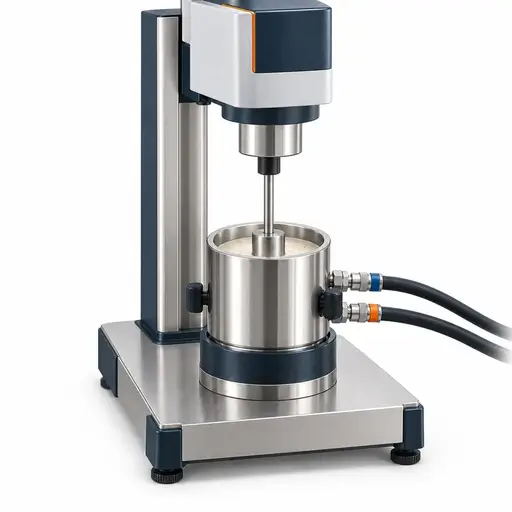
Suspension rheology
A controlled deformation is applied while stress or strain response is measured using a suitable rheometer geometry.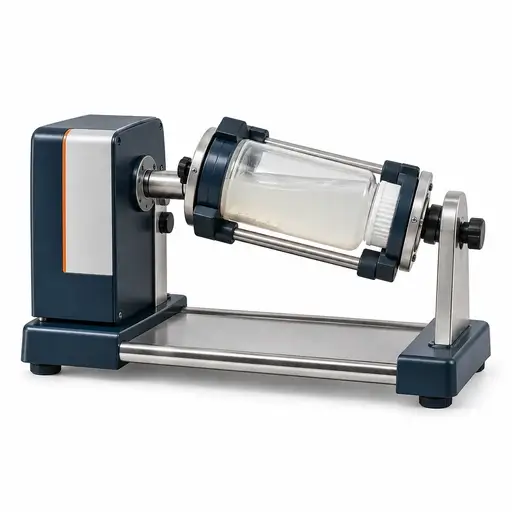
Controlled redispersion
An aged suspension is remixed under a defined treatment and recovery is assessed against a stated endpoint.Core concept
Preparation is not performance
Wetting allows liquid to contact and enter powder structures. Incorporation moves powder into the liquid. Deagglomeration separates associated particles under an imposed treatment. Dissolution transfers material into molecular or ionic solution. A powder disappearing from the surface does not prove that lumps have broken down or that the solid has dissolved.
Once prepared, a dispersion must be assessed over the relevant time and conditions. Sedimentation, optical profiles, accelerated separation, and rheology describe different aspects of its behavior. A suspension can settle yet redisperse well, or appear uniform while developing an unacceptable particle-size distribution or flow response.
Key takeaway
Test the stage that controls the decision
Select wetting and incorporation trials for entry into the liquid, controlled deagglomeration for preparation response, sedimentation or optical profiling for physical change with time, centrifugation for a bounded accelerated comparison, rheology for flow and structure, and redispersion testing for recovery after aging. Preserve the relevant liquid composition, solids concentration, and preparation history. Neither a clear mixing endpoint, a single stability index, nor a high-acceleration result establishes complete dispersion quality or shelf life without independent evidence and application-specific acceptance criteria.
What controls it
Six decisions define a defensible dispersion test
<p>Start with the formulation and process question, then define a reproducible preparation and observation plan.</p>
Selection and interpretation
Different dispersion tests answer different questions
<p>Compare results only after accounting for preparation, concentration, time, temperature, imposed motion, and the actual measured quantity.</p>
Engineering question | Primary route | Useful output | Critical boundary |
|---|---|---|---|
| Does powder enter the liquid reliably? | Wetting and incorporation | Defined incorporation endpoint and remaining lumps | Surface disappearance does not prove complete dispersion or dissolution |
| What treatment produces the required dispersed state? | Controlled deagglomeration | Independent response versus treatment | Avoid confusing agglomerate breakup with primary-particle damage |
| What changes during ordinary storage? | Gravitational sedimentation | Clarification, sediment development, and concentration distribution | Sediment volume alone does not establish redispersibility |
| Where and when does optical behavior change? | Multiple light scattering | Transmission and backscatter profiles | Concentration and particle changes can both affect the signal |
| How do formulations separate under acceleration? | Analytical centrifugation | Separation profiles under a defined field | Acceleration can change the mechanism and compress sediment |
| How does the suspension flow and recover? | Suspension rheology | Flow curves and time-dependent or oscillatory response | Control slip, settling, geometry, and measurement history |
| Can the aged material return to an acceptable state? | Controlled redispersion | Recovery endpoint and residual cake | Cloudiness alone is insufficient evidence of recovery |
How to measure it
Select the method by the evidence the decision requires
The method sections below separate principle, sample state, preparation, output, limitation, disagreement, and decision use. Use the image selector above to jump directly to a method.
Test method 01
Wetting and incorporation
Measurement principle: Powder is added to a defined liquid under controlled mixing while entry into the liquid and persistent surface material are observed.
Suitable sample state: Representative powder and the actual or specified formulation liquid.
Sample preparation: Control powder addition rate and order, mass ratio, vessel, impeller, liquid level, agitation, temperature, and the endpoint definition. Record trapped air, floating material, and lumps.
Test method 02
Controlled deagglomeration
Measurement principle: A defined mixing or dispersion treatment is applied in steps and its effect is measured independently.
Suitable sample state: A wetted suspension prepared at a stated solids content and liquid composition.
Sample preparation: Specify mixer or disperser geometry, speed, time, temperature control, sample volume, addition sequence, and sampling. Track power or energy where meaningfully measured.
Test method 03
Gravitational sedimentation
Measurement principle: A suspension is held under gravity while concentration distribution, interfaces, or sediment development are followed with time.
Suitable sample state: A representative suspension in a compatible observation vessel.
Sample preparation: Control preparation, concentration, vessel dimensions, fill height, closure, temperature, vibration, observation times, and any sampling disturbance.
Test method 04
Multiple light scattering
Measurement principle: Transmission and backscattering profiles are recorded along a sample to track physical changes with time.
Suitable sample state: A dispersion compatible with the instrument optics, sample cell, and validated concentration range.
Sample preparation: Control concentration, liquid composition, sample preparation, cell cleanliness and path length, temperature, scan interval, and analysis region. Avoid bubbles and unintended disturbance.
Test method 05
Analytical centrifugation
Measurement principle: Optical profiles are monitored during centrifugation to follow separation under a defined acceleration field.
Suitable sample state: A suspension suitable for the rotor cells, optical range, and intended analytical model.
Sample preparation: Report rotor speed, radial position or acceleration range, temperature, cell and optical path, loading, concentration, run program, and preparation history.
Test method 06
Suspension rheology
Measurement principle: A controlled deformation is applied while stress or strain response is measured using a suitable rheometer geometry.
Suitable sample state: A representative suspension that fits the geometry and remains sufficiently controlled during measurement.
Sample preparation: Specify geometry and gap, particle-size suitability, temperature, preshear, rest period, loading, evaporation control, and the stress or rate sequence. Check wall slip and settling.
Test method 07
Controlled redispersion
Measurement principle: An aged suspension is remixed under a defined treatment and recovery is assessed against a stated endpoint.
Suitable sample state: An aged suspension with documented storage conditions and a matched fresh reference.
Sample preparation: Control aging time, temperature, orientation, container, fill and headspace, mixing motion, rate and duration, and sampling positions. Define residual-cake and uniformity checks.
Conditional routes
When the suspension test needs a companion method
Add an orthogonal measurement when the engineering question extends beyond physical dispersion behavior.
Surface chemistry or charge is the uncertainty
Use contact-angle, capillary-penetration, or electrokinetic methods when the question concerns interfaces. These do not replace a formulation-level dispersion trial. Compare surface methods.
The measured particle size changes after preparation
Check sampling, dilution, dispersion treatment, dissolution, and the measurement model before assigning the change to the original powder. Compare sizing routes.
Dissolution is the actual endpoint
Use a suitable dissolved-concentration assay and validated phase-separation or sampling procedure. Turbidity loss or disappearance of visible powder is not by itself a dissolution measurement.
Chemical or biological change controls storage
Add appropriate chemical, microbiological, or application-specific testing. Physical separation measurements alone do not establish chemical stability, microbiological quality, or usable shelf life.
Process relevance
Connect the evidence to the operating step
A useful test links a controlled material state to an observable operating or product requirement.
Technical FAQ
Common questions about dispersion testing
Keep preparation, physical stability, and recovery distinct when comparing results.
Go deeper
Continue into wetting and dispersion
These published PTI articles provide processing and application context. Use the scoped references below for the technical basis of method selection.


Technical basis / sources
Sources and scope boundaries
Select the edition and scope appropriate to the measurement. Guidance documents and instrument descriptions do not create universal pass/fail limits.
- ISO/TR 13097:2013: guidance for characterizing dispersion stability; it does not prescribe one universal stability index or acceptance threshold.
- ISO 13318-1:2024: centrifugal liquid sedimentation for particle-size analysis, including its dilute-system assumptions; distinguish this scope from concentrated-formulation stability screening.
- ISO 3219-2:2021: general principles of rotational and oscillatory rheometry; supplement these with suspension-specific geometry and history controls.
- Microtrac static multiple light scattering and LUMiSizer analytical centrifugation: instrument-principle references, not universal shelf-life validation procedures.
- Wetting, deagglomeration, gravity storage, and redispersion trials require documented sample preparation, operating conditions, replicate plans, and independently defined endpoints suited to the product.
Need the measurement, not just the guidance?
If the uncertainty concerns powder incorporation, dispersion treatment, separation, suspension flow, or recovery after storage, define the relevant formulation state and process conditions before commissioning tests. Agree the preparation history, liquid composition, solids concentration, observation period, and interpretation boundaries with the laboratory. PTI works closely with Delft Solids Solutions, a contract research organization specializing in the physical behavior of powders and granules. Contact Delft Solids Solutions.