

Test methods
Moisture and Environmental Response
Separate water content, water activity, and response
to humidity
A drying loss, a Karl Fischer result, and a water-activity value describe different aspects
of a powder. Humidity exposure adds another question: how much water moves into or
out of the material, how quickly, and with what effect on its behavior? Choose the
measurement by the decision, sample chemistry, and exposure history.




Select a method
Choose the moisture quantity or response you need
Six routes separate mass loss, chemical water determination, headspace equilibrium, sorption, and environmental exposure. Direct and oven-transfer Karl Fischer are configurations of the same analytical principle.
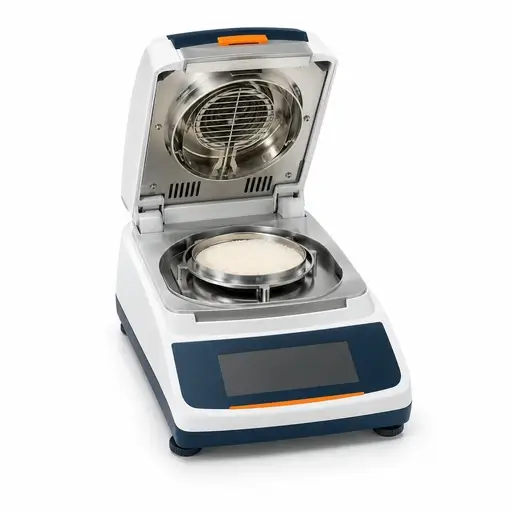
Gravimetric moisture and loss on drying
Measure sample mass before and after a defined heating program or continuously during drying.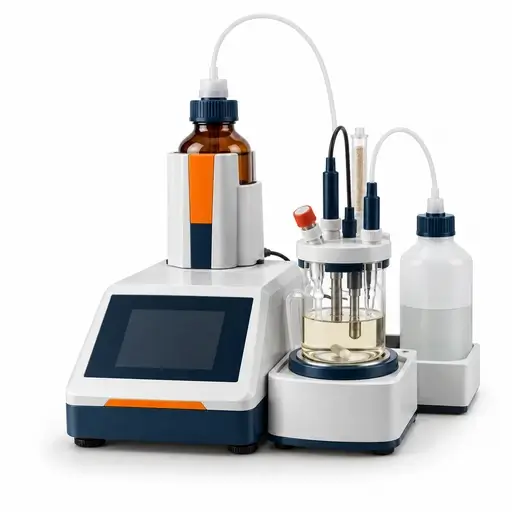
Direct Karl Fischer titration
Introduce or extract the sample into a compatible medium and determine water by the Karl Fischer reaction.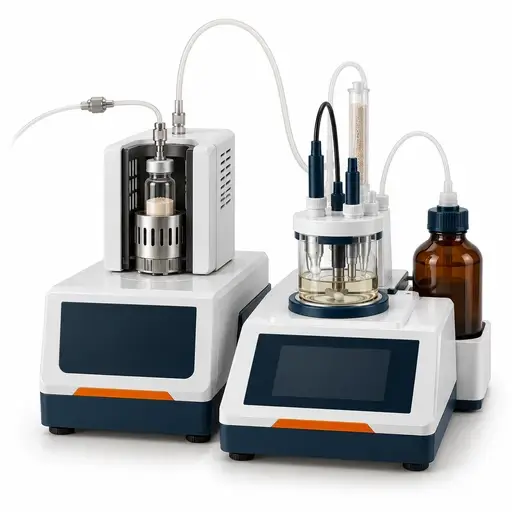
Oven-transfer Karl Fischer
Heat a sealed sample vial and carry released water with dry gas into a Karl Fischer cell.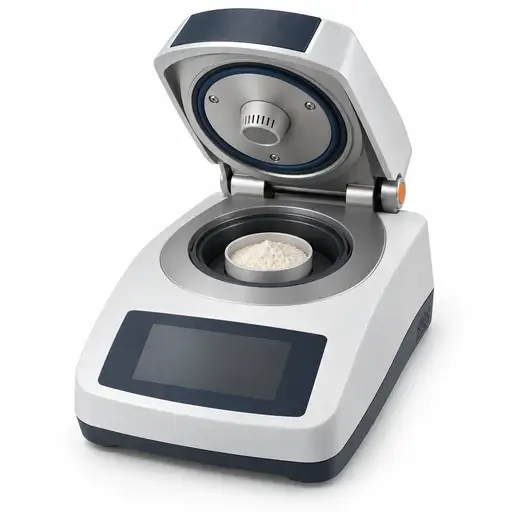
Water activity
Measure the equilibrium water-vapor condition in the headspace above the sample at controlled temperature.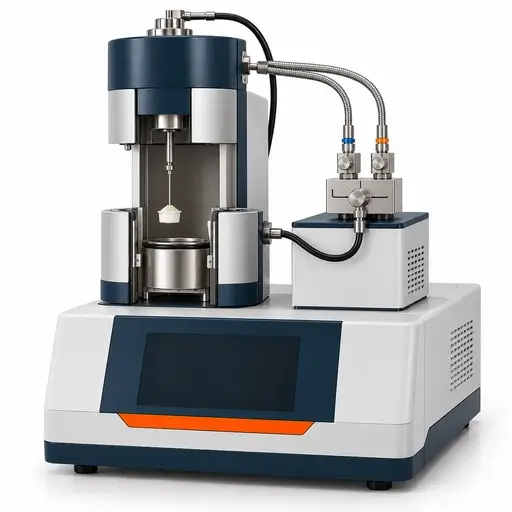
Dynamic vapor sorption
Track sample mass while stepping or ramping controlled humidity at a defined temperature.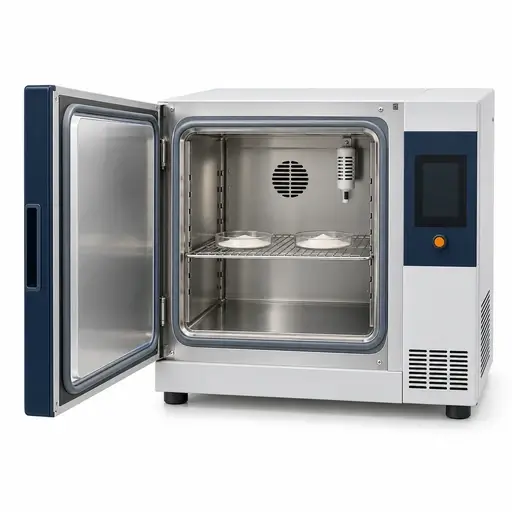
Controlled humidity and environmental conditioning
Expose samples to a defined temperature and humidity history before measuring changes in material performance.Core concept
Water amount is not water activity
Water content is the amount of water measured under a defined analytical procedure. Loss on drying measures mass lost under specified heating conditions and may include substances other than water. Karl Fischer determines water through a chemical reaction, provided the method releases or extracts the relevant water and controls interference.
Water activity describes the equilibrium vapor-pressure ratio of water above the sample to that above pure water at the same temperature. It is not a percentage of free water. Sorption measurements follow mass change with humidity and time; conditioning establishes an exposure history for later measurements. These routes complement each other rather than providing interchangeable moisture numbers.
Key takeaway
Match the moisture measurement to the decision
Use loss on drying for a validated mass-loss specification, Karl Fischer when water-specific content is required, and water activity when equilibrium vapor conditions are the relevant variable. Use dynamic vapor sorption to examine humidity-dependent uptake, release, and kinetics, then apply controlled conditioning and a separate performance test when flow, caking, dissolution, or stability is the decision. Keep temperature, sample history, equilibration, and reporting basis explicit. No single moisture value establishes a universal safe storage condition or predicts every humidity-driven failure.
What controls it
Six decisions define a useful moisture test
Start by specifying the quantity and material state that the process decision requires.
Selection and interpretation
Different moisture results can all be valid
Check quantity, sample basis, temperature, extraction or release, and endpoint before interpreting disagreement. An as-received water percentage and a dry-basis sorption gain use different denominators. A matching percentage does not establish matching water activity or humidity response.
Engineering question | Primary route | Useful output | Critical boundary |
|---|---|---|---|
| How much mass is lost under the drying procedure? | Gravimetric moisture and loss on drying | Loss on drying and drying curve | Loss is not automatically all water |
| How much water can a direct KF method determine? | Direct Karl Fischer titration | Water content on a stated basis | Validate extraction and interference |
| Can water be released and transferred from the matrix? | Oven-transfer Karl Fischer | Water released under oven conditions | Separate incomplete release from decomposition |
| What is the equilibrium water-vapor state? | Water activity | Water activity at a stated temperature | Activity is not a water-mass fraction |
| How does uptake change with humidity and time? | Dynamic vapor sorption | Sorption, desorption, kinetics, and hysteresis | Verify equilibration and reference mass |
| Does environmental exposure change performance? | Controlled humidity and environmental conditioning | Conditioned state and paired performance result | Specify exposure and a separate endpoint |
How to measure it
Choose the route by chemistry, state, and timescale
Each route below separates preparation, output, interpretation, limitations, and decision use. Select the method above to jump directly to its details.
Test method 01
Gravimetric moisture and loss on drying
Measurement principle: Measure sample mass before and after a defined heating program or continuously during drying.
Suitable sample state: A representative sample whose major matrix remains sufficiently stable at the selected temperature.
Sample preparation: Control sample mass, layer thickness, pan, temperature, atmosphere, duration or endpoint, and cooling and weighing where applicable. Validate the illustrated halogen analyzer against the intended reference method.
Test method 02
Direct Karl Fischer titration
Measurement principle: Introduce or extract the sample into a compatible medium and determine water by the Karl Fischer reaction.
Suitable sample state: Powders for which water can be released or extracted without unacceptable interference.
Sample preparation: Minimize exposure during weighing and addition. Select solvent, extraction time, sample size, and volumetric or coulometric configuration; verify blanks, drift, reagent performance, and recovery with appropriate checks.
Test method 03
Oven-transfer Karl Fischer
Measurement principle: Heat a sealed sample vial and carry released water with dry gas into a Karl Fischer cell.
Suitable sample state: Powders that release water at a validated temperature, particularly when direct introduction is unsuitable.
Sample preparation: Optimize temperature and duration for release without decomposition. Control carrier gas, flow, vial and septum blank, transfer-line condition, sample mass, leaks, and background drift.
Test method 04
Water activity
Measurement principle: Measure the equilibrium water-vapor condition in the headspace above the sample at controlled temperature.
Suitable sample state: A representative sample sealed promptly in a suitable measurement cup.
Sample preparation: Control sample and instrument temperature, cup filling, equilibration, sensor cleanliness, and volatile interference. Verify performance with suitable reference standards covering the range.
Test method 05
Dynamic vapor sorption
Measurement principle: Track sample mass while stepping or ramping controlled humidity at a defined temperature.
Suitable sample state: A small representative sample prepared without unintentionally changing its relevant solid state.
Sample preparation: Specify initial condition, reference mass, gas flow, temperature, RH sequence, mass-change-rate criterion, minimum and maximum holds, cycles, and balance baseline. Record steps that reach the time limit.
Test method 06
Controlled humidity and environmental conditioning
Measurement principle: Expose samples to a defined temperature and humidity history before measuring changes in material performance.
Suitable sample state: Powders or granules in an exposure geometry representing the intended open or packaged condition.
Sample preparation: Specify RH, temperature, time, sample depth, airflow, container or barrier, cycling, and transfer conditions. Include an unexposed control and confirm chamber conditions at the sample location.
Conditional routes
Add evidence when the basic result does not explain the change
Use these routes for process monitoring, phase identification, condensation, or package-specific questions.
Spectroscopic or inline moisture
Use NIR, microwave, or another process sensor with a matrix- and range-specific reference calibration. Validate temperature, density, particle-size, and formulation effects.
Phase and thermal confirmation
Use thermal analysis, diffraction, or microscopy when sorption features may reflect hydrate changes, crystallization, glass transition, or deliquescence.
Air dew point and surface temperature
Measure the gas dew point and the actual surface temperature when condensation is suspected. Ambient RH alone does not characterize every local exposure.
Packaged stability and performance
Test relevant barriers, closures, and exposure cycles. Combine moisture measurements with the performance endpoint rather than deriving shelf life from one RH step.
Where it matters
Connect moisture measurements to operating decisions
Specify the observed performance change and pair it with the relevant moisture state or exposure history.
Technical FAQ
Common questions about moisture measurements
Resolve differences in quantity, preparation, temperature, and endpoint before judging the result.
Go deeper
Connect moisture measurements with material behavior
<p>Continue with three published PTI articles on moisture control, water activity, and formulation response.</p>


Technical basis / sources
References and method boundaries
Apply each reference within its stated scope and use the procedure required for the product. Similar apparatus alone does not establish conformity.
- ASTM E1868-26: loss on drying by thermogravimetry; the result identifies mass lost, not the chemical identity of that loss.
- ASTM E203-24: volumetric Karl Fischer for suitable solid and liquid matrices. It does not cover coulometry.
- ISO 18787:2017: water activity in specified food and feed products, subject to its material exclusions and interference provisions.
- ASTM E104-20a: constant-humidity environments generated with aqueous solutions in closed systems, not a general DVS or climatic-chamber procedure.
USP <731> (Loss on Drying) and USP <921> (Water Determination) may apply in pharmaceutical work together with the relevant monograph. For oven KF, DVS, and chamber conditioning, document sample preparation, validation, operating sequence, and endpoints. ASTM E1064-24 is specific to coulometric KF of organic liquids and should not be cited as a universal powder-oven method. The PTI articles provide application context rather than substitute laboratory procedures.
Need the measurement, not just the guidance?
If the uncertainty concerns water content, water activity, humidity uptake, or a change after environmental exposure, define the required quantity and material state before commissioning tests. Agree sample handling, temperature, extraction or release conditions, equilibration, reporting basis, and any subsequent performance measurement with the laboratory. PTI works closely with Delft Solids Solutions, a contract research organization specializing in the physical behavior of powders and granules. Contact Delft Solids Solutions.
