
Test methods
Surface, Wettability and Electrostatics
Separate wetting, surface interactions, electrokinetics, and dry-powder electrical behavior
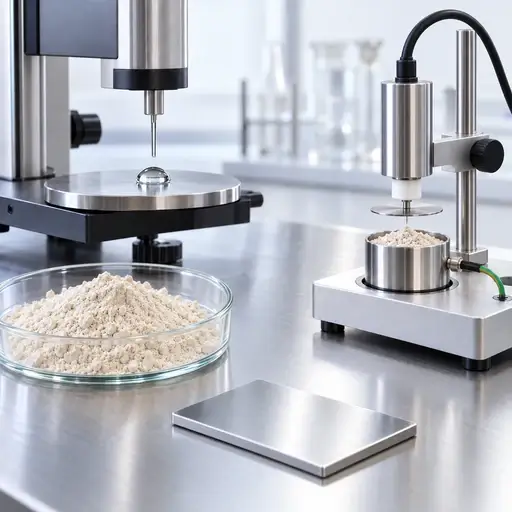
A powder surface interacts with liquids, vapor probes, other particles, and equipment walls in different ways. Select the measurement by the interface and decision: initial wetting, surface-energy comparison, electrokinetic behavior in suspension, contact charging, charge retention, or conduction through a powder bed.
Test methods
Surface, Wettability
and Electrostatics
Separate wetting, surface interactions, electrokinetics,
and dry-powder electrical behavior
A powder surface interacts with liquids, vapor probes, other particles,
and equipment walls in different ways. Select the measurement by the
interface and decision: initial wetting, surface-energy comparison,
electrokinetic behavior in suspension, contact charging, charge
retention, or conduction through a powder bed.




Select by test method
Choose the interface you need to measure
Select a method to compare its principle, preparation, output, interpretation, and limitations. The images illustrate the measurement routes; they do not specify a standard-compliant fixture.
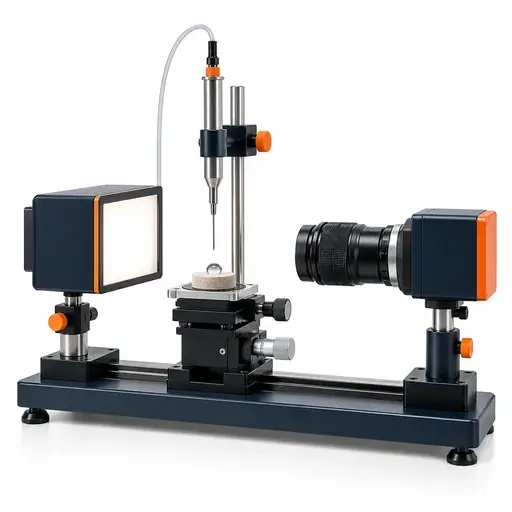
Sessile-drop contact angle on a powder compact
Observe a liquid droplet on a prepared compact and report the apparent angle under defined conditions.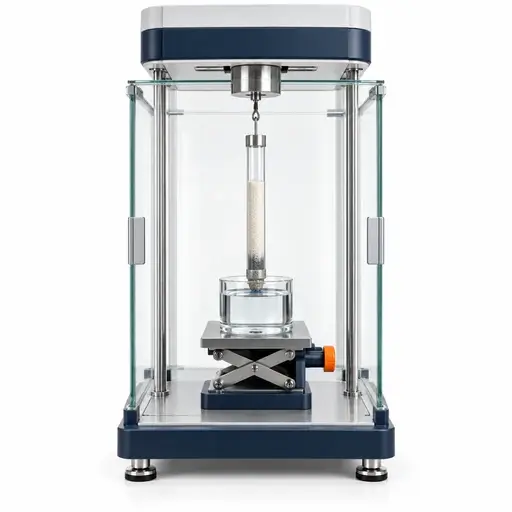
Capillary penetration and Washburn wetting
Follow liquid uptake through a reproducibly packed powder bed and assess the limits of the inferred angle.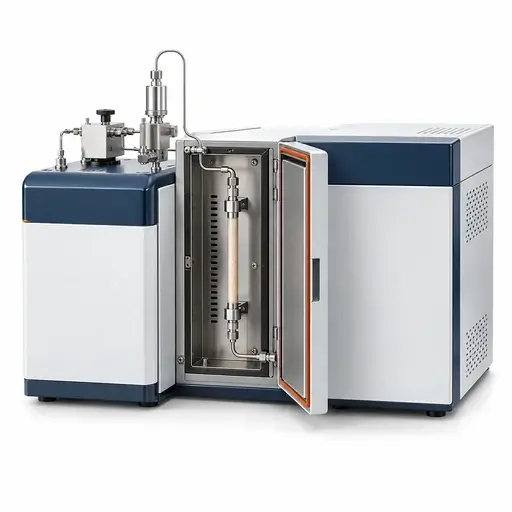
Inverse gas chromatography
Use vapor-probe retention to compare accessible surface interactions and inferred surface energy.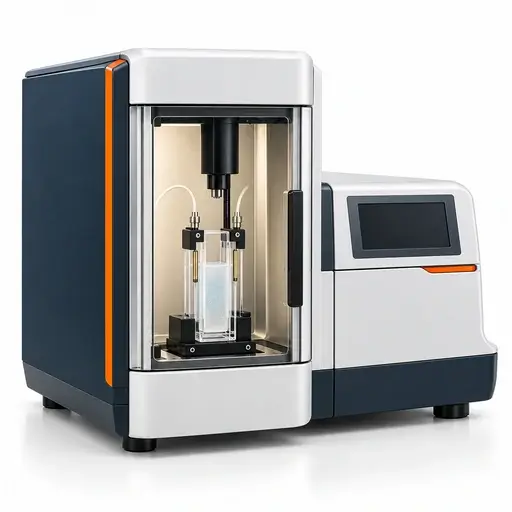
Zeta potential by electrophoretic light scattering
Measure electrophoretic mobility in a defined liquid and derive zeta potential using a suitable model.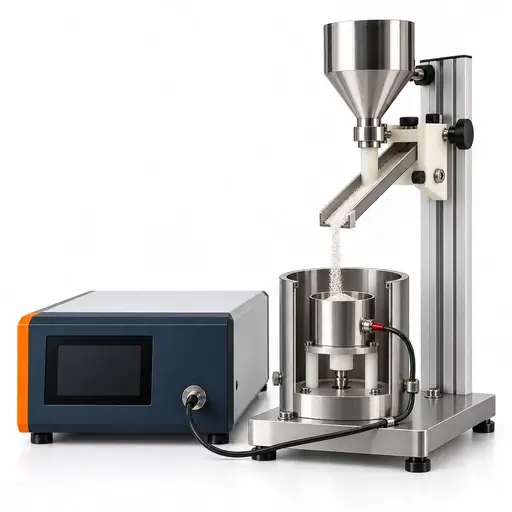
Triboelectric charging and Faraday-cup measurement
Measure net collected charge after a defined powder-contact sequence.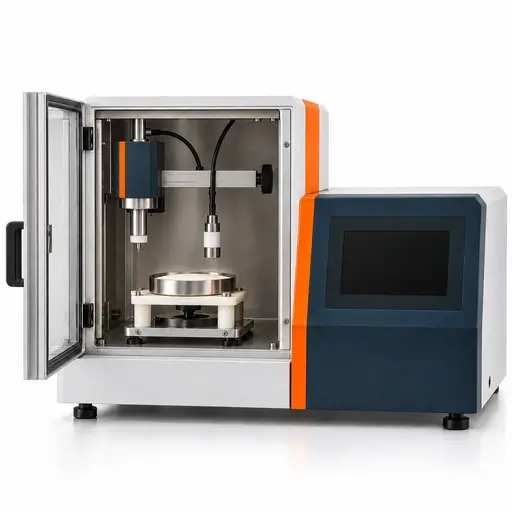
Electrostatic charge decay
Follow potential decay after controlled charging under specified support and environmental conditions.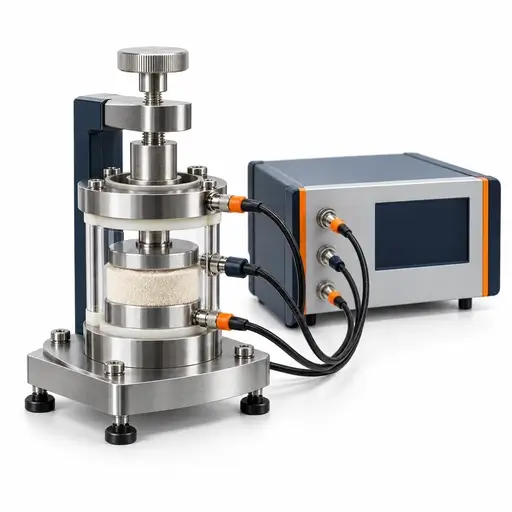
Powder-bed electrical resistivity
Measure conduction through a powder bed with controlled geometry, packing, and electrode contact.Core concept
Measure the relevant interface
Wettability describes how a specified liquid contacts and enters a solid structure. Surface free energy is inferred using selected probes and an interaction model. A droplet on a compact, liquid penetration through a packed bed, and vapor retention in a column therefore interrogate different surface states and access routes.
Zeta potential concerns particles dispersed in a specified liquid. Dry-powder electrostatics concerns charge generated during contact and separation, its subsequent retention, and available paths for dissipation. A powder can show low net collected charge while containing oppositely charged particles. Neither that result nor a zeta-potential value establishes the electrostatic behavior of a production line.
Key takeaway
Match the interface to the decision
Use compact contact-angle or capillary-penetration tests for a defined wetting question, inverse gas chromatography for probe-dependent surface interactions, and electrophoretic methods for particles in a specified liquid. For dry handling, measure contact charging, charge decay, and powder-bed resistivity separately when needed. Control preparation, humidity, liquid chemistry, contact materials, and timing before comparing results; one surface-energy value, zeta potential, or charge number cannot replace the other measurements or predict complete process performance.
What controls it
Six decisions define a useful surface test
A defensible comparison requires the same interface, sample history, and measurement definition.
Selection and interpretation
Similar symptoms can require different measurements
Floating powder, wall deposition, and inconsistent dispersion do not identify a unique mechanism. Use the output that addresses the specific interface and follow it with a relevant performance check.
Engineering question | Primary route | Useful output | Critical boundary |
|---|---|---|---|
| How does a liquid contact a prepared powder surface? | Sessile-drop contact angle on a powder compact | Apparent angle and time dependence | Compaction, roughness, absorption, and dosing define the result. |
| How readily does liquid enter a packed powder bed? | Capillary penetration and Washburn wetting | Uptake curve and conditional wetting-angle inference | Packing and reference calibration must remain valid. |
| Has surface interaction behavior changed? | Inverse gas chromatography | Probe retention and inferred energy components | Probe coverage, accessibility, and analysis model matter. |
| How do dispersed particles respond to an electric field? | Zeta potential by electrophoretic light scattering | Mobility and derived zeta potential | The liquid chemistry and conversion model define meaning. |
| How much net charge follows a defined contact route? | Triboelectric charging and Faraday-cup measurement | Charge, polarity, and charge-to-mass ratio | Cancellation and transfer losses can conceal particle charging. |
| How long does the imposed potential persist? | Electrostatic charge decay | Potential decay and specified endpoint times | Support, charging route, and probe geometry must match. |
| How conductive is the prepared powder bed? | Powder-bed electrical resistivity | Resistance and effective resistivity | Packing, contacts, voltage, and time affect the result. |
How to measure it
Select the method by the evidence the decision requires
The method sections below separate principle, sample state, preparation, output, limitation, disagreement, and decision use. Use the image selector above to jump directly to a method.
Test method 01
Sessile-drop contact angle on a powder compact
Measurement principle: A camera records a liquid-drop profile on a prepared compact; image analysis estimates the apparent contact angle at a defined time or during controlled volume change.
Suitable sample state: A coherent, sufficiently flat compact prepared without unacceptable changes to the surface of interest.
Sample preparation: State compaction pressure, hold time, exposed face, roughness, porosity, liquid, drop volume, dosing rate, temperature, and observation time. Use fresh positions and independently prepared compacts.
Test method 02
Capillary penetration and Washburn wetting
Measurement principle: A weighing system follows liquid uptake into a packed powder column; a suitable uptake region supports a Washburn-type inference.
Suitable sample state: A reproducibly packed powder that remains structurally stable and compatible with the test liquid.
Sample preparation: Control tube and support, sample mass, packing, temperature, and liquid properties. Establish the capillary constant using a compatible fully wetting reference and equivalent packing.
Test method 03
Inverse gas chromatography
Measurement principle: Known vapor probes pass through a powder-packed column, and their retention is analyzed to characterize accessible surface interactions.
Suitable sample state: A powder that can be packed reproducibly and remains stable under the selected conditioning, temperature, and probe exposures.
Sample preparation: Document packing, mass, pretreatment, carrier flow, temperature, humidity, dead-volume correction, probe set, and concentration or coverage. Check repeat injections and stable retention.
Test method 04
Zeta potential by electrophoretic light scattering
Measurement principle: An applied electric field moves dispersed particles; optical measurement determines electrophoretic mobility, from which a suitable model estimates zeta potential.
Suitable sample state: A stable, measurable particle suspension in a defined liquid medium.
Sample preparation: Record medium composition, pH, conductivity, solids concentration, temperature, dispersion method, dilution medium, equilibration, cell, and electrode condition. Check repeatability and sample change during measurement.
Test method 05
Triboelectric charging and Faraday-cup measurement
Measurement principle: Powder undergoes a controlled contact sequence before a shielded Faraday collector and electrometer measure its net collected charge.
Suitable sample state: A representative powder conditioned for the relevant handling environment and capable of quantitative collection.
Sample preparation: Define contact material, finish, cleanliness, path length, speed, throughput, sample mass, prior charge, humidity, and temperature. Verify collector isolation, shielding, zero, background, transfer delay, and recovered mass.
Test method 06
Electrostatic charge decay
Measurement principle: A sample receives a controlled charge, then a noncontact probe follows its electrostatic potential as a function of time under defined boundary conditions.
Suitable sample state: A stationary, reproducible powder layer or prepared specimen held in a specified electrical and environmental configuration.
Sample preparation: Define charging method, polarity, initial level, sample thickness, support, grounding, probe gap, measurement dead time, humidity, and temperature. Record the full trace and chosen decay endpoints.
Test method 07
Powder-bed electrical resistivity
Measurement principle: A defined electrode arrangement applies voltage across a powder bed and measures current to determine resistance and geometry-dependent effective resistivity.
Suitable sample state: A powder bed with controlled moisture, density, thickness, and electrode contact.
Sample preparation: Record conditioning, filling and compaction, electrode geometry, guarding, applied voltage, polarity, electrification time, temperature, and humidity. Check leakage, contact effects, and instrument range.
Conditional routes
Add a route when the primary measurement leaves a gap
Use complementary tests to resolve process performance, surface chemistry, or a specialist electrical question.
Controlled wetting and incorporation trials
Measure a defined sinking, wetting, or incorporation endpoint at fixed powder addition, liquid composition, temperature, and mixing conditions. This gives a process-specific comparison rather than an intrinsic contact angle.
Complementary suspension measurements
Pair zeta potential with particle size, sedimentation, and rheology when dispersion stability is the decision. Steric stabilization and concentrated-system behavior may not follow a simple zeta-potential threshold.
Surface chemistry and localized interactions
Use suitable spectroscopy, microscopy, or specialist force measurements when contamination, coating coverage, or local adhesion is unresolved. Chemical identification and force measurements answer different questions from surface energy.
Electrostatic hazard assessment
If ignition or shock is the decision, combine applicable electrical tests with the process geometry, discharge mechanism, grounding arrangements, and material hazard data. A charge, decay, or resistivity measurement alone is not a complete safety assessment.
Where it matters
Turn interface measurements into process decisions
A useful test result identifies a variable to control and a process response to verify.
Technical FAQ
Questions that prevent misleading comparisons
Check what the number represents before transferring it to another medium, fixture, or process.
Go deeper
Wetting, charging, and practical troubleshooting
Continue into these published PTI articles for process context and complementary interpretation.


Technical basis / sources
Standards and method boundaries
These references define method principles or scoped procedures. Follow the complete applicable standard and a validated laboratory protocol; a method-family description or illustrative image is not a claim of conformity.
-
- ASTM D7334-08(2022): Advancing contact-angle practice for coatings, substrates, and pigment disks. Static observation of an arbitrary powder compact does not automatically meet this procedure.
-
- KRÜSS: Washburn method: Technical basis for mass uptake, capillary calibration, and packing-dependent inference. Treat this as manufacturer method guidance.
-
- Surface Measurement Systems: Inverse Gas Chromatography: Manufacturer guidance on vapor-probe surface characterization. Declare the probe set, coverage, pretreatment, and analysis model.
-
- ISO 13099-2:2025: Optical measurement of electrophoretic mobility in liquids. Zeta potential is obtained through an appropriate model, not measured as dry-powder charge.
-
- IEC 61340-2-1:2015 with AMD1:2022: Charge-dissipation methods, including distinct corona and charged-plate approaches. Specify and validate the powder-layer adaptation.
-
- IEC 60079-32-2:2015: Electrostatic test methods including powder resistivity. Use the applicable prescribed method when the result supports a hazard assessment.
Custom contact-charging tests, compact preparation, wetting trials, and inverse-gas-chromatography analyses require documented suitability for the powder and decision. Preserve measured signals and preparation records alongside derived values.
Need the measurement, not just the guidance?
If the uncertainty concerns wetting, surface interactions, suspension electrokinetics, contact charging, charge retention, or powder-bed conduction, define the relevant interface and process conditions before commissioning tests. Agree the sample preparation, liquid or probe chemistry, humidity, contact materials, timing, and interpretation boundaries with the laboratory. PTI works closely with Delft Solids Solutions, a contract research organization specializing in the physical behavior of powders and granules. Contact Delft Solids Solutions.