
Test methods
Thermal, Solid-State and Reactivity
Separate heat flow, mass change, phase identity, and self-heating
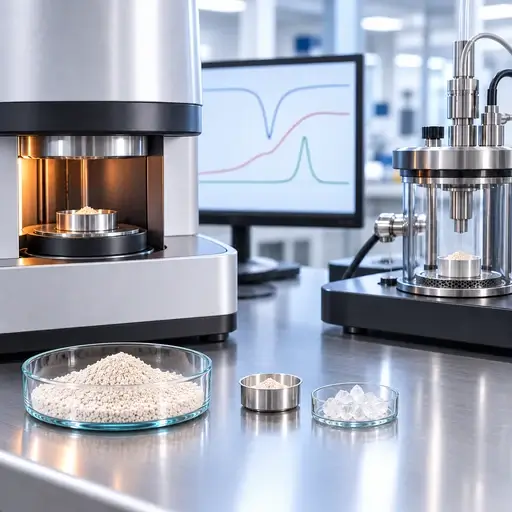
Heating a powder can change its physical state, composition, or reaction rate. Differential scanning calorimetry, thermogravimetry, diffraction, microscopy, and adiabatic calorimetry measure different parts of that response. Choose the route by the event that matters and the temperature, atmosphere, time, and confinement the material will experience.
Test methods
Thermal, Solid-State
and Reactivity
Separate heat flow, mass change, phase identity,
and self-heating
Heating a powder can change its physical state, composition, or reaction rate.
Differential scanning calorimetry, thermogravimetry, diffraction, microscopy,
and adiabatic calorimetry measure different parts of that response.
Choose the route by the event that matters and the temperature, atmosphere,
time, and confinement the material will experience.




Select by test method
Choose the signal you need to interpret
Select a method to compare its principle, sample preparation, output, and limitations. The instrument images illustrate the routes; they are not standard-compliant fixture drawings.
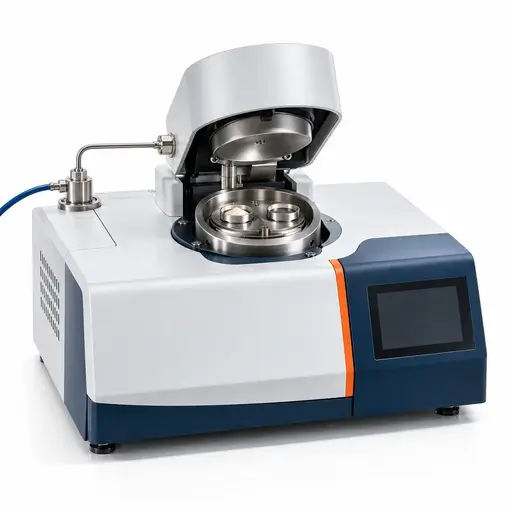
Differential scanning calorimetry
Measure heat-flow events associated with transitions or reactions under a defined temperature program.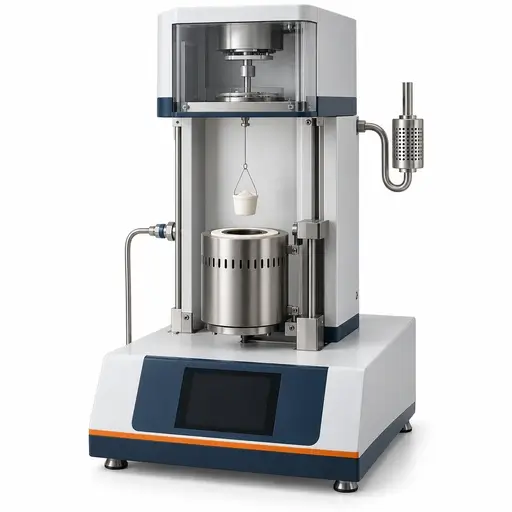
Thermogravimetric analysis
Measure net mass loss or gain during controlled heating and atmosphere exposure.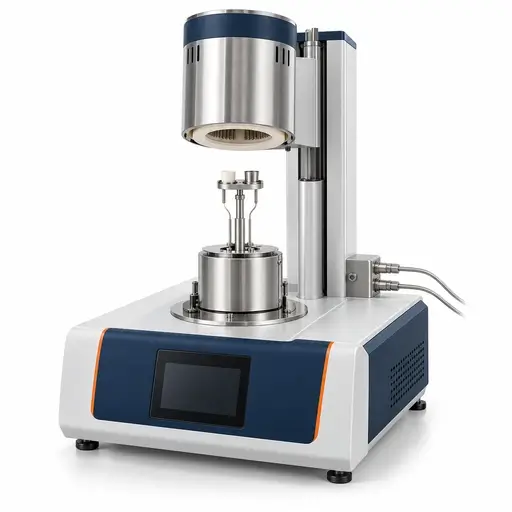
Simultaneous thermal analysis
Compare mass change and a thermal signal from the same specimen during one program.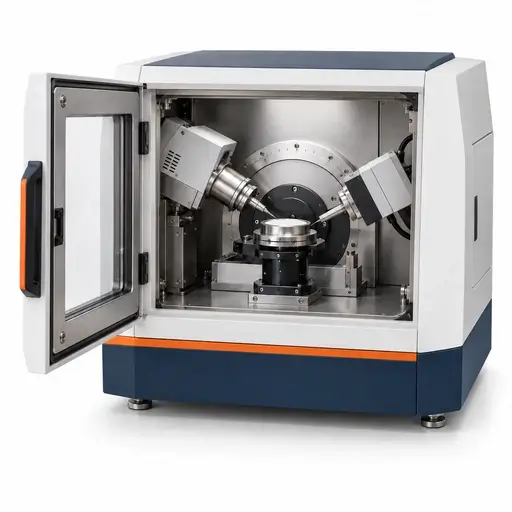
Powder X-ray diffraction
Identify crystalline phases and assess phase proportions using a validated diffraction analysis.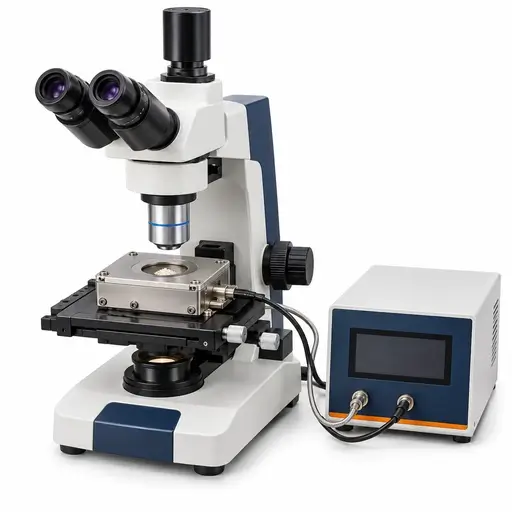
Hot-stage microscopy
Observe visible specimen changes during controlled heating, cooling, or holding.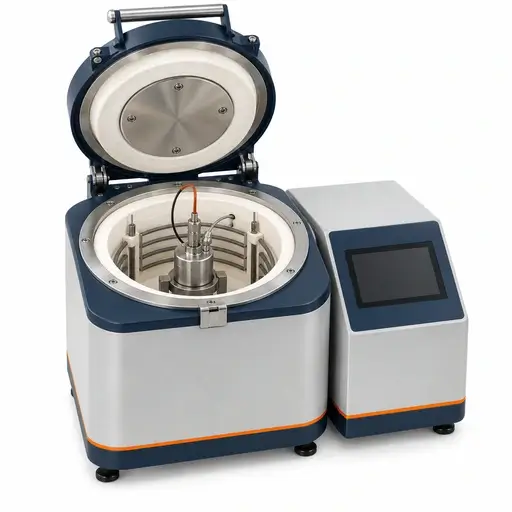
Adiabatic calorimetry and self-heating assessment
Investigate self-heating under near-adiabatic conditions and defined vessel constraints.Core concept
An event needs an identity
A DSC endotherm may accompany melting, evaporation, dehydration, or another transition. An exotherm may reflect crystallization, oxidation, curing, or decomposition. TGA shows net mass change but does not identify an evolved gas or uniquely assign a reaction. Combined thermal signals narrow the possibilities; they do not automatically establish the mechanism.
Powder X-ray diffraction identifies crystalline phases within the measurement and reference-model limits. It complements thermal analysis when polymorphism, crystallization, or amorphous content matters. Hot-stage microscopy shows visible changes, while adiabatic calorimetry examines self-heating under a different thermal boundary condition. A glass transition is a kinetic change associated with an amorphous fraction, not a melting peak or a unique sticky-point temperature.
Key takeaway
Choose the signal that resolves the decision
Use DSC for heat-flow events, TGA for mass change, and simultaneous thermal analysis when their timing must be compared on the same specimen. Use powder XRD to investigate crystalline phases and hot-stage microscopy to observe physical changes directly. Add adiabatic calorimetry when self-heating behavior is the unresolved question. Control atmosphere, temperature program, sample history, mass, and confinement; confirm event identity before applying the result to a process. A measured transition or decomposition onset is not by itself a safe storage temperature, a scale-up rule, or a complete dust-explosion assessment.
What controls it
Six decisions define a defensible thermal test
Define the material state and exposure before selecting a temperature or peak from a report.
Selection and interpretation
Separate the signal from the event assignment
A single temperature can hide several different definitions. Compare the sample state, program, atmosphere, detection criterion, and physical signal before comparing reported values.
Engineering question | Primary route | Useful output | Critical boundary |
|---|---|---|---|
| Where is a transition or heat-flow event? | Differential scanning calorimetry | Heat flow, event temperatures, and qualified enthalpy | A peak alone does not identify its mechanism. |
| Is the specimen losing or gaining mass? | Thermogravimetric analysis | Mass change, derivative response, and residue | Mass change alone does not identify the gas or reaction. |
| Does a thermal event coincide with mass change? | Simultaneous thermal analysis | Matched thermal and mass signals | Shared timing narrows interpretation without proving identity. |
| Which crystalline phases are present? | Powder X-ray diffraction | Phase assignments and validated quantitative analysis | An amorphous fraction needs a justified separate treatment. |
| What visible change occurs during heating? | Hot-stage microscopy | Images linked to temperature and time | Stage geometry and a small field of view limit representativeness. |
| Does the material self-heat under the test conditions? | Adiabatic calorimetry and self-heating assessment | Temperature history, rate, and pressure where measured | Detection and thermal inertia affect interpretation and scale-up. |
How to measure it
Select the method by the evidence the decision requires
The method sections below separate principle, sample state, preparation, output, limitation, disagreement, and decision use. Use the image selector above to jump directly to a method.
Test method 01
Differential scanning calorimetry
Measurement principle: A controlled temperature program produces a differential heat-flow signal between the sample and a reference.
Suitable sample state: A representative powder compatible with the selected pan, atmosphere, and temperature range.
Sample preparation: Record sample mass, pan and lid, conditioning, thermal contact, heating and cooling rates, holds, purge, calibration, and baseline. Distinguish the first heating from later cycles.
Test method 02
Thermogravimetric analysis
Measurement principle: A sensitive balance records specimen mass during a specified temperature and atmosphere program.
Suitable sample state: A representative solid or powder compatible with the crucible and measurement environment.
Sample preparation: Define initial mass, bed depth, crucible, atmosphere and switches, flow, temperature ramp, holds, and normalization. Check mass and temperature calibration, buoyancy or baseline effects, and repeatability.
Test method 03
Simultaneous thermal analysis
Measurement principle: The same specimen is measured for mass change and a thermal signal during one temperature and atmosphere program.
Suitable sample state: A representative powder compatible with the combined balance, sensor, crucible, and temperature range.
Sample preparation: Specify whether the thermal channel is DSC or DTA, not just STA. Document sample mass, crucibles, reference, gas program, calibration of both channels, baselines, and the timing or temperature alignment.
Test method 04
Powder X-ray diffraction
Measurement principle: X-rays diffract from ordered crystal structures; the measured intensity pattern is compared with reference phases or structural models.
Suitable sample state: A representative powder prepared to preserve the phases and provide adequate particle statistics.
Sample preparation: Control sampling, grinding, packing, specimen height, orientation, scan range, resolution, counting time, and instrumental calibration. Protect air- or moisture-sensitive phases and document any internal standard.
Test method 05
Hot-stage microscopy
Measurement principle: An optical microscope records specimen appearance during controlled heating, cooling, or holding on a temperature-regulated stage.
Suitable sample state: A small representative powder or crystalline specimen that can be observed in a suitable holder.
Sample preparation: Define specimen thickness, optical mode, stage and sample-temperature calibration, ramp, holds, atmosphere, coverslip or containment, and image timing. Observe multiple fields or specimens when heterogeneity matters.
Test method 06
Adiabatic calorimetry and self-heating assessment
Measurement principle: A calorimeter tracks a sample vessel to approximate adiabatic conditions while measuring the time-dependent thermal response and, where configured, pressure.
Suitable sample state: A representative material or mixture accepted for testing in a compatible, appropriately rated calorimetric vessel.
Sample preparation: Define composition, contamination scenario, atmosphere, fill, vessel material, heat capacity, pressure measurement, detection threshold, and temperature-search or other operating program. A specialist laboratory must establish suitable test conditions.
Conditional routes
Add evidence when a signal has more than one explanation
These routes address chemical identity, overlapping events, long timescales, deformation, or process-specific hazards beyond the primary measurements.
Evolved-gas analysis
Couple TGA or STA to suitable FTIR or mass spectrometry when the identity of released species matters. Validate transport delay, condensation, background, and spectral or fragment assignments.
Resolved transitions and phase evolution
Consider modulated DSC, temperature-resolved XRD, or Raman/IR measurements when events overlap or phase identity changes during heating. Modulation separates responses by a model; it does not automatically assign chemistry.
Isothermal kinetics and bulk self-heating
Use justified hold tests, multiple temperature programs, or specialist bulk self-heating methods when duration, oxygen transport, or bed size controls the decision. A model fitted to one scan is not validated by the fit alone.
Mechanical response and process safety
Use TMA, DMA, dilatometry, or controlled stickiness tests when deformation is the endpoint. Use dedicated dust-explosion, ignition, reaction-hazard, or relief-design work when those are the actual safety questions.
Where it matters
Connect thermal evidence to the material decision
Use each result within its exposure and interpretation boundaries, then verify the process-relevant consequence.
Technical FAQ
Questions that prevent overinterpreting a thermal result
Clarify event identity, method configuration, and the limits of a reported temperature before using it.
Go deeper
Physical state, formulation, and practical stability
These published PTI articles provide application context. Use the technical references below for the scope of the measurement methods.


Technical basis / sources
Standards and interpretation boundaries
These sources distinguish scoped standards from instrument guidance. Select the complete applicable procedure and validate it for the material, configuration, and intended decision.
- ASTM E794-24: Melting and crystallization temperature measurements for suitable pure, thermally stable materials. Its scope is narrower than all DSC event interpretation.
- ASTM E1356-25: Glass-transition assignment for suitable amorphous or partially crystalline materials, without decomposition or sublimation in the transition region.
- ASTM E1131-25: Compositional thermogravimetry using inert and reactive gas environments. Mass-change fractions still need justified interpretation.
- ASTM E1981-26: Accelerating-rate calorimetry guidance. Results require appropriate interpretation and scaling before application to a process.
- TA Instruments: simultaneous DSC/TGA: Manufacturer information illustrating combined heat-flow and mass measurement; it does not standardize all STA configurations.
- Malvern Panalytical: X-ray diffraction: Manufacturer overview of diffraction methods and phase analysis. Validate the material-specific preparation and quantitative model.
- Linkam: temperature-controlled microscopy stages: Manufacturer instrument guidance for observing samples under controlled temperature; not a universal powder-event assignment procedure.
Report calibration, sample history, atmosphere, vessel, temperature program, event definition, normalization, and uncertainty. Use complementary evidence for chemical or phase assignments and specialist assessment for process-safety decisions.
Need the measurement, not just the guidance?
If the uncertainty concerns a thermal event, volatile release, phase change, visible softening, or self-heating, define the relevant material state and process conditions before commissioning tests. Agree the exposure history, atmosphere, temperature program, sample configuration, and interpretation boundaries with the laboratory. PTI works closely with Delft Solids Solutions, a contract research organization specializing in the physical behavior of powders and granules. Contact Delft Solids Solutions.