
Troubleshooting
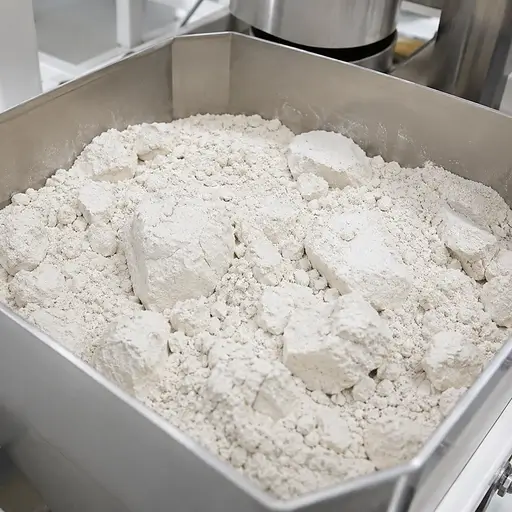
Caking and hardened beds
Soft cakes, crusts, and hardened beds develop by different routes
Troubleshooting
Caking and hardened beds
Soft cakes, crusts, and hardened beds develop by different routes




Find your route
Start with the observed failure, then add context
Caking is a history-dependent increase in bulk strength. Start with where the cake or hardened region formed, how easily it breaks, and what changed in moisture, temperature, load, storage time, or chemistry before selecting a test.
- 1 Observation
- 2 Change or context
- 3 Route
Step 1 What are you seeing?
Step 2 What changed, or when does it happen?
The same caking pattern can arise from different mechanisms depending on storage time and load, thermal history, environmental exposure, or material state.
Step 3 Your diagnostic route
Quick diagnostic comparison
Separate the leading routes before changing the process
Use the pattern and event history to select the first discriminating measurement. The table is a triage aid, not a substitute for reproducing the failed state.
Use the observed caking pattern and the change that preceded it to select the first discriminator. The pattern does not prove the mechanism.
| What you observe | What changed | Likely mechanism | Measurement that separates it |
|---|---|---|---|
| A weak cake forms and breaks apart easily | After a humidity, product-temperature, or dew-point shift | Moisture uptake and liquid bridging | Moisture state: Do water content, water activity, or controlled humidity conditions separate good and failed material? |
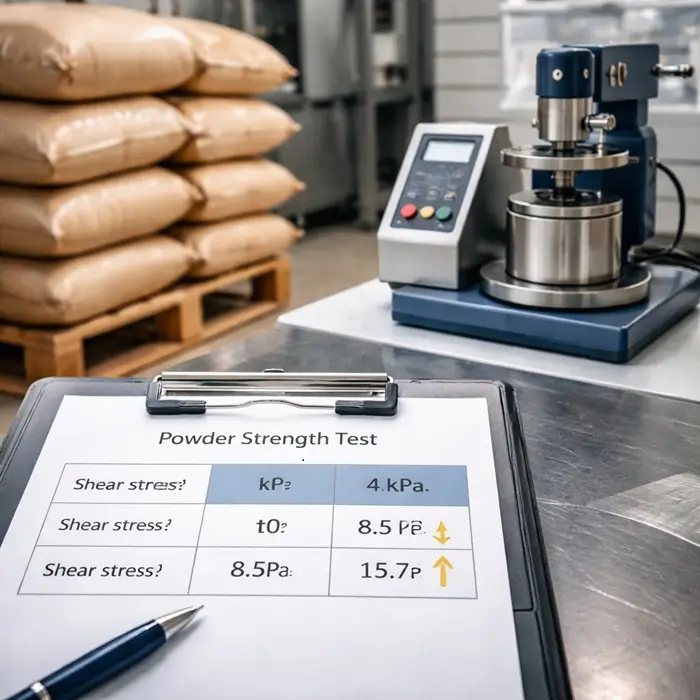
| A hard coherent cake or crust forms | After longer storage or higher head load | Time consolidation and compaction | Strength after conditioning: Does cake or bed strength grow with storage time, consolidation stress, humidity, or temperature? |
| A hardened layer is strongest near walls or cold surfaces | After a humidity, product-temperature, or dew-point shift | Temperature cycling and condensation | Temperature and dew-point route: Do product or wall temperatures approach or cross the local dew point when the cake forms? |
| Fresh powder flows but stored powder sets | After longer storage or higher consolidation load | Time consolidation and compaction | Strength after conditioning: Does cake or bed strength grow with storage time, consolidation stress, humidity, or temperature? |
Use the measurement under the material state, storage history, environmental conditions, and applied stress that produced the failure.
Likely mechanisms
Separate the cause before changing the process
Each route links the observation to a physical cause, a discriminator, and the process implication.
Measurement routes
The test that answers the diagnostic question
Caking is a change in material state, not one measurement result. Strength growth, moisture history, particle-contact structure, and thermal or solid-state transitions answer different questions. Choose the route that reproduces the failed storage or process condition and separates the leading mechanisms.
Process context
Where the problem appears changes what to check first
The same material can cake differently across storage, transfer, feeding, drying, and packaging because residence time, consolidation stress, temperature history, and environmental exposure are different. Keep that process history attached to the diagnosis.
Go deeper
Guides and articles for caking and hardened beds
Longer reads and direct routes that connect the visible caking problem to storage history, moisture, strength development, material behavior, and measurement choice.

FAQ
Caking and hardened-bed questions
Need the measurement, not just the guidance? PowderTechnology.info works closely with Delft Solids Solutions,
a contract research organization specializing in the physical behavior of powders and granules. DSS provides
contract testing and characterization, with its laboratory working in accordance with ISO 17025.
Contact Delft Solids Solutions.