
Process & Equipment
Size Reduction & Classification
Choose the breakage route and control the product distribution
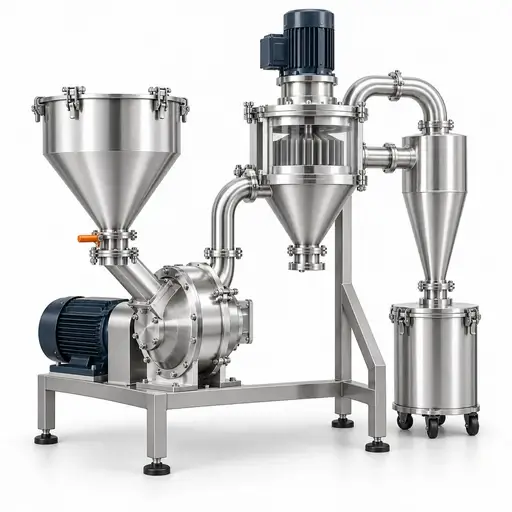
Select milling and separation equipment around the required particle-size distribution, acceptable material change, and saleable yield. Connect feed properties, breakage mechanism, classification, and circuit operation before committing to equipment or scale-up.
Process & Equipment
Size Reduction & Classification
Choose the breakage route and control
the product distribution
Select milling and separation equipment around the required particle-size distribution,
acceptable material change, and saleable yield. Connect feed properties, breakage
mechanism, classification, and circuit operation before committing to equipment or scale-up.




Jump to
Jump to a specific engineering decision, or follow the sections from process requirements through equipment selection and verification.
Key Takeaway
Specify the usable product, not only the median size
Choose size reduction and classification as a combined product-making duty. Define the full size requirement, measurement basis, allowable fines and oversize, particle shape, purity, and functional limits before trials. Match the breakage mechanism to the feed, then verify separation performance, recycle loading, and recovered yield at representative throughput. A lower D50 or a finer classifier setting alone does not demonstrate a better product.
Start with the requirement
Define what the finished powder must achieve
Set the acceptance basis before comparing mill names or nominal fineness claims.
Powder constraints
Identify how the feed responds to stress
Hardness alone is not a complete measure of grindability or wear.
Choose by application question
Start with the unresolved design decision
Use the required product change to select the next engineering question.
Equipment principles
Match the loading mechanism to the feed
Most mills combine several stresses. Select by the dominant useful action and its side effects.
Impact and gas-driven collisions
Rotor, pin, and hammer arrangements apply impact and may include shear or screen-controlled retention. Jet mills accelerate particles with gas; the balance of particle-particle and wall impacts depends on the design. Neither route is automatically free of wear or heating.
Compression, cutting, and media
Roll-based systems apply compression, sometimes with shear from differential speeds. Cutting mills suit materials that respond to shearing between cutting edges. Tumbling and stirred-media mills apply repeated contact stresses; media size, loading, and motion determine the exposure.
Choose the required degree of breakage
For soft lumps or granules, a controlled delumping or screen-milling step may meet the duty with less unwanted fines generation. Verify primary-particle preservation. Do not equate a machine aperture with an exact product top size.
Separation principles
Define separation performance as well as cut size
Classification changes the distribution by routing particles into different streams; it does not inherently make them smaller.
Screening
A screen separates according to passage through apertures. Shape, orientation, near-size particles, bed loading, blinding, and residence on the screen affect the result. Specify aperture, useful open area, capacity, and allowable misplaced material in both streams.
Air and liquid classification
Fluid-based separation depends on drag and opposing forces. Dynamic air classifiers, gravitational devices, and hydrocyclones have different operating principles and boundaries. Establish density, shape, dispersion, and fluid properties before translating a size requirement into a setting.
Measure the partition
Request feed and both outlet mass flows and size distributions on compatible bases. State which stream defines the partition curve and whether any bypass correction is applied. A classifier cut size at 50% partition is not the median size of its product. Assess separation sharpness and recovery as well as the nominal cut.
Circuit design
Balance breakage, separation, and recycle
The circuit must produce the required fraction sustainably, not just a fine sample during a short trial.
Open or closed circuit
An open circuit passes material through without intentional oversize return. A closed circuit returns a selected stream for further treatment. Removing acceptable material can limit unnecessary exposure, but imperfect separation may recycle useful product or release off-spec particles.
Track load and inventory
Distinguish fresh feed, classifier feed, recycle, product, and losses. State the recycle ratio denominator. Increasing recycle can raise internal load and energy use without increasing saleable output; confirm stable inventory and capacity across the intended range.
Coordinate the controls
Feed rate, mill loading, speed or gas supply, classifier settings, and collection pressure interact. Establish a stable operating map and response to disturbances. A setting change should be judged by recovered product rate, distribution, and energy demand together.
Product quality
Measure what milling changes beyond size
Freshly created surfaces and repeated stressing can alter performance even when the size target is met.
Heat and solid state
Record the thermal history and assess temperature-sensitive properties. Product discharge temperature is useful but may not capture local contact heating. Check relevant crystal-state or chemical changes when the application depends on them.
Wear and contamination
Choose liners, tools, screens, and media around both wear resistance and acceptable contamination. A ceramic contact material is not automatically acceptable; its wear products must also meet the purity requirement. Include a duration sufficient to reveal evolving wear or deposits.
Shape and surface
Compare morphology, surface area, and functional performance where relevant. Finer particles may agglomerate after processing, and a change in dispersion procedure can alter measured PSD. Use a consistent analytical protocol before assigning every shift to breakage.
Process route
Compare the whole dry or wet route
The preferred milling environment depends on the product and the operations needed afterward.
Dry processing
Define feed conditioning, gas quality, heat removal, and collection. Gas-assisted milling includes compressor or blower demand and filtration. Cooling or cryogenic conditioning may change fracture behavior, but verify consumption, condensation control, and final product condition.
Wet processing
Specify liquid compatibility, solids concentration, suspension rheology, and any dispersant. Fluid properties affect stressing and separation. Media separation, pumping, solvent handling, and contamination are part of the selected route.
Recovery and downstream use
If the product is required dry, include dewatering and drying, with the possibility of re-agglomeration. If it is used as a suspension, verify stability and redispersion. A finer wet-milled sample does not establish the performance of a subsequently dried powder.
Scale-up
Base the design on representative product-making trials
A laboratory result establishes feasibility under its tested conditions, not a complete production specification.
Define the energy boundary
Record energy per mass of acceptable recovered product and state the included equipment. Distinguish mill-drive energy from total system demand, including gas compression, pumps, cooling, classification, and drying where relevant.
Choose a justified model
Equal rpm, residence time, or specific energy does not preserve every stress distribution across sizes and designs. Describe the relevant geometry, media or tool conditions, loading, transport, and separator behavior. Use empirical energy correlations only within their calibrated material and size range.
Test sustained operation
Run long enough to assess stable recycle, temperature, deposits, collector performance, and product variability. Include realistic feed extremes and starts or stops. Document differences between the trial and installation and assign commissioning checks.
Selection comparison
Compare principles and their boundaries
Mill and separator choices are complementary; match each to the role it must perform.
Principle | Best fit | Critical inputs | Strength | Limitations and integration |
|---|---|---|---|---|
| Rotor impact / pin / hammer | Impact-responsive feed requiring breakage | Fracture response, feed size, moisture, abrasion | Adaptable mechanical stressing | Heat, wear, fines, screen loading, and retention require trials |
| Roll / compression | Feed suited to compression and controlled nip loading | Strength, deformability, feed size, friction | Defined compression zone | Nip capture, gap, roll condition, and differential speed influence product |
| Cutting | Fibrous or tough feed responsive to shear | Fiber length, toughness, moisture, contaminants | Defined cutting action | Edge wear, wrapping, heat, and screen passage |
| Tumbling / stirred media | Repeated stressing for fine grinding where appropriate | Breakage response, media compatibility, rheology if wet | Adjustable media and exposure conditions | Media wear, heat, agglomeration, and media separation |
| Jet milling | Feed suited to gas-driven fine grinding | Feed size, strength, density, moisture | No grinding media; classification may be integrated | Gas demand, feed preparation, collection, and contact wear |
| Screen / conical milling | Delumping or granule sizing under controlled action | Lump strength, primary-particle strength, tackiness | Potential to limit unnecessary intensive grinding | Aperture does not uniquely define PSD; check fines and screen condition |
| Screening | Removal or recovery of a defined size fraction | Shape, near-size content, moisture, bed load | Direct aperture-based separation | Blinding, capacity, misplaced fractions, and screen integrity |
| Dynamic air classification | Dry separation with a suitable dispersed feed | Size, density, shape, cohesion, gas conditions | Adjustable fluid-based separation | Cut is not product D50; verify bypass, sharpness, recovery, and dispersion |
| Liquid classification | Suitable suspension-based separation duty | Density, shape, liquid properties, solids loading | Integration with wet processing | Entrainment, separation efficiency, dewatering, and liquid recovery |
Operating window
Specify the stable product-making range
Record material conditions and the coordinated settings that meet all product limits.
Variable | Define and monitor | Acceptance boundary |
|---|---|---|
| Feed | Fresh-feed rate, PSD, moisture, temperature | Stable loading and representative material envelope |
| Stress conditions | Speed, gap, tools or media, exposure | Size distribution with acceptable fines and material change |
| Gas or liquid | Flow, pressure, temperature; solids concentration if wet | Stable transport, cooling, and separation |
| Classifier / screen | Speed or aperture, feed loading, condition | Partition, coarse carryover, fine loss, and yield |
| Recycle | Flow, ratio basis, inventory | Sustainable internal load and product rate |
| Collection | Filter pressure drop, recovery, residue | Product balance and consistent system conditions |
| Run duration | Thermal stabilization, wear, deposits | Repeatable product and defined maintenance interval |
Data before design or scale-up
Request evidence tied to the product decision
Use representative feed and retain the measurement conditions for every before-and-after comparison.
Decision | Measurement route | Contribution | Remaining verification |
|---|---|---|---|
| Size and separation | Particle size and morphology | Distribution, coarse tail, fines, shape | Sampling, dispersion, and compatible stream analyses |
| Breakage feasibility | Strength and attrition | Stress response and susceptibility | Actual mill exposure, product distribution, and throughput |
| Surface change | Surface area and density | Surface development and packing changes | Functional performance and downstream behavior |
| Heat and structure | Thermal and solid-state methods | Relevant thermal transitions and structural change | Actual process history and application-specific limits |
| Moisture and adhesion | Moisture response | Conditioning sensitivity | Deposits, screen performance, and post-process storage |
| Purity | Composition and contaminants | Detectable wear or composition shifts | Suitable detection limits and sustained-run sampling |
| Wet route | Liquid-phase and dispersion behavior | Suspension behavior and redispersion | Milling, separation, and final recovery sequence |
| System performance | Representative milling and classification trials | Yield, energy, partition, stability | Scale-up rationale and installed acceptance |
Verification and acceptance
Agree numerical criteria before testing
Specify methods, sampling points, uncertainty, duration, and material envelope in the trial protocol.
Integration
Specify the interfaces that control the result
Assign responsibility for the complete line rather than treating the mill as an isolated machine.
When a problem already occurs
Use the diagnostic route
For an installed process with unintended particle damage or wear, use Attrition, Breakage and Wear. For deposits or lumps, use Caking and Agglomeration; for poor discharge after milling, use Poor Flow and Discharge. Use the diagnosis to define the equipment or operating change that needs verification.
Go Deeper
Read the supporting technical articles
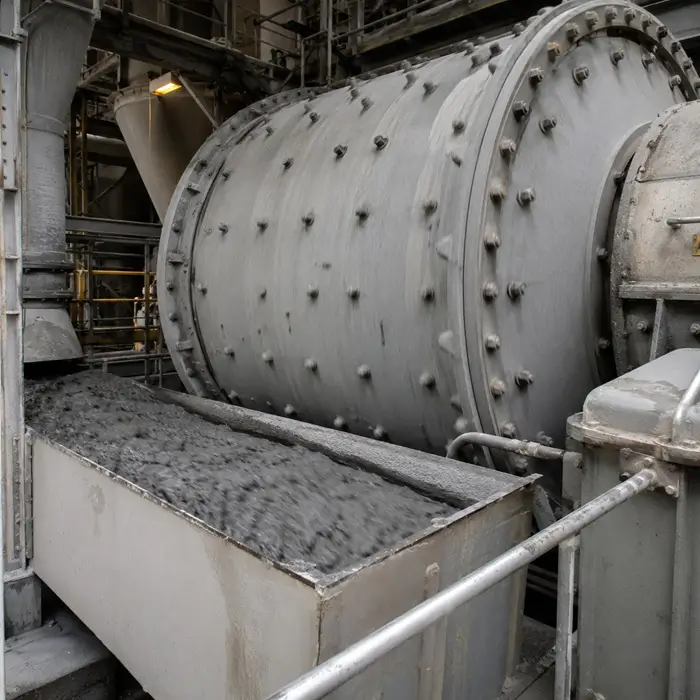
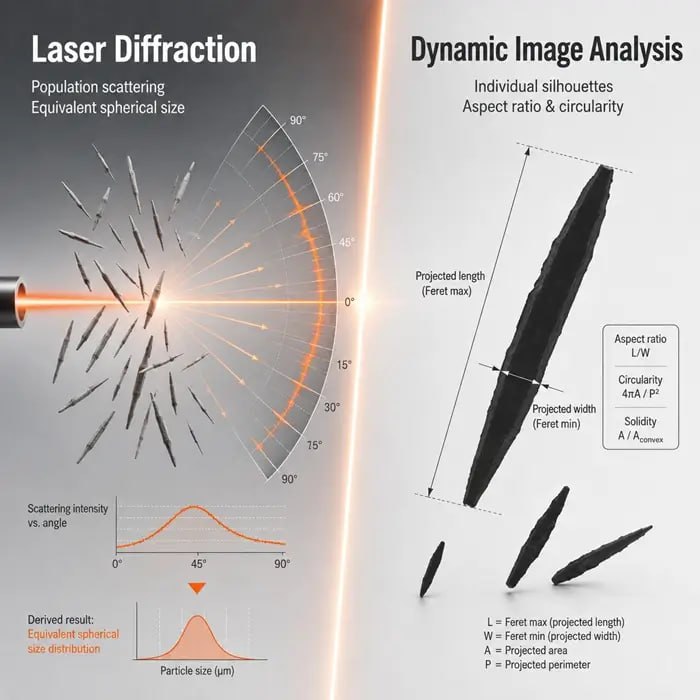
<p>Explore grinding effects, screening performance, and interpretation of size and shape measurements.</p>

Technical FAQ
Size reduction and classification questions
Use these distinctions when reviewing equipment proposals and trial data.
Technical basis
Sources and scope
Use mechanism and circuit references alongside representative measurements and trials.
- Salman, Ghadiri, and Hounslow (eds., 2007), Particle Breakage, Handbook of Powder Technology, Volume 12: independent reference covering particle fracture, impact and media milling, jet milling, feed-property effects, energy, and circuit modeling. Supports mechanism selection rather than a universal equipment-performance claim.
- Wills and Finch, Wills’ Mineral Processing Technology, eighth edition: independent engineering reference for comminution, grinding circuits, screening, and classification. Its mineral-processing context must be considered before applying methods to other powders.
- Hosokawa Alpine, Grinding and Classifying: manufacturer explanation of mill principles and integrated classification. Use application-specific trials to establish fineness, wear, utility demand, and material compatibility; catalogue ranges are not acceptance limits.
- Quadro Engineering, Milling and Size Reduction: manufacturer guidance distinguishing conical milling, delumping, and fine grinding. Relevant to preparing a granule-sizing or deagglomeration trial, with product outcomes to be verified independently.
Agree a project-specific protocol for feed variability, sampling, size analysis, mass balance, purity, and sustained performance. Apply the relevant material, equipment, and sector requirements through the responsible design disciplines. A laboratory PSD method does not certify mill capacity or classifier performance.
Need the material data behind the design decision?
Define the feed, target distribution, and allowable material change before commissioning characterization. Delft Solids Solutions can discuss the relevant testing scope. Contact the laboratory with the application and sample information; agree separately who will design and verify the milling and classification circuit.