
Troubleshooting

Electrostatic charging

Charge is generated by a contact pair and handling history,
then controlled by leakage and relaxation

Do not treat a powder as having one fixed charge tendency. Identify the contact surfaces, polarity, handling energy, humidity, residence time, grounding path, and where the charge produces adhesion, shocks, segregation, or measurement error.


By what you see

By what you see

Powder coats walls, windows, or tools; operators receive shocks; feeding or weighing drifts; or components separate after transfer.

By what changed

By what changed

After conveying; after humidity, contact material, or grounding changed; or when batch, PSD, composition, or recycle conditions shift.

By likely mechanism

By likely mechanism

Contact charging, poor dissipation, low-humidity surface state, charged fines, and induction or external-field effects.

By measurement route

By measurement route

Choose the measurement that most clearly separates the leading physical explanations under realistic process and operating conditions.

Find your route

Start with the observed failure, then add context

Do not treat a powder as having one fixed charge tendency. Identify the contact surfaces, polarity, handling energy, humidity, residence time, grounding path, and where the charge produces adhesion, shocks, segregation, or measurement error.

  1. 1Observation
  2. 2Change or context
  3. 3Route

Step 1  What are you seeing?

Step 2  What changed, or when does it happen?

Electrostatic behavior depends on both how charge is generated and how quickly it can dissipate. Add the process or material change that best matches when the failure appears.

Step 3  Your diagnostic route

Quick diagnostic comparison

Separate the leading routes before changing the process

Use the pattern and event history to select the first discriminating measurement. The table is a triage aid, not a substitute for reproducing the failed state.

Use the observed pattern and the change that preceded it to select the first discriminator. The pattern does not prove the mechanism.

What you observe What changed Likely mechanism Measurement that separates it
Powder coats walls, windows, or tools After contact material or humidity changed Contact charging or reduced dissipation Charge generation and relaxation across the actual contact and humidity conditions
Operators or equipment experience discharges After grounding, bonding, or residence time changed Poor dissipation and charge accumulation Charge relaxation, resistance, and grounding-path verification
Feeding or weighing becomes erratic After pneumatic conveying or handling intensity changed Charge accumulation or charged fine fraction Charge generation and relaxation under the actual conveying history
Components separate after transfer With a changed batch, composition, or contact sequence Differential contact charging Component-resolved charge polarity and magnitude after the real contact sequence

Use the measurement under the material state and process conditions that produced the failure.

Likely mechanisms

Separate charge generation from charge persistence and field effects

Electrostatic symptoms can come from different parts of the charge history. Reproduce the actual contact pair and handling sequence, then separate how charge is generated, how quickly it relaxes, and where the resulting field changes adhesion, flow, segregation, or measurement.

Contact charging

Particle-surface and particle-particle contacts transfer charge. Polarity and magnitude depend on the actual material pair, surface condition, and contact history.

Separate it with: charge polarity and magnitude after the real contact sequence.
Triboelectric Charging in Powders

Poor dissipation

Charge can persist when the powder, coating, liner, or equipment path is sufficiently insulating, so the effect remains long after the original charging event.

Separate it with: charge decay time, resistance, and continuity of the dissipation path.
Charge Decay Time

Low-humidity surface state

Dry conditions can reduce surface conduction and extend charge lifetime, making an existing charging mechanism more visible without changing the underlying contact pair.

Separate it with: charge generation and relaxation across the relevant humidity range.
Why Humidity Matters

Charged fine fraction

Fine particles can carry disproportionate charge relative to their mass and may adhere, migrate, or separate from the bulk after repeated transfer.

Separate it with: size-resolved charge, fines distribution, and deposition pattern.
Triboelectric Charging in Powders

Induction or external fields

Nearby energized equipment, ionizers, charged surfaces, or strong electric fields can alter apparent powder behavior even when the powder-contact pair has not changed.

Separate it with: field survey and controlled isolation of the suspected source.
Electrostatic Troubleshooting in Powder Handling

ⓘ Diagnostic note

Grounding the equipment does not neutralize an insulating powder

Bonding and grounding control conductive equipment potential and discharge paths. Charge stored on insulating particles can remain until material, humidity, residence time, and contact conditions allow it to relax.

Measurement routes

Measure generation, persistence, and environmental dependence separately

The useful measurement is the one that reproduces the failed charging history and distinguishes whether the process creates more charge, retains it longer, or changes the field and dissipation conditions around the powder.

Charge generation & contact pair

Reproduce the real powder-surface or powder-powder contact sequence and compare polarity and charge magnitude under representative handling energy.

Charge decay & dissipation

Measure how quickly charge relaxes, then check whether equipment bonding, grounding, resistance, or insulating interfaces alter the available dissipation path.

Humidity-conditioned behavior

Repeat charging and relaxation measurements across the actual humidity window instead of assuming one fixed RH threshold applies to every powder.

Process context

Where the contacts occur determines the relevant charge history

Keep contact materials, handling energy, residence time, humidity, grounding path, and the location of the observed effect attached to the diagnosis. Electrostatic behavior is created by the process history, not by the powder alone.

01

Conveying & transfer

Repeated wall and particle contacts can generate substantial charge, while receiver conditions determine whether it persists on arrival.

02

Feeding & dosing

Charge can alter adhesion, refill, screw fill, and low-rate weighing when small masses and repeated contacts dominate the handling history.

03

Filling & packaging

Insulating liners, containers, drop height, and fill events can change charge generation, retention, and the available dissipation path during packaging.

04

Sampling & laboratory handling

Polymer tools, small samples, and repeated transfer can create a charge history that differs from the plant process and distorts the comparison.

05

Storage & discharge

Residence time can allow charge to relax, while dry walls, liners, and discharge contacts can generate a new charged state during outlet flow.

06

Mixing & blending

Repeated particle contact and component differences can create unequal charging that promotes adhesion or component separation downstream.

Go deeper

Guides and articles for electrostatic charging

Use the deeper technical material to separate the charging mechanism from charge persistence, humidity effects, and the process conditions that determine where electrostatics becomes operationally important.
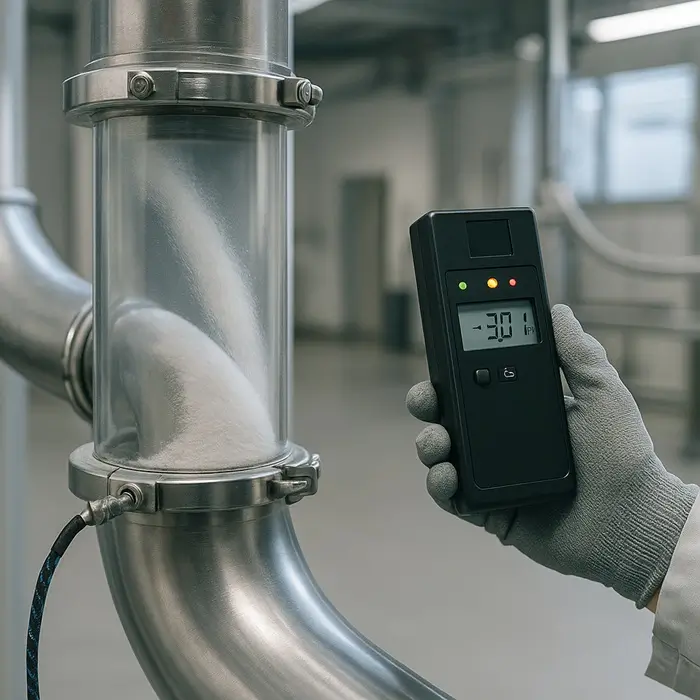
Triboelectric charging in powders during industrial handling

Triboelectric Charging in Powders: The Science, Failure Modes, and Industrial Controls

Explains how contact pairs generate charge, why polarity and magnitude vary, and how those charges affect industrial powder handling.

Charge decay time and powder handling risk

Charge Decay Time: A Fast Predictor of Powder Handling Risk

Focuses on charge persistence and why the time required for a charged powder to relax can matter downstream.

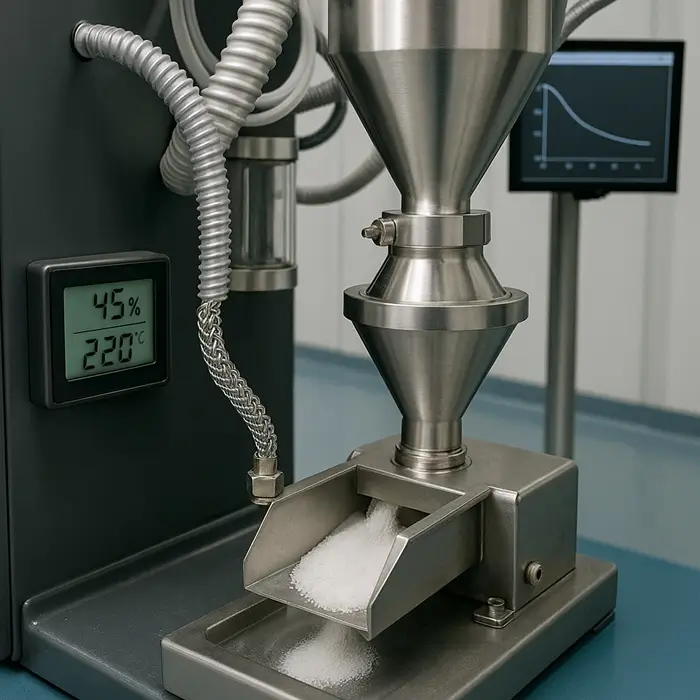
Triboelectric charging and humidity effects in powder handling

Triboelectric Charging in Powders: Why Humidity Matters

Examines how humidity changes charge generation and relaxation and why the same powder can behave differently as conditions change.

Electrostatic effects

Use the Particle Behavior child to understand charge generation, relaxation, contact-pair effects, and electrostatic interactions.

Electrostatic articles

Browse PTI articles covering tribocharging, charge decay, humidity effects, adhesion, segregation, and handling consequences.

Electrostatic testing

Use the Test Methods family to compare charge generation, relaxation, wettability, and surface-related electrostatic behavior.

Conveying & transfer

Follow the Process & Equipment child when repeated contact, transfer energy, receivers, or liners dominate the charge history.

FAQ

Electrostatic charging questions

No. Grounding is essential for controlling conductive equipment potential and discharge paths, but an insulating powder can retain charge after contact. The diagnosis still needs to separate where charge is generated, how quickly it relaxes, and whether the powder itself has an effective dissipation path.
Humidity can change surface conductivity, adsorbed moisture, and charge relaxation without changing the powder formulation. The direction and magnitude of the effect are material- and contact-dependent, so reproduce the actual humidity window rather than assuming one universal threshold.
Measure both parts of the history. First reproduce the real contact sequence and quantify the charge generated. Then measure how quickly that charge decays under representative humidity, temperature, residence time, and grounding conditions. Similar observed symptoms can arise from either mechanism.
Yes. Fine particles have high surface area relative to mass and can carry, migrate, or deposit charge differently from the coarse fraction. Size-resolved sampling or charge measurements can help determine whether a charged fine fraction is driving adhesion, segregation, or measurement drift.
Yes where practical. Triboelectric charging depends on the material pair and surface condition, so changing a liner, coating, polymer tool, pipe wall, or other contact surface can change charge polarity and magnitude even when the powder itself is unchanged.
No. Electrostatic effects can alter adhesion, deposition, segregation, feeding, and low-mass measurements without a visible discharge. Diagnose the operational symptom and charge history separately from any ignition or personnel-safety assessment.

Independent diagnostic support

Need the measurement, not just the guidance?

PowderTechnology.info works closely with <a href=”https://powdertechnology.info/delft-solids-solutions-partner/”>Delft Solids Solutions</a>, a contract research organization specializing in the physical behavior of powders and granules. DSS provides contract testing and characterization, with its laboratory working in accordance with ISO 17025. <a href=”https://www.solids-solutions.com/”>Contact Delft Solids Solutions</a>.