
Table of contents
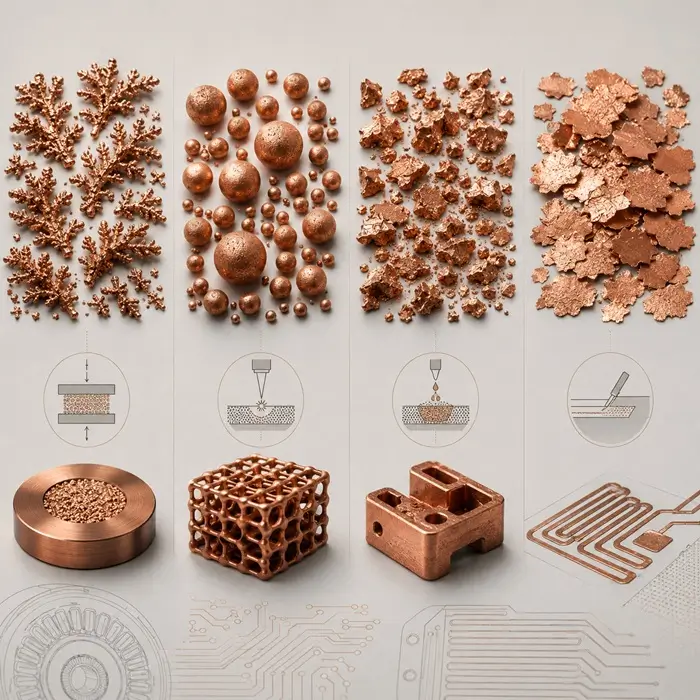
Copper powder has served powder metallurgy for over a century, but electrification is rewriting what fitness for purpose means. The same element that defines the 100% IACS conductivity baseline now arrives in four distinct morphological forms, each produced by a different route, each suited to a specific downstream process, and each with a characteristic failure mode when specified incorrectly or accepted without incoming verification.
EV drivetrain components, thermal management heat exchangers built by additive manufacturing, sintered electrical contacts, and conductive pastes for electronics all use copper powder. None of them uses the same copper powder. Treating them as interchangeable creates conductivity shortfalls, sintering failures, or process inconsistencies that do not surface until parts are in service, after thermal cycling, or in field measurement data that misses specification by a margin no process adjustment can recover.
Four Morphological Classes and Why They Exist
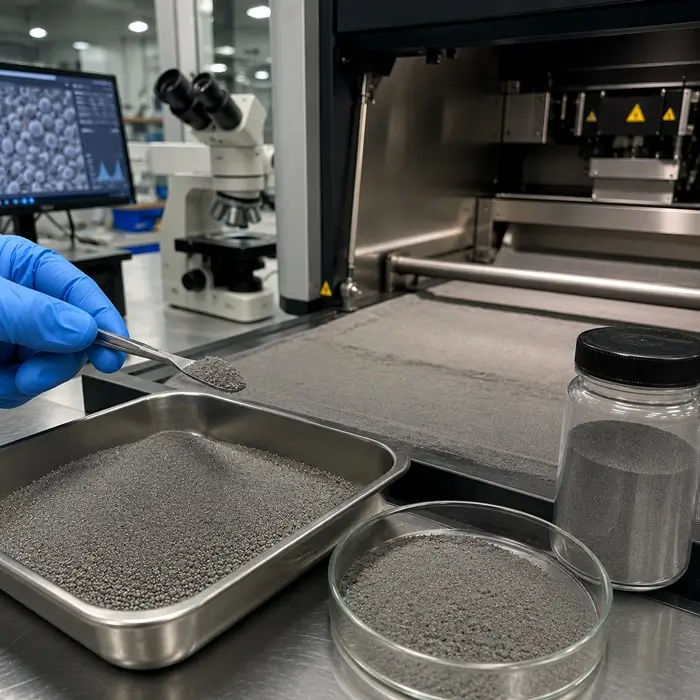
Copper powder is produced by four principal routes, and each route produces a distinct morphology. Electrolytic deposition yields dendritic particles: branched, high-surface-area structures that interlock when poured into a die. Gas atomization produces spherical or near-spherical particles with smooth surfaces and high packing efficiency. Water atomization generates irregular, nodular particles, less spherical than gas-atomized and more spherical than electrolytic, with intermediate surface area and packing behavior. Mechanical milling of copper sheets or thick foils produces flake particles with high aspect ratios and large surface areas per unit mass.
The production route determines morphology, and morphology determines which downstream processes the powder can reliably serve. This is not a matter of preference or supplier convenience. A recoater blade in a laser powder bed fusion machine cannot spread dendritic copper powder into a consistent 30-micron layer. A conductive paste formulator cannot achieve the surface area needed for low-resistivity curing from coarse spherical powder. A press-and-sinter toolmaker cannot achieve adequate green strength from a powder that does not interlock. The four classes are not grades of a single commodity; they are functionally distinct materials.
Surface area, which varies significantly across these morphology classes, also governs oxidation rate and moisture uptake rate. Dendritic and flake powders present substantially more surface per gram than spherical powders at the same nominal particle size, which accelerates surface oxide formation during storage and handling. This makes the combination of morphology and storage conditions a quality variable, not just a logistics variable.
What Each Morphology Controls in Practice
In press-and-sinter electrical contacts, dendritic morphology provides green strength through mechanical interlocking of the branched particle arms. Contacts can be ejected from the die and handled before sintering without crumbling, even at moderate compaction pressures. Controlled porosity in the sintered part is also achievable through morphology selection: the less efficient packing of dendritic powder leaves interstitial space that translates into predictable porosity when sintering conditions are held constant. For sintered contacts used in circuit breakers, relays, and switchgear, this porosity distribution affects arc erosion behavior as well as bulk conductivity.
In laser powder bed fusion, spherical morphology is not optional. The recoater or blade mechanism deposits a thin layer across the build platform before each melt pass. Irregular or dendritic particles create surface roughness in that layer, generate voids, and resist uniform spreading. The result is inconsistent local packing density, variable energy absorption, and porosity in the finished part. Metal powder feedstock quality in additive manufacturing addresses the broader relationship between powder characteristics and AM part performance across alloy systems; the same logic applies to copper, with the added complication that copper’s high reflectivity at infrared wavelengths creates independent processing challenges.
For conductive pastes used in electronic interconnects, photovoltaic metallization, and printed electronics, flake morphology provides the particle surface contact area needed for low resistivity after curing at temperatures that cannot sinter particles. Flake particles oriented parallel to the substrate create overlapping conductive networks in the cured binder matrix. Sub-micron spherical particles are used in some high-resolution paste formulations where flake geometry would interfere with fine feature resolution. In either case, morphology drives paste rheology: particle shape affects viscosity and thixotropy of the unfired paste, which determines printability and feature definition.
Binder jetting occupies an intermediate position. Non-spherical or irregular copper powders can be used in binder jetting, and in some configurations provide better binder wettability and green compact integrity than spherical powder. The debinding and sintering steps that follow binder jetting complete densification, so the morphology-green density relationship becomes the key variable to manage, rather than flowability alone.
Particle Size Distribution Targets by Application
Gas-atomized spherical copper powder for laser powder bed fusion is typically supplied in the 15 to 53 µm range, with D50 values around 25 to 30 µm. This range balances layer thickness requirements, flowability through the recoater mechanism, and packing density in the powder bed. Fines below approximately 10 µm reduce flowability, increase the surface area exposed to oxidation, and can adhere electrostatically to the recoater blade, disrupting layer uniformity precisely where the surface oxide problem is also most acute. Oversize particles above 53 µm reduce packing density and can protrude above the layer surface, causing recoater damage or inconsistent melt pool depth. Reading D10, D50, D90, fines, and oversize in process context provides a framework for interpreting these distribution parameters against process requirements.
Press-and-sinter applications for electrical contacts tolerate broader particle size distributions, often in the range of 45 to 150 µm for structural-grade parts, but fines content still matters. A controlled fines fraction improves packing by filling interstitial voids between coarser particles, increasing green density at a given compaction pressure. Excessive fines, however, degrade flowability and can cause die-filling inconsistencies, leading to part-to-part density variation in high-volume production. The role of fines in powder behavior covers this dual effect in detail.
Conductive paste formulations require much finer copper particles, typically below 5 µm and in some screen-printing applications below 1 µm. At this size regime, surface chemistry and surface area are the dominant quality variables rather than bulk flowability. Agglomeration of fine copper particles is a persistent handling problem: van der Waals forces and electrostatic interactions between sub-micron particles create agglomerates that behave as coarser particles during dispersion and paste application, breaking down only partially during mixing. Whether the dispersion step in paste manufacturing fully de-agglomerates the powder is a process-specific question that cannot be answered from the powder certificate of analysis.
Binder jetting for copper can accommodate finer powder than LPBF. Some systems operate with D50 values in the 5 to 15 µm range because the binder deposition step does not require free-flowing powder in the same sense as laser-based processes. Finer powder improves green density and supports better dimensional accuracy after sintering. The trade-off is higher surface area and thus a higher rate of oxygen accumulation during storage and handling.
Purity and the Oxidation Variable
Copper’s primary purity challenge in electrification applications is not bulk contamination; it is surface oxidation. Copper oxidizes in air at room temperature, forming Cu₂O (cuprous oxide) as the initial oxidation product. Cu₂O is a p-type semiconductor with electrical conductivity orders of magnitude below metallic copper. When copper powder particles carry a surface oxide layer into sintering or paste curing, that oxide can partially survive at grain boundaries and particle necks in the finished part. The conductivity penalty is disproportionate to the oxide volume fraction because it occurs precisely where current must cross between particles.
Experimental work on the impact of copper powder oxidation states in powder bed fusion processing has shown that oxidation, creating approximately 17 vol% Cu₂O in the copper matrix, can reduce electrical conductivity to approximately 60% IACS. This is not an edge case. It is a direct consequence of handling or storing copper powder under conditions that allow surface oxide accumulation, then processing without a reducing atmosphere step. Fundamental investigation on the impact of Cu powder oxidation states on processability by PBF-LB/M provides experimental data for the oxidation-conductivity relationship in additive manufacturing of copper.
Oxygen content thresholds matter at the specification stage. Published sintering research indicates that copper powder with oxygen content above approximately 0.15 wt% shows degraded sintering properties and reduced sinterability, while oxygen-free high-conductivity (OFHC) copper, with oxygen below 0.001%, supports the highest conductivity in finished parts. Between these limits, the tolerable oxygen content depends on the sintering atmosphere. Spark plasma sintering research on copper powders with different particle sizes and oxygen contents demonstrates that oxygen content and particle size interact in determining sintering outcome, with higher oxygen content being more damaging at finer particle sizes due to the higher surface-to-volume ratio.
Hydrogen reducible oxygen (HRO) is the fraction of total oxygen that exists as reducible oxides, primarily Cu₂O, rather than dissolved oxygen or refractory oxide phases. It is measured by exposing the powder to a hydrogen atmosphere at an elevated temperature and recording the mass loss as water vapor is released. HRO is a more informative QA metric than total oxygen alone for sintering and conductivity applications because it identifies the fraction that actively inhibits neck formation during sintering. Total oxygen content can include entrapped gas or oxide bound in forms that do not reduce under typical sintering conditions, so a powder with high total oxygen but low HRO behaves differently from one with equivalent total oxygen concentrated as Cu₂O at particle surfaces.
Beyond oxygen, purity specifications for electrical contacts in switching applications must address trace elements that embrittle copper at grain boundaries. Bismuth and lead at concentrations above a few parts per million cause liquid-phase embrittlement during sintering or high-temperature service. Sulfur reduces electrical conductivity and can form Cu₂S at particle surfaces with behavior analogous to Cu₂O. These impurity effects are distinct from oxygen control and require their own specification limits and incoming test methods, separate from the oxygen measurement.
Packing Density and the Green Density Chain
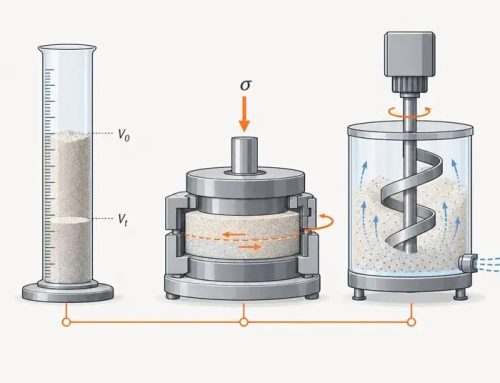
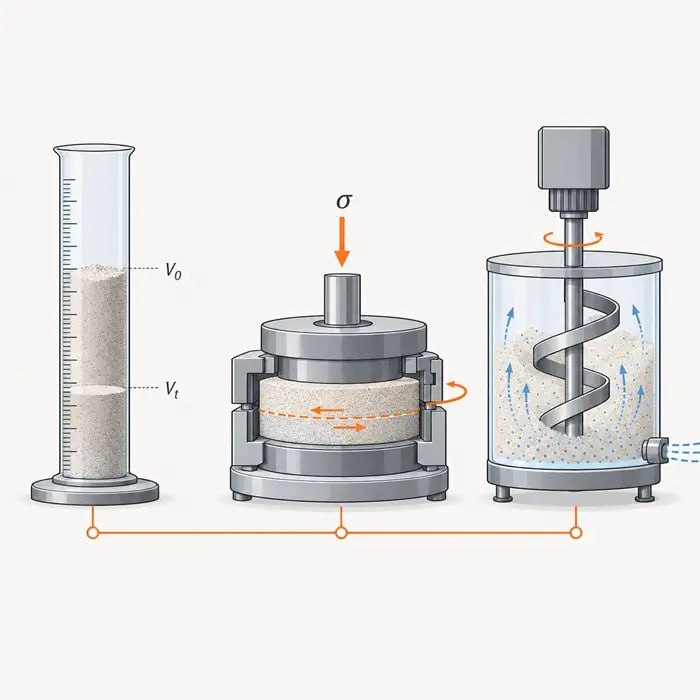
Apparent density, the density of powder poured freely into a container, and tap density, measured after mechanical tapping to a stable volume, define the range within which a copper powder can be handled and compacted. The Hausner ratio, the ratio of tap to apparent density, provides a first indication of powder flow behavior: values above approximately 1.35 typically signal cohesive behavior or constrained flow. Balancing packing density and powder flow in continuous processing covers the tension between high packing density targets and maintaining adequate flow for process reliability. Apparent density of free-flowing metal powders is standardized in ASTM B212, Standard Test Method for Apparent Density of Free-Flowing Metal Powders Using the Hall Flowmeter Funnel.
In press-and-sinter routes, the chain from apparent density through compaction to green density to sintered density is the primary quality control sequence for part performance. Green density determines how much particle contact area exists before neck formation begins during sintering. Higher green density means more contact area, shorter diffusion distances, and faster densification, leading to higher final sintered density and lower residual porosity. For high-conductivity copper contacts, residual porosity disrupts the conductive network; isolated spherical pores are less damaging than interconnected porosity of equivalent volume fraction, but both reduce the effective conductor cross-section.
Spherical gas-atomized copper powder approaches random close packing, approximately 64% of theoretical density, in the powder bed before any compaction force is applied. Electrolytic dendritic copper powder packs much less efficiently: apparent densities typically run well below 2.0 g/cm³ compared to values above 4.0 g/cm³ for spherical powder of similar particle size. The compaction ratio, the ratio of fill height to part height in the die, is therefore much larger for dendritic powder. This affects tooling design, press stroke requirements, and part-to-part density uniformity in multi-cavity tooling. Assessing powder packing density provides a broader reference for measuring and interpreting packing density across powder types.
For laser powder bed fusion, powder bed packing density affects laser energy absorptivity and the thermal environment of the melt pool. A more uniformly packed bed transfers energy more predictably and produces more consistent melt pool behavior. Inconsistent packing, caused by bimodal particle size distributions, mixed morphology, or electrostatic effects from fine dry particles, creates local absorptivity variation that translates into porosity in the finished part. This is one reason that incoming PSD and morphology verification for LPBF copper powder is a process requirement, not an optional QA step.
QA Challenges Specific to Copper Powder
Copper powder oxidizes during storage, and the rate depends on morphology, particle size, humidity, temperature, and packaging atmosphere. High-purity spherical copper for LPBF is typically packaged under inert gas and should remain sealed until shortly before use. Dendritic copper for sintering, with its higher surface area, is more susceptible to atmospheric oxidation. When powder has been stored for an extended period or when packaging integrity is uncertain, incoming oxygen measurement is necessary. The certificate of analysis oxygen value reflects the powder at the time of production and shipment, not at the time of receipt. Powder certificate of analysis versus reality addresses this gap directly.
Particle size measurement by laser diffraction presents specific challenges for copper powder. Copper’s density of 8.96 g/cm³ causes rapid sedimentation in wet dispersion media, which can bias the measurement toward finer particles if acquisition is too slow relative to settling. Dry dispersion with compressed air must be carefully controlled because fine copper particles are susceptible to electrostatic charging during dispersion, causing agglomerate formation that is reported as coarser particles in the distribution. Both wet and dry methods are used in practice; the method must be documented, applied consistently, and compared against sieve data where distribution tails are critical to the process. Laser diffraction troubleshooting: pressure titration for reliable PSD; covers dispersion-state verification for dry measurement.
An incoming test panel for copper powder used in electrification applications should cover at minimum: PSD by laser diffraction with method fully documented, apparent density and tap density, oxygen content by inert gas fusion, BET surface area for fine or dendritic powders, and morphology verification by SEM on a representative sample. For LPBF applications, the flow rate of the Hall flowmeter should be included as a process-relevant indicator. Surface passivation coatings applied by some suppliers to reduce oxidation during shipping must be declared, and their burnout behavior characterized: residual carbon from organic passivants can affect sintering and reduce conductivity in high-purity contact applications.
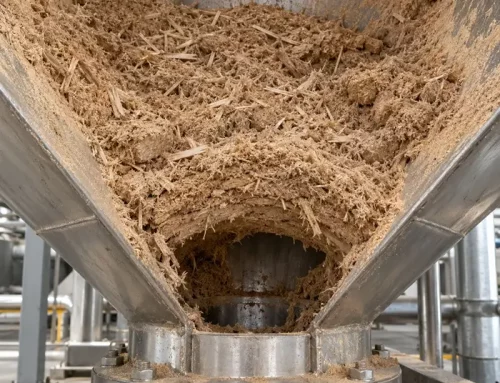
Segregation during sampling is a practical concern for copper powder in large bags or containers. Particle size segregation during filling and transport concentrates fines at the bag center or top and coarser particles toward the walls or bottom, depending on fill pattern. A single sample from the top of a bag is not representative of the bulk. Representative sampling from multiple depths and locations, composited before measurement, is the minimum required to produce a test result that reflects what the process will receive. Representative powder sampling: a practical guide covers composite sampling methodology in detail.
Specifying Copper Powder for Electrification Applications
A functional specification for copper powder in electrification applications starts with morphology class, not particle size or purity. Morphology determines process compatibility and narrows the manufacturing routes that can supply the powder. Once morphology class is fixed, PSD requirements define the acceptable size window, with D10, D50, D90, and fines limits set to process-relevant values rather than defaults from a generic datasheet. Purity specification follows, with oxygen content limit, HRO limit where relevant, and named limits for embrittling trace elements in contact applications. Packing density, expressed as apparent density range and Hausner ratio limit, closes the specification by confirming that the powder will fill tooling, flow through feeders, or spread in a powder bed within the process window.
This sequence reflects a technical hierarchy. Morphology controls what is possible; PSD controls what is practical; purity controls what the finished part can achieve; packing density confirms that the process can handle the powder reliably. When a copper powder fails in service, the root cause often traces back to a specification written in the wrong sequence: purity or PSD defined before morphology was confirmed for the process, or packing density never specified because it was assumed consistent within a named product grade. Across the range of electrification applications, incoming QA is the point where specification fidelity is tested before powder enters the process.
Copper powder specification by electrification application
No single copper powder specification fits all electrification routes. Each application places a different constraint on morphology, particle size distribution, surface oxidation, and packing behavior. A spherical powder that spreads well in laser powder bed fusion may not provide enough green strength for sintered contacts, while a dendritic contact powder may fail immediately in a recoater-based process.
The table below translates those differences into practical specification logic. It connects each application to the preferred morphology, the main powder variable, the QA checks that matter, and the failure mode that can occur when copper powder is specified too generically.
| Application | Preferred copper powder morphology | Main powder variable | What QA should confirm | Failure mode when specified incorrectly |
|---|---|---|---|---|
| Laser powder bed fusion heat exchangers and electrical components | Gas-atomized spherical or near-spherical powder | Narrow PSD, low fines content, stable oxygen level, good flowability | D10, D50, D90, fines, oversize, Hall flow, oxygen content, morphology by SEM | Poor spreading, recoater disturbance, inconsistent powder bed density, porosity, reduced conductivity |
| Press-and-sinter electrical contacts | Electrolytic dendritic powder | Green strength, controlled packing, reducible oxygen, trace impurity limits | Apparent density, tap density, green density response, HRO, total oxygen, bismuth, lead, sulfur | Weak green compacts, unstable porosity, poor sintering, grain-boundary contamination, conductivity loss |
| Binder-jetted copper parts | Irregular or moderately flowable powder, often water-atomized | Binder compatibility, green compact integrity, sintering response | PSD, apparent density, tap density, morphology, oxygen content, sintered density | Fragile green parts, non-uniform shrinkage, residual porosity, poor final conductivity |
| Conductive pastes and printed electronics | Flake powder or fine spherical powder, depending on resolution target | Surface area, dispersion behavior, paste rheology, oxide condition | Particle size, BET surface area, agglomeration state, oxygen content, surface treatment | Poor print definition, unstable viscosity, incomplete conductive network formation, high cured resistance |
| EV motor components and high-conductivity sintered parts | Morphology selected around the forming route, often spherical or dendritic depending on process | Conductivity after forming, sintering density, oxygen control | PSD, packing density, oxygen, HRO, sintered density, electrical conductivity | Parts meet shape specification but miss conductivity, thermal, or durability requirements |
| Incoming powder qualification across all routes | Application-specific, not generic “copper powder” | Fit between morphology, PSD, purity, and packing behavior | Representative sampling, documented PSD method, density testing, oxygen testing, SEM verification | A powder passes the certificate of analysis but fails in the actual process |