
Table of contents
A Kst value arrives on a test certificate and gets entered into a venting calculation. A vent area comes out. Most engineers at this point move on. Within defined limits, that sequence is sound engineering practice. But what the number represents, what test conditions produced it, and where those conditions diverge from real plant geometry are questions the certificate rarely answers.
Kst is the deflagration index for dust explosions, derived from the maximum rate of pressure rise recorded in a standardized closed vessel and normalized to a 1 m³ reference volume using the cubic law. In Europe, measurement follows EN 14034; in North America, ASTM E1226. These results feed the explosion venting and suppression calculations that appear in design documentation across almost every industry handling combustible powder. What the test actually assumes, and what it cannot capture, defines the limits of that calculation.
This article examines what the test actually measures, why Pmax belongs alongside Kst in any complete explosion characterization, how the cubic law constrains the applicability of those results, and where real process conditions systematically diverge from the laboratory. Kst-based design, applied correctly within its defined applicability boundaries, is sound and well-validated engineering. The risk is in not recognizing where those boundaries are, or in treating a certificate value as a universally applicable design input regardless of process geometry, turbulence level, or material condition.
What the 20-Litre Sphere and 1 m³ Vessel Actually Capture
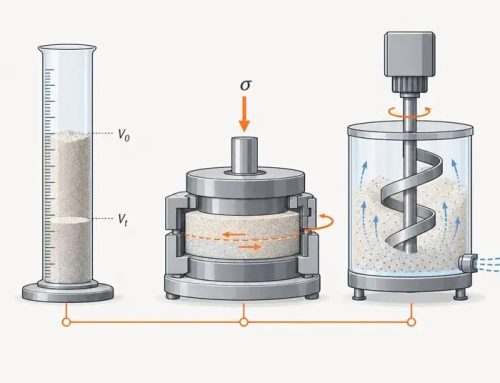
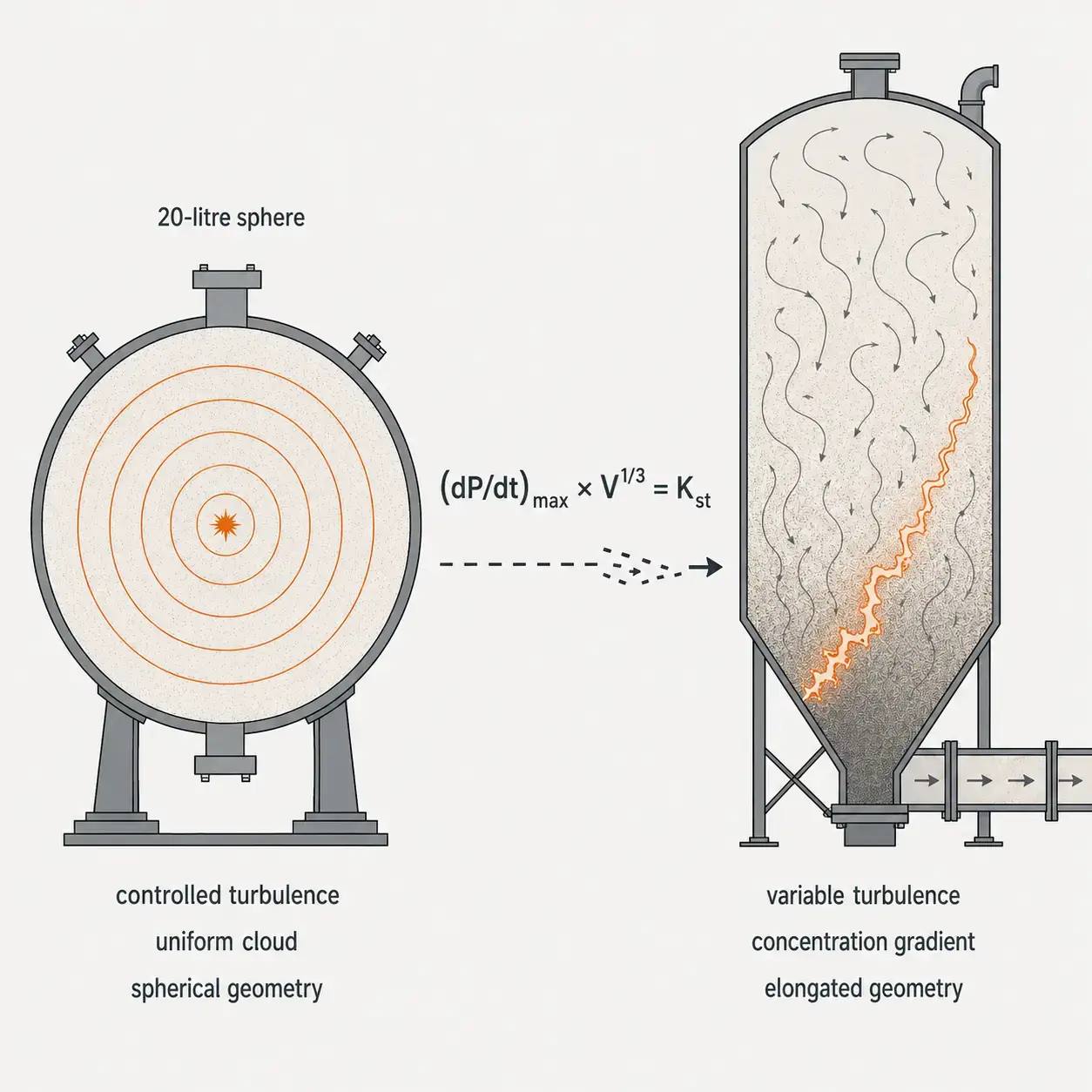
The 20-litre sphere disperses a weighed dust sample into a closed spherical vessel using a pressurized air blast through an annular nozzle. After a fixed ignition delay of typically 60 ms, a chemical igniter fires the cloud. The test records the maximum explosion pressure Pmax and the maximum rate of pressure rise (dp/dt)max. Kst is then calculated as (dp/dt)max multiplied by V to the power of one-third, where V is the vessel volume in cubic meters. The cubic law assumes spherically symmetric flame propagation from a central ignition point into a uniformly dispersed, uniformly turbulent cloud. Those conditions are reproducible in a laboratory. They are not descriptive of most industrial processes. Results are classified by explosion class: St1 (Kst 1 to 200 bar·m/s), St2 (201 to 300 bar·m/s), and St3 (above 300 bar·m/s), with St0 indicating no propagating flame under the test conditions.
The standard requires that explosion characteristics be measured across a range of dust concentrations to identify the most explosive condition, the concentration at which Kst and Pmax reach their peak values. This optimum concentration is what appears on the certificate. In a real process vessel, the actual dust concentration during an upset or filling event may be substantially higher or lower than the test optimum, and explosion severity will vary accordingly. A vessel where dust is only dispersed in the headspace above a settled bed presents a different scenario than one where the entire volume is uniformly suspended. A conveying line where concentration varies along the pipe length presents a different scenario again. The certificate captures one well-defined point on the explosion response curve, not the full range of conditions a process may produce.
The ignition energy used in the standard test is defined by the test method and is intended to ensure reliable ignition without excessively amplifying the result. For process conditions involving high-energy ignition sources, hot surfaces, mechanical impact sparks from hard particle contacts at high velocity, or electrostatic discharges from highly insulating powders, the effective response of the material may differ from what the standard igniter produces. Sample preparation introduces a separate set of effects: material that has been dried, sieved to a narrower size fraction, or equilibrated at a controlled humidity before testing will produce a Kst that may not match the behavior of the same material in its actual process state. These are not failures of the test method. Standardization is what makes results comparable across laboratories and materials. There are constraints on applicability that the engineer interpreting the certificate must understand.
Pmax and the Structural Side of Explosion Severity
Kst describes the rate at which pressure builds in a deflagration. Pmax describes the maximum pressure that would be reached in a fully confined, unvented explosion of the same material at the optimum concentration. Both parameters are required for protective system design. Kst drives the minimum vent area needed to limit the rate of pressure rise to a tolerable level. Pmax establishes the upper pressure bound against which the structural resistance of the vessel must be assessed. A vent calculation that uses Kst without cross-referencing Pmax against the vessel design pressure is working with an incomplete picture. Some materials with modest Kst values, comfortably within the St1 class, carry a Pmax that imposes meaningful structural demand even with an adequately sized vent. Others with high Kst values may produce a Pmax that the vessel structure can accommodate within normal design margins. The two parameters address different aspects of the same event, and neither is sufficient without the other.
Hybrid mixtures introduce a further dimension that a single-material dust certificate does not address. When a combustible dust is suspended simultaneously with a flammable vapor or gas, as occurs in facilities where solvent use, coating operations, or drying processes coexist with powder handling, the combined explosion behavior can produce both higher Pmax and higher Kst than either component tested individually. The presence of even a relatively small vapor concentration near the lower explosive limit can substantially change the explosion characteristics of a dust cloud that, in isolation, would be characterized by the certificate value. This is a recognized hazard class addressed in NFPA 68 and in the European venting standards, and it represents a process scenario where the dust-only Kst certificate is not the correct starting point for design.
Where the Cubic Law Breaks Down in Industrial Reality
The cubic law scales reliably between the 20-litre sphere and the 1 m³ reference vessel when material properties, dust concentration, and turbulence conditions are comparable across both geometries. That comparability breaks down in real plant conditions. Industrial vessels are not spherical. Elongated hoppers, silos, cyclones, and conveying lines support pressure wave dynamics and pre-compression effects that spherical scaling does not capture. Partial filling, stratified dust concentration, or locally enriched zones in a real vessel produce flame behavior that a uniform test cloud does not replicate. The 20-litre sphere also tends to yield higher Kst values than the 1 m³ vessel for the same material, because the smaller volume retains more turbulence at the moment of ignition. This difference is not trivial for turbulence-sensitive materials, and it is part of the broader discussion of the search for universal dust explosivity criteria that has occupied the research community for decades.
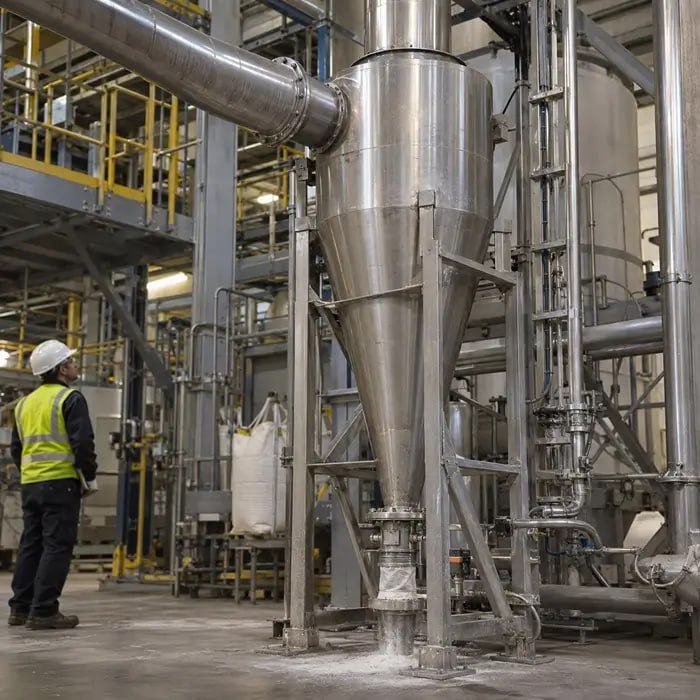
One of the most consequential departures from cubic law assumptions occurs when process vessels are interconnected. When a deflagration initiates in one enclosure and propagates through connecting ductwork into an adjacent vessel, the receiving vessel is pre-compressed by the arriving pressure wave before its suspended dust cloud ignites. This pressure piling effect raises the effective initial pressure above atmospheric, and since maximum explosion pressure scales with initial pressure, the resulting explosion severity in the downstream enclosure can substantially exceed what the certificate values would predict for either vessel operating independently. Process plants where hoppers, silos, cyclones, bag filters, and collection bins are linked through common ducting are exposed to this mechanism as a matter of standard configuration. Explosion isolation (chemical barrier suppressors, fast-acting valves, or rotary valves rated for isolation duty) exists precisely because interconnected geometry places the real explosion outside the boundaries of any single-vessel cubic law calculation.
Elongated vessel geometry introduces a further class of problem that the cubic law does not address. In a sphere, the flame front expands symmetrically, and the propagation geometry is predictable at each stage. In a tall silo, a vertical riser, or a transfer duct with a high length-to-diameter ratio, the flame front propagates axially through a path that allows for turbulent self-acceleration as it advances. Turbulence generated by the expanding flame feeds back into the unburned cloud ahead of the front, increasing the flame surface area and accelerating the rate of pressure rise beyond the initial conditions. For high-reactivity materials in severely elongated confinement, this mechanism produces explosion behavior qualitatively different from what the spherical propagation model predicts. In such configurations, specialist assessment is required rather than the direct application of the standard venting calculation with an increased vent area.
Turbulence Is the Dominant Hidden Variable
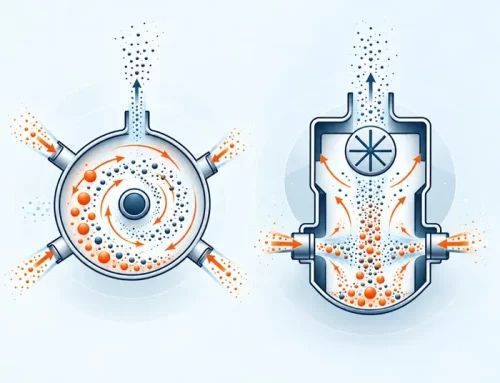
Turbulence at the moment of ignition is the single most significant factor separating lab test behavior from real explosion behavior. In the 20-litre sphere, turbulence generated by the dispersion blast decays over the ignition delay period, leaving a moderately turbulent cloud at the moment of firing. In a mill, a grinder, an agitated reactor, or a pneumatic conveying system running at high velocity, turbulence at ignition can be substantially higher. Greater turbulence increases flame surface area and accelerates the rate of pressure rise well beyond what the certificate Kst would indicate. Using an uncorrected lab Kst as the sole design input for a high-turbulence process is not conservative; it may underestimate actual explosion severity. The fines content in the powder population compounds this: fine particles respond more sharply to turbulence-driven flame acceleration, and fines content in the process often differs from the tested sample.
Industrial powder equipment spans a much wider range of turbulence conditions than the standardized test represents. Passive discharge from a silo into a receiving vessel under gravity, without mechanical agitation, maintains relatively low turbulence at the point where ignition is most credible, conditions closer to the test assumption than most other process scenarios. At the other end of the range, size reduction equipment such as hammer mills, pin mills, and jet mills operates at turbulence intensities that have no analog in the sphere test environment. Pneumatic conveying at high transport velocities generates turbulence at every bend, expansion, and valve, and the dust cloud in an active conveying line is never in the quiescent, uniformly dispersed state that the cubic law assumes. The critical question in any hazard assessment is whether the credible ignition scenario occurs in a low-turbulence or a high-turbulence environment. That answer determines whether the certificate Kst can be applied directly or whether it requires correction or supplementary analysis.
The moisture content of the material in process introduces a systematic effect that operates independently of turbulence. Standard testing is typically performed on material that has been dried or equilibrated to a specified condition. If the actual process material carries higher ambient moisture, as is common in food processing, wet granulation operations, or humid geographic or seasonal conditions, explosion severity in a real event will generally be lower than the dry-sample test result suggests, and the test is conservative in this direction. However, if the process operates on material that is meaningfully drier than the test sample, as when operating downstream of a spray dryer, in a heated pneumatic conveying system, or in extended storage in a dehumidified environment, the actual hazard may exceed the certificate value. Evaluating the moisture condition of the process material against the moisture condition of the tested sample is a necessary step in applying a Kst certificate to a real design, and that comparison rarely appears explicitly on the certificate itself.
When Kst Is Sufficient, and When a Competent Person Must Go Further
For enclosed equipment operating at low to moderate turbulence, within the applicability limits of a recognized standard (NFPA 68 for venting in North America, EN 14491 in Europe), Kst-based calculation is a valid and well-supported engineering approach. Those standards define vessel volume limits, design overpressure ranges, and implicit turbulence assumptions that govern where the method applies. Used correctly within those boundaries, Kst-based sizing is appropriate.
Beyond those boundaries, the number on the certificate is not sufficient by itself. Treating Kst as a universal input regardless of process conditions is how vent sizing errors occur: not in the arithmetic, but in the selection of inputs. A competent person in explosion protection needs to assess the specific geometry, turbulence level, ignition scenario, and material condition before transferring a lab result into a design. The work of controlling airborne dust generation that creates the hazard in the first place is addressed in managing powder dustiness in industrial plants, and the broader regulatory and practical framework is covered in dust explosion risks and safety protocols.
A common and underappreciated source of error is the use of Kst values from published dust explosion databases in place of testing the specific material in production. Database compilations aggregate results from many sources, using different sample preparations, ignition energies, size fractions, and moisture conditions. An entry for a named material category, such as wheat flour, polyethylene, or aluminum powder, encompasses a range of grades, processing histories, and particle size distributions. The certificate value that results from testing a specific production lot at process-relevant conditions will often differ from the database value, and the direction of that difference is not predictable without testing. For materials where the Kst classification boundary matters for protective system selection, for instance, material near the St1/St2 boundary, using a database value without material-specific testing introduces a classification risk that may not be visible in the design documentation.
Where process conditions exceed the stated applicability limits of the standard method, a more complete explosion safety assessment draws on supplementary tools. Turbulence correction approaches, modified test conditions intended to better represent the process environment, consequence modeling specific to the actual vessel geometry, and flame transfer analysis for interconnected systems are all part of the specialist toolkit. The regulatory frameworks governing this, including NFPA 652 on the fundamentals of combustible dust alongside NFPA 68 in North America and the ATEX directives with their supporting CEN standards in Europe, do not treat a Kst certificate as a complete design input for every scenario. They define a methodology within which test results are one element. Knowing where the standard calculation applies, and where it requires supplementary analysis by a qualified person, is as important as knowing how to perform the arithmetic correctly.
Red Flags That Kst Alone Is Insufficient for Design
- Process equipment includes high-turbulence zones: mills, grinders, agitated reactors, or high-velocity pneumatic conveying
- Vessel geometry is elongated, or equipment is connected by ducting that could transfer a flame front between enclosures
- Vessel volume or design pressure falls outside the applicability limits stated in the venting or suppression standard
- Particle size distribution or moisture content in the process differs meaningfully from the sample used in testing
- The Kst value is sourced from a published general database rather than a test of the specific material in its current processing state
- Ignition scenarios include potential sources with energy substantially higher than the standard test assumption
- Process conditions involve simultaneous presence of combustible dust and flammable vapor or gas, creating a hybrid mixture scenario not covered by the dust-only certificate