
🔑 Key Takeaway
Growing aerospace PBF-LB capacity means more powder is moving through repeated recovery, sieving, replenishment, and reuse cycles. The virgin-to-reused blend ratio has therefore become a controlled qualification input rather than a housekeeping choice. However, the ratio alone does not describe the powder population. PSD shift, satellite content, morphology, oxygen and nitrogen pickup, and exposure history do not change together or at the same rate. A single PSD or flowability result can screen a candidate blend, but acceptance ultimately depends on whether the powder and resulting build remain within a qualified feedstock and process envelope appropriate to the component’s criticality and stress state.
Table of contents
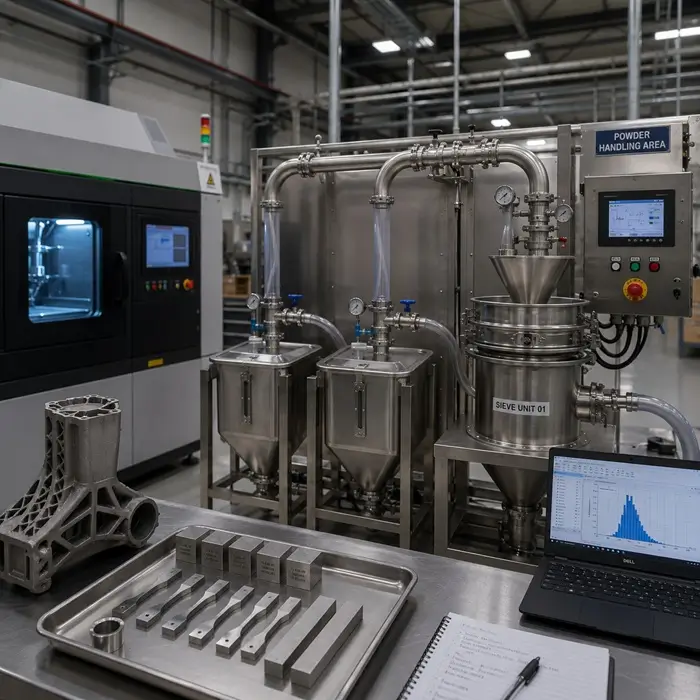
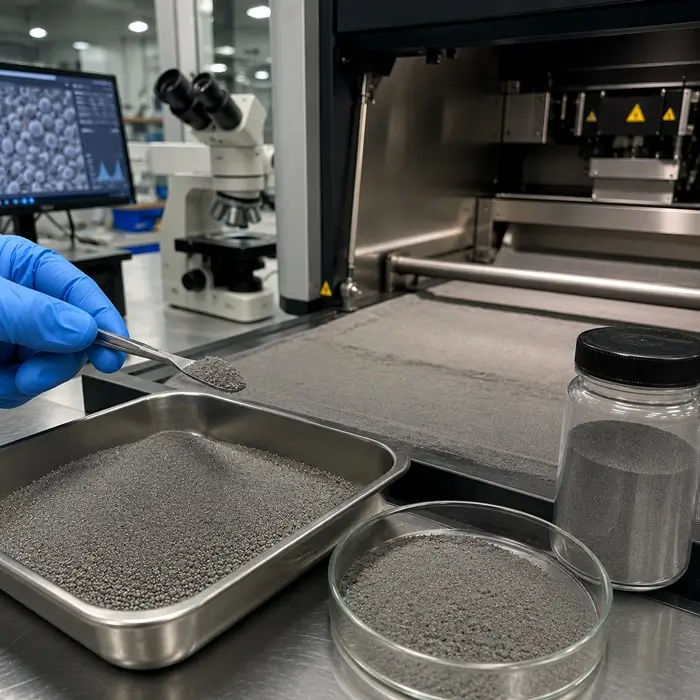
A virgin-to-reused blend ratio such as 50:50 appears precise, but it does not reveal how many build exposures the reused fraction has experienced, where the powder was recovered, how it was replenished, or whether its chemistry and particle condition remain within the qualified feedstock envelope. As aerospace PBF-LB production expands through larger build volumes, multiple lasers, faster recoating systems, and higher throughput, more powder moves through repeated recovery, sieving, storage, and reuse before it reaches a part. The blend ratio therefore becomes more than a material-yield decision. It becomes a process variable that the qualification program must define and control.
The difficulty is that a blend ratio does not represent one property drifting in one direction. Particle size distribution, satellite particle content, particle morphology, and interstitial oxygen and nitrogen levels can all change with reuse, but they change at different rates, through different mechanisms, and not always together. Two blends with the same nominal virgin-to-reused ratio may contain very different powder populations because their reuse histories, replenishment strategies, and exposure distributions differ. A powder lot that passes a particle size distribution or flowability check may therefore still contain particle or chemistry changes that affect the resulting defect population under the stress state a specific part experiences. This article examines what changes in reused PBF-LB powder, why one powder test cannot establish qualification on its own, and where the blend-ratio decision should sit within a controlled powder-management and process envelope.
Why the Blend Ratio Became a Qualification Variable, Not a Housekeeping Choice
Blending unused (virgin) powder with recovered (reused) powder from prior builds has long been standard practice in PBF-LB, largely for material cost and yield reasons. Powder that survives a build without being fused is swept, sieved, and reintroduced, often mixed with fresh material rather than used alone. In some production environments, the ratio was historically managed through supplier guidance, internal practice, or fixed replenishment rules rather than an explicitly part-linked qualification rationale.
That approach is harder to justify as reuse volumes grow. ISO/ASTM 52928:2024 now addresses powder life cycle management specifically, covering how virgin and used metal powders should be tracked and controlled through repeated cycles, building on the characterization scope already set out in ISO/ASTM 52907:2019 for feedstock metal powders. ASTM F3049 supplies the broader reference list of test methods a producer or purchaser can draw on to characterize a metal AM powder in the first place. The existence of a dedicated life-cycle-management standard is itself a signal that the industry no longer treats reuse as a background housekeeping question.
None of these documents assign a specific virgin-to-reused ratio. They establish what should be measured and tracked, not what number is acceptable for a given application. The blend ratio is a controlled input, but it is not a sufficient description of the powder population. Powder genealogy, exposure distribution, replenishment strategy, and lot traceability determine what that ratio actually means. The qualification decision therefore sits not in the ratio alone, but in whether the resulting powder condition remains within a defined and traceable feedstock and process envelope. The broader relationship between powder condition and part performance is discussed in Metal Powder Feedstock Quality in Additive Manufacturing, while Sustainable Powder Metallurgy: Powder Reuse, LCA, and Circular Manufacturing examines the issue from a lifecycle and circularity perspective.
What Actually Changes in a Powder Lot Across Reuse Cycles
Reuse does not degrade a powder lot uniformly. Several distinct mechanisms operate at once, and each one has a different practical signature.
Particle Size Distribution Shift
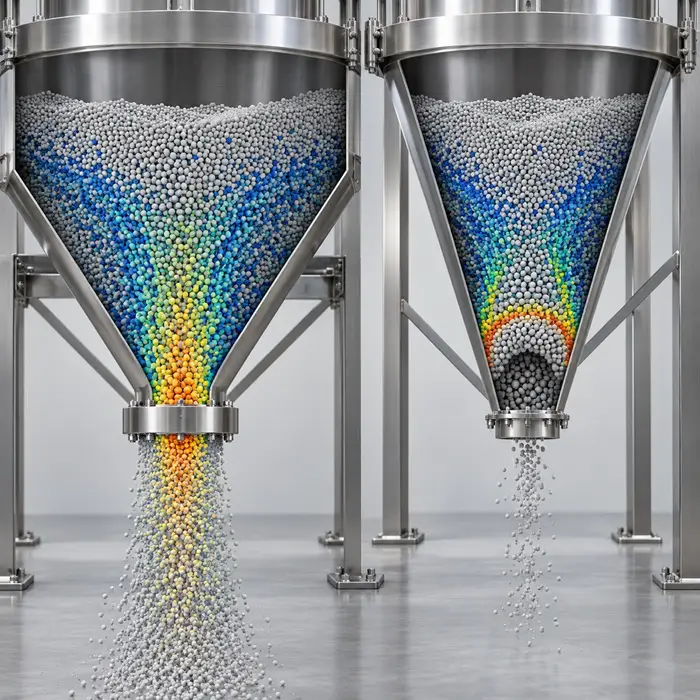
Recoating and sieving are not perfectly efficient separation steps. Fine particles can be preferentially lost to dust collection or left adhered to larger particles, while spatter generated during melting introduces new particles, some coarser and some finer than the original distribution. The net direction of PSD shift is not fixed across every system: some studies report a modest coarsening trend with reuse, while others report a widening of the distribution toward both tails. What is consistent is that the distribution can change shape, not just its mean. A shift in D10 or fines content has direct implications for packing density and melt-pool stability, discussed in more depth in Particle Size Distribution Interpretation and Fines in Powder Behavior: Why Small Amounts Matter.
Satellite Particle Formation and Accumulation
Satellite particles, small fragments attached to the surface of a larger particle, originate partly during gas atomization itself. Research on electrode induction melting gas atomization shows that satellites can form when particles recirculated by the gas flow collide with newly atomized particles that remain partly molten (<a href=”https://www.mdpi.com/1996-1944/16/6/2499″>Wu et al., <em>Materials</em></a>).
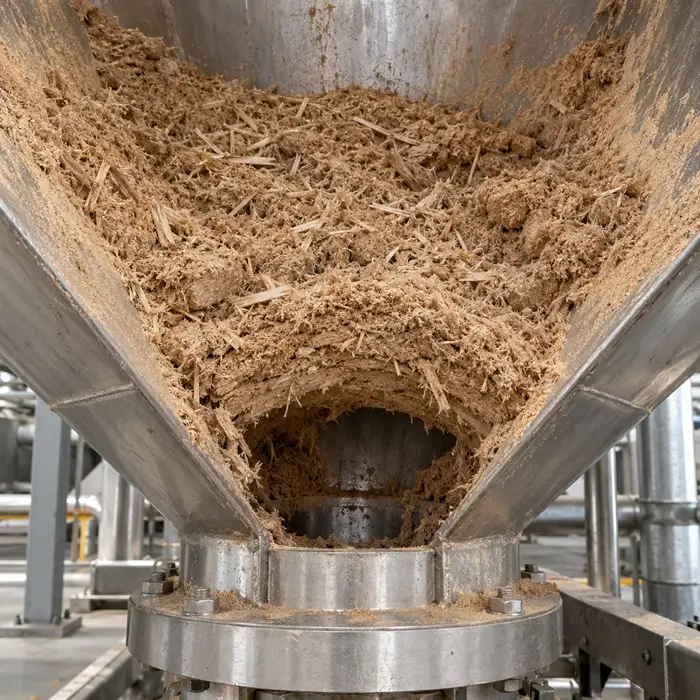
In reused powder, satellite content is not fixed at the atomizer. Repeated thermal exposure near the melt pool can promote partial sintering between fine and larger particles, while recaptured spatter can add irregular or partially fused material to the recovered powder population. Because satellite-rich or irregular particles can impair spreading, packing, and local layer uniformity, an increasing satellite fraction is a supporting indicator of reuse-related powder-condition change, not a direct measurement of the porosity that will form in the finished part.
Morphology and Sphericity Drift
Sphericity and overall particle morphology may drift with reuse cycles, though the direction and magnitude reported across studies of Ti-6Al-4V PBF-LB reuse are not identical. Some report a trend toward less spherical, more irregular particles alongside changes in oxygen content and mechanical properties, while others report that particle size shifted without a meaningful change in sphericity. This variability across studies is itself informative. It indicates that morphology drift depends on the specific machine, atmosphere control, and recoating hardware in use, not on reuse cycle count alone. A blend-ratio decision built on one published reuse curve from a different machine and material system is a weak basis for a specific qualification. Flow-relevant consequences of morphology change are covered in Powder Flowability: Factors and Measurement Techniques, while Laser Spheroidization of Titanium Powders discusses a separate route for deliberately reshaping titanium feedstock.
Chemistry Drift: Oxygen and Nitrogen Pickup
Interstitial oxygen and nitrogen pickup during handling and build exposure is one of the better-documented reuse effects for Ti-6Al-4V. A recent repeated-reuse study reported oxygen content exceeding the applicable alloy specification after more than six reuse cycles under the conditions tested, alongside reduced elongation and localized inclusion formation. This is a study-specific finding tied to a particular powder, machine, reuse protocol, and atmosphere-control regime, not a universal cycle count that applies to every facility or alloy. It is still a useful signal that chemistry drift can become limiting before morphology or flowability differences become visually or numerically obvious. That is part of why oxygen and nitrogen tracking is treated as a distinct measurement axis in finished-part specifications such as ASTM F3302 for titanium alloys processed by powder bed fusion.
Why a Single PSD or Flowability Check Cannot Substitute for Re-Qualification
A common shortcut is to run one particle size distribution scan or one flowability measurement on a reused lot, compare it with the virgin powder specification, and treat a passing result as clearance to proceed. This treats a supporting indicator as a determining criterion, and the gap between those two levels is where risk accumulates.
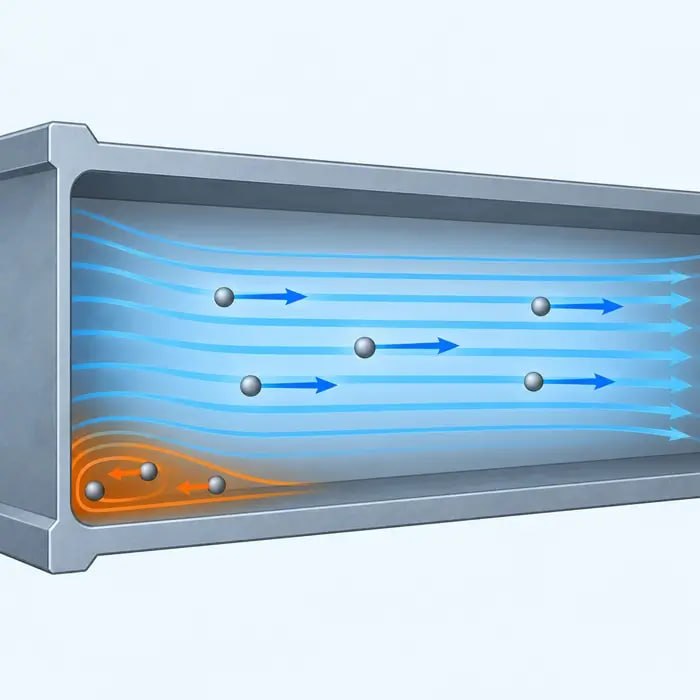
Several limits work against the shortcut. First, sample representativeness: a reused powder lot may contain unevenly distributed populations of fines, satellites, and spatter-derived particles, so a small analytical sample may not capture the tail of the distribution that matters most for defect formation. Practical guidance on avoiding this pitfall is covered in Representative Powder Sampling: A Practical Guide and Overview. Second, detection limits and method sensitivity: laser diffraction PSD and bulk flow indices such as the Hausner ratio are bulk-average measurements, and they are not designed to flag a low-concentration population of satellite particles or a narrow band of oversize agglomerates that may disrupt spreading, local packing, or melting even when the bulk result remains within specification. The interpretive limits of these bulk ratios are discussed in Hausner ratio and Carr Index: What the Numbers Tell You and Where They Break Down, while shear-based flow characterization is discussed in Shear Cell Testing: The Key to Understanding and Controlling Powder Flow.
Third, and most fundamentally, a PSD or flow result on the powder says nothing directly about the resulting defect population inside a printed part or about how that defect population interacts with the stress state the part will actually see in service. A powder check is a decision input. It supports a go or no-go call alongside build parameters, atmosphere control, and post-build inspection, but it is not, by itself, a determining criterion for whether a given blend ratio is acceptable for a specific application.
Tying the Blend Ratio Decision to the Part’s Stress State
The same reused powder lot can be acceptable for one part and unacceptable for another because the consequence of a given defect population depends on where and how the part is loaded. A statically loaded bracket with generous margin may be less sensitive to a given defect population than a rotating or high-cycle-fatigue component, where a single subsurface pore near a stress concentration can initiate a crack. This is the reasoning behind finished-part specifications such as ASTM F3302 linking process control back to the mechanical property requirements of the intended application rather than defining powder acceptance in isolation from part function.
In practice, the blend-ratio decision needs at least two inputs working together: the powder-level characterization described above and a defect-tolerance assessment for the relevant part geometry and loading condition, informed by porosity and defect-population data from representative test coupons or from the part itself. Where a component is fatigue-critical, a blend-ratio change outside the qualified powder-management and process envelope may require representative-build or mechanical-test evidence from the candidate blend because a powder-only pass does not establish that the resulting microstructure and defect population meet the requirements for that stress state.
A blend ratio validated on one machine, build configuration, or part family should not automatically be transferred to another application using the same feedstock. Changes in build geometry, plate location, recoating conditions, machine atmosphere, and process settings can alter how powder condition translates into porosity and other defects, as discussed in The Ultimate Guide to Porosity in Powders. Process and storage history between builds can also affect powder behavior, as explained in Powder Memory: How Processing History Affects Behavior. The acceptable ratio should therefore remain within a qualified powder-management and process envelope whose supporting evidence is appropriate to the component’s criticality, loading condition, and defect tolerance. A change outside that envelope may require additional representative-build testing or requalification rather than acceptance based on the nominal blend ratio alone.
A Practical Framework for Blend Ratio Decisions
None of this produces a single defensible number that applies across facilities, alloys, or machines. What it does support is a structured way to weigh the inputs rather than relying on one bulk measurement.
Particle size distribution comparison against the virgin baseline is a useful early screen for gross shifts in fines content or the oversize tail, but it does not reveal satellite content, chemistry drift, or defect-forming subpopulations on its own. Morphology imaging, typically SEM-based, adds direct visual evidence of satellite accumulation and sphericity change, but it is limited by the small number of particles a typical image set can practically cover relative to a full production lot. Oxygen and nitrogen analysis is comparatively sensitive to chemistry drift and directly relevant to embrittlement risk in titanium alloys, but it says nothing about the physical defect population. Flowability and packing measurements support process-consistency arguments during the build itself, but they are indirect with respect to final part porosity. Representative-build evidence from the candidate blend, which may include density measurement, metallography, computed tomography, mechanical testing, fatigue testing, or part-level inspection, connects powder condition to the requirements associated with the part’s stress state. A powder-only screen cannot make that connection on its own.
A workable decision sequence uses the cheaper, faster powder-level checks to catch gross problems early and determine whether the candidate blend remains within the qualified powder-management and process envelope. Where additional evidence is required, representative-build or part-level data should address the specific qualification question. If acceptance rests only on a PSD or flowability result, the record supports a screening decision, not a validated qualification decision.