
Table of contents: sustainable powder metallurgy

Sustainable powder metallurgy is often presented as a cleaner alternative to conventional metal manufacturing. That claim can be valid, but it needs technical boundaries. The sustainability benefit does not come from powder alone. It comes from material efficiency, controlled reuse, efficient consolidation, qualified recycling, and reliable life-cycle assessments.
The strongest powder metallurgy routes preserve material value without creating a larger energy or quality burden elsewhere. That is why circular manufacturing depends on measured powder condition, not recovery alone.
Sustainable Powder Metallurgy Starts With Material Efficiency
Sustainable powder metallurgy begins with a simple advantage: more of the starting material can end up in the final part.
Conventional metal manufacturing often starts with more material than the component requires. Casting, forging, milling, and machining can all remove or reshape large amounts of metal before the final geometry is reached. Those chips, offcuts, and scrap streams may be recycled, but recycling does not erase the energy already spent on melting, forming, transporting, cooling, cutting, and handling the material.
Powder metallurgy follows a different logic. Metal powder is compacted, molded, sintered, printed, or otherwise consolidated closer to the final geometry of the part. The Metal Powder Industries Federation notes that powder metallurgy can minimize machining by producing parts at or close to final dimensions, while typically using more than 97 percent of the starting raw material in the finished part. MPIF describes this near-net-shape capability as one of the core advantages of powder metallurgy.
That material efficiency gives powder metallurgy a real sustainability advantage. However, the advantage is conditional. A process that reduces machining waste can still carry a high environmental burden if the powder is produced inefficiently, rejected frequently, discarded after one use, or consolidated through energy-intensive routes without process control.
For engineers, the relevant issue is where the process creates measurable savings, where it shifts the burden, and which control points determine the final balance.
Powder Reuse Is the Strongest Circularity Lever
Powder reuse is one of the most direct routes toward circular metal manufacturing.
In powder-based additive manufacturing, unused powder often remains after a build. Depending on the process, geometry, shielding strategy, and equipment, a large part of the powder stream may never become part of the component. In directed energy deposition, deposition efficiency is often below 50 percent, which makes powder recovery and reuse a practical necessity rather than a side benefit. Oak Ridge National Laboratory’s summary of directed energy deposition powder reuse research highlights this issue and describes how reused powder may change in morphology, flowability, agglomeration, chemistry, and microstructure.
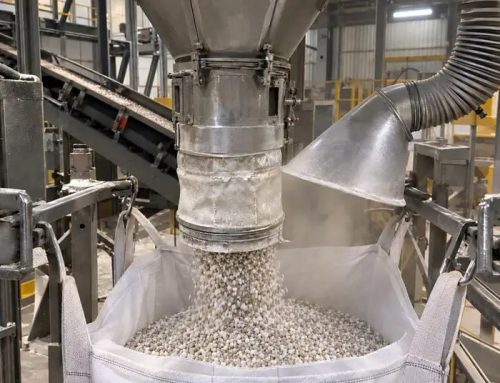
Direct powder reuse is usually the most efficient circularity loop. It preserves much of the energy and material value already invested in powder production. Instead of producing an entirely new batch through melting, atomization, classification, packaging, and transport, unused powder can be collected, sieved, conditioned, blended where appropriate, and returned to production.
That loop has clear value because metal powder production is not a low-impact step. Atomization requires melting, controlled gas or liquid flow, classification, sieving, and handling under controlled conditions. If powder is used once and discarded, part of the sustainability advantage of powder-based manufacturing is lost before the part reaches service.
Full recycling sits further down the loop. Failed parts, machining chips, spent powder, and end-of-life components may be remelted and re-atomized into new powder. That route requires more energy than direct reuse, but it can still reduce dependence on primary raw material extraction and keep valuable alloying elements in circulation. The practical aim is controlled reuse for as long as the powder remains technically suitable, followed by recycling when reuse no longer meets the process requirements.
Reused Powder Is a Measurement Problem
Powder reuse only works when the reused material remains process-relevant.
Recovered powder may look similar to virgin powder, but the material can change during every handling and processing cycle. Heat exposure, oxygen pickup, humidity, spatter, partial melting, mechanical impact, sieving, blending, and storage can all alter the powder stream.
For metal additive manufacturing, <a href=”https://powdertechnology.info/metal-powder-feedstock-quality-in-additive-manufacturing/”>metal powder feedstock quality</a> already determines how reliably powder spreads, packs, melts, and consolidates. Reuse history adds another variable to that control problem.
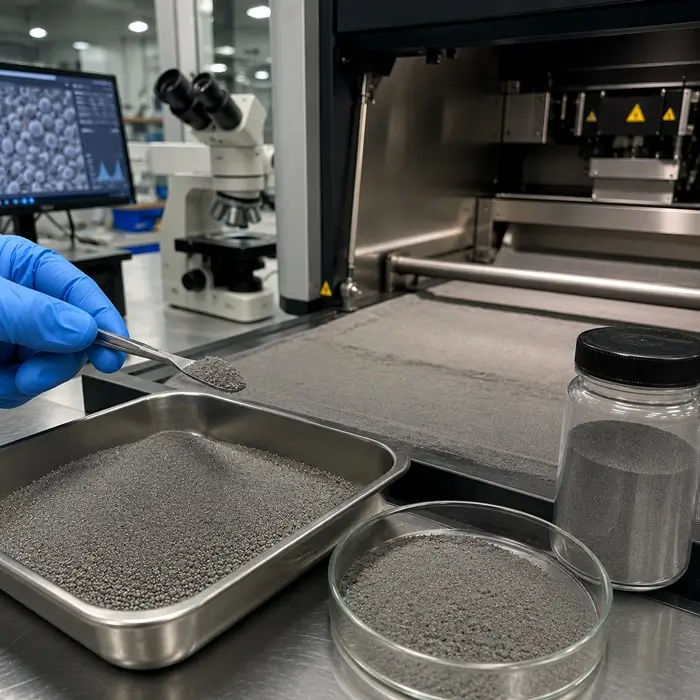
A reused powder batch may show changes in particle size distribution, fines content, particle morphology, satellite particles, surface oxidation, moisture level, apparent density, tapped density, flowability, and chemical composition. Some changes may be small enough to tolerate. Others may shift the process window.
A basic sieve step can remove oversized particles or visible spatter. It does not prove that the powder remains equivalent to the original feedstock. Circular powder use therefore needs characterization, not recovery alone.
| Property | Reason for monitoring |
|---|---|
| Particle size distribution | Detects fines buildup, oversize particles, and distribution shifts. |
| Morphology | Shows satellites, irregularity, agglomerates, and surface change. |
| Flowability | Indicates whether powder can feed, spread, or pack consistently. |
| Apparent and tapped density | Tracks packing behavior and bulk structure. |
| Oxygen and nitrogen content | Detects chemistry shifts that may affect performance. |
| Moisture content | Identifies storage and handling effects. |
| Contamination | Detects foreign material, lubricant residue, or process debris. |
| Batch history | Links powder condition to reuse cycles and part quality. |
This measurement layer is essential. Circularity without powder characterization is material drift.
Powder Condition Affects Process Behavior
A small increase in fines can change spreading behavior, dustiness, flow stability, permeability, and packing density. A shift in particle morphology can affect how powder flows through a feeder, spreads across a powder bed, or packs inside a mold. Oxygen pickup can influence alloy chemistry, surface behavior, melt-pool response, and mechanical performance. Moisture or organic contamination can affect flow, handling, degassing, sintering, or defect formation.
This is why powder reuse decisions should not be based on reuse count alone. A powder that has been reused three times under stable storage and process conditions may remain suitable. Another powder may shift after one cycle because of heat exposure, poor handling, contamination, or fines accumulation. For production environments, the reuse decision should be based on measured powder conditions and process response. That includes interpreting particle size distribution, morphology, flow behavior, chemistry, moisture, and part performance data where needed.
This approach also connects powder reuse to powder flowability. A reused powder stream that remains chemically acceptable may still fail in feeding, spreading, dosing, packing, or die filling if the physical powder behavior changes enough.
For aerospace, automotive, medical, and energy applications, this control burden becomes even higher. Reused powder needs stable chemistry, predictable mechanical behavior, traceability, and a documented qualification route. Without that discipline, powder reuse can reduce material waste while increasing scrap, rejects, or quality risk.
Powder Production Can Dominate the Footprint
Powder metallurgy reduces waste most clearly during forming and consolidation. The full environmental picture depends on the entire process chain.
Metal powder production can carry a significant footprint. A recent life-cycle assessment of gas atomization for additive manufacturing reported global warming potential values between 4.61 and 6.69 kg CO2-equivalent per kg of powder for the studied nitrogen-based systems, with cumulative energy demand between 77.94 and 112.43 MJ per kg. The same study identified inert gas use as an important contributor, with argon carrying a higher environmental burden than nitrogen. The study provides useful inventory data for gas atomization in additive manufacturing powder production.
This does not mean gas atomization is unsuitable. It means powder production must be included in the sustainability calculation.
Fraunhofer ILT makes the same point for laser powder bed fusion. LPBF can reduce material consumption, but it can also shift energy and resource demand to upstream and downstream steps, including powder production, post-processing, application, and recycling. Fraunhofer ILT’s LPBF life-cycle assessment overview stresses the need for a holistic assessment of the process chain.
This creates an important qualification for sustainable powder metallurgy. A part that minimizes machining waste may still have a high footprint if the powder production step is energy-intensive, the build yield is low, the rejection rate is high, or the post-processing burden is large.
The powder route becomes strongest when several conditions align. The component is produced close to final shape. The powder has a qualified reuse pathway. The rejection rate stays low. Sintering or consolidation is efficient. The alloy avoids unnecessary critical elements. The final part delivers enough performance, durability, weight reduction, or service-life benefit to justify the production route. Without that full-chain view, sustainability claims remain incomplete.
Lean Alloys and Efficient Sintering Reduce the Process Burden
Sustainable powder metallurgy is also influenced by alloy design and thermal processing. High-performance alloys often rely on nickel, cobalt, tungsten, molybdenum, and other alloying elements that may be expensive, energy-intensive, strategically important, or difficult to source. In many applications, those elements are necessary. In others, performance can be achieved with leaner compositions, tighter processing control, or improved densification.
Powder metallurgy gives manufacturers useful control over alloy composition because powders can be blended, compacted, and consolidated with a high degree of distribution before final densification. This can support lean alloy design, where the material meets the required strength, wear resistance, corrosion behavior, thermal performance, or fatigue performance without unnecessary alloying additions.
Sintering is the second major lever.
Conventional sintering may require long thermal cycles, controlled atmospheres, high furnace temperatures, and careful cooling. Advanced densification techniques such as spark plasma sintering and field-assisted sintering can shorten cycles and reduce thermal exposure in suitable systems. They are not universal replacements for conventional sintering, and their industrial value depends on part size, geometry, material, throughput, tooling, cost, and scale-up.
The sustainability point is practical. Sintering energy, furnace loading, atmosphere control, cycle length, reject rate, and final density all affect the part’s actual footprint.
A lean alloy that creates processing difficulty may not reduce the total burden. A fast sintering route that creates defects may increase waste. A lower-energy cycle that fails to meet density or performance requirements has no sustainability value in production. Sustainable powder metallurgy requires evaluating the alloy, powder condition, equipment, processing route, and final performance target together.
Life-Cycle Assessment Keeps Sustainability Claims Honest
Life-cycle assessment gives sustainable powder metallurgy a decision framework. For powder metallurgy and metal additive manufacturing, LCA can compare raw material production, powder manufacturing, forming, sintering or melting, post-processing, transport, use phase, reuse, recycling, and end-of-life treatment. It can also show when an apparent saving in one step creates a larger burden somewhere else.
That matters because powder-based manufacturing can reduce material waste while increasing demand in other parts of the chain. Powder production, inert gas use, thermal processing, failed builds, support removal, heat treatment, HIP, machining, inspection, and surface finishing can all influence the final footprint.
The functional unit also matters. A powder metallurgy part should not only be compared by kilogram of material processed. In many cases, the better comparison is function delivered: one gear, one bracket, one implant, one heat exchanger, one lightweight structural part, or one component over its service life.
This prevents weak comparisons. A process with higher powder production energy may still make sense if it produces a lighter part that reduces energy use during service. A near-net-shape PM route may outperform machining if it avoids large losses of expensive alloy. A reused powder route may reduce raw material demand, but only if the reused powder still produces qualified parts at an acceptable rejection rate.
LCA also helps define practical improvement targets. If the footprint is dominated by atomization, the focus should shift toward atomization efficiency, inert gas management, recycled feedstock, energy mix, powder yield, and reuse. When sintering dominates, the focus should shift toward furnace loading, insulation, heat recovery, cycle optimization, atmosphere control, and reject reduction. If post-processing dominates, part design and surface requirements need to be reviewed.
Control Points for Circular Powder-Based Manufacturing
A circular powder metallurgy strategy needs measurable control points. Each sustainability gain has a technical condition attached to it. This is the same principle behind powder testing for circular economy powder usage: circularity only becomes useful when material changes are measured across repeated use, storage, handling, and processing.
| Control point | What to monitor | Sustainability effect | Process risk |
|---|---|---|---|
| Powder production | Atomization route, yield, energy use, inert gas, feedstock origin. | Reduces upstream footprint. | Powder production can offset downstream material savings. |
| Powder reuse | Reuse cycles, blending ratio, sieving, storage, handling. | Preserves embodied powder value. | Uncontrolled reuse can alter powder behavior. |
| Powder condition | PSD, morphology, flowability, moisture, oxygen, nitrogen, contamination. | Keeps reuse technically viable. | Surface change or fines buildup can affect production. |
| Alloy design | Critical element content, recyclability, required performance. | Reduces material scarcity pressure. | Over-lean design can compromise service behavior. |
| Sintering or consolidation | Temperature, time, atmosphere, density, furnace loading, reject rate. | Reduces thermal burden. | Poor densification creates waste and quality risk. |
| Traceability | Batch history, certification, reuse records, part outcomes. | Supports qualification and confidence. | Weak records limit reuse in regulated sectors. |
| LCA framework | System boundary, functional unit, energy mix, recycling credit. | Separates real gains from weak claims. | Narrow boundaries can distort decisions. |
This table shows why sustainability in powder metallurgy is an engineering issue. Circularity only works when the powder loop is measured, documented, and linked to process performance.
Sustainable Powder Metallurgy Is Controlled Circularity
Powder metallurgy has a credible role in lower-waste metal manufacturing. Its near-net-shape capability, powder reuse potential, alloy flexibility, and compatibility with efficient sintering routes give it advantages that many conventional production routes do not have.
Those advantages need control.
The powder must be produced efficiently. Reuse must be qualified. Chemistry and morphology must be monitored. Sintering must achieve the required density without excessive energy or rejects. Alloy design must reduce unnecessary critical raw material use without weakening performance. The life-cycle assessment must include enough of the process chain to show whether the claimed benefit is real.
That is the strongest argument for sustainable powder metallurgy. It is not a shortcut to green manufacturing. It is a controlled route toward circular production, where material value is preserved through measurement, reuse, recycling, and process discipline.