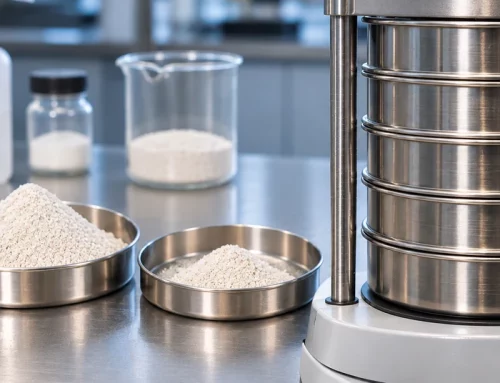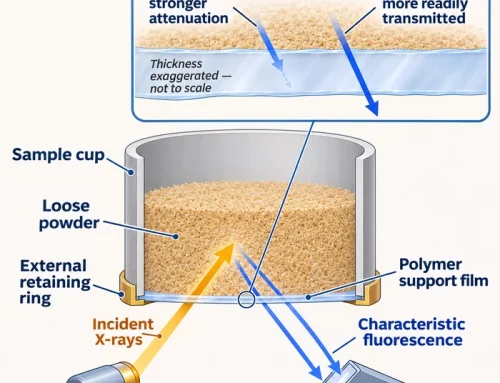
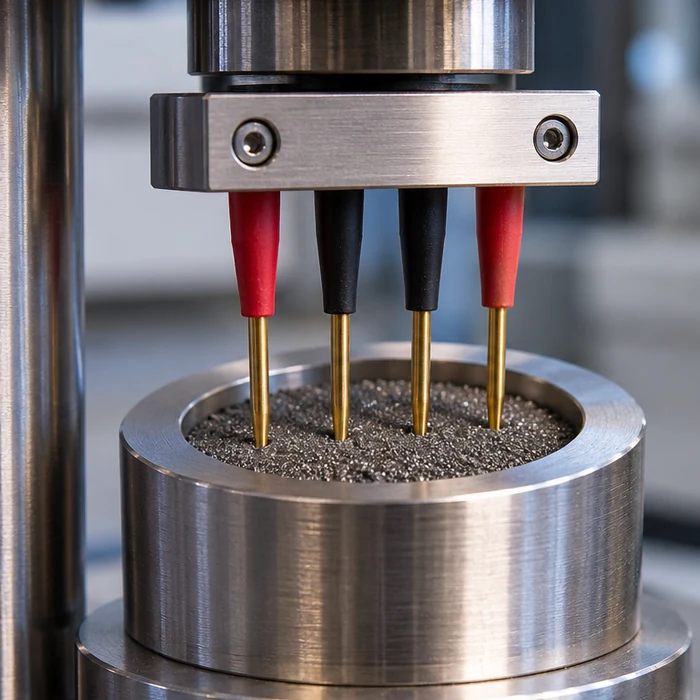
Laboratory illustration of powder-bed resistivity testing under compaction. Electrical contacts and measurement conditions influence the reported result.
Two laboratories measure the same conductive powder. One reports a result within specification; the other finds much higher resistivity. Both instruments are calibrated, and both laboratories obtain repeatable readings. Yet their compaction pressures differ. Can either result support a release decision?
Why Compression Changes the Reading
Current passes through networks of contacting particles. Compression rearranges particles, creates additional contacts, and increases existing contact areas. In metal powders, oxide films add resistance at contacts. Mechanical pressure and electrical excitation can alter these barriers, changing measured resistivity without changing the intrinsic resistivity of the metal.
Thickness reduction alone changes measured resistance by tens of percent in a moderately compacting bed. Contact formation can shift effective resistivity by orders of magnitude. Correct for geometry before attributing a change to the powder.
Match the Calculation to the Cell
For axial current through an insulated cylindrical powder cell, effective resistivity is:
ρ = R × A / h
Here, R is the resistance attributed to the bed, A its cross-sectional area, and h its thickness under pressure.
Four-point probe systems, such as the linear four-pin probe in a conductive die used by Lee and Kim (2026), apply their own geometry factor, which also depends on bed thickness. Their paper denotes resistivity as ρE and thickness as t; this brief uses ρ and h.
Four-terminal sensing excludes current-lead and current-electrode voltage drops from the sensed voltage. Guarded electrodes suppress leakage currents along insulating surfaces, an issue especially for high-resistivity powders. They address different measurement errors.
What Nickel Powder Measurements Show
Lee and Kim (2026) tested four commercial nickel powders. Every replicate of the dendritic group conducted at 2.6 MPa. The spherical group required 10.3 MPa before all replicates conducted.
At 25.7 MPa, the spherical powders showed 16 to 42 times the resistivity of the dendritic powders. Dendritic powders had lower resistivity despite lower packing fractions. Contact topology therefore mattered more than packing density in this comparison.
The spherical and dendritic powders came from different suppliers, so the study does not isolate morphology from supplier-related differences.
Investigate Disagreement Between Laboratories
First, compare the laboratories’ compaction pressures, cell geometries, and electrical excitation levels. If any differ, results are not comparable until both laboratories rerun the powder under matched, validated conditions.
Then document the test:
1. Control bed geometry. Fix die diameter, filling procedure, and initial bed height-to-diameter ratio. Record compressed thickness and height-to-diameter ratio at each pressure. Die-wall friction creates stress gradients, particularly in taller beds.
2. Specify electrical excitation. Record test current or voltage, measurement duration, electrode configuration, and instrument measurement range. Electrical excitation can affect oxide-coated contacts.
3. Record environmental conditions. Measure temperature and relative humidity, especially for carbon and oxide-coated powders.
4. Measure across defined pressures. Calculate effective resistivity using the cell’s geometry correction. Repeat the test with at least three independently filled beds. Classify over-range readings separately rather than assigning them a resistance value.
Use a separate loading-unloading sequence to examine irreversible compaction. Successive pressure steps on one filling are not independent replicates.
When Is a QC Limit Valid?
A release limit must specify compaction pressure, cell geometry, electrical excitation, and relevant environmental conditions, with validated repeatability. Packing density helps characterize lots of the same grade; it cannot normalize resistivity across grades, morphologies, or suppliers.
Return to the two laboratories. If their procedures differ and the specification does not control those conditions, neither result establishes a defensible pass or fail. Match the methods, repeat the test, and apply an acceptance limit validated for the intended use.
Technical Basis / Sources
-
Kane, Warnat, and Ryan (2021). Improvements in Methods for Measuring the Volume Conductivity of Electrically Conductive Carbon Powders. Advanced Powder Technology, 32(3), 702–709.
-
Lee and Kim (2026). Pressure-Dependent Resistivity of Commercial Nickel Powders with Different Morphologies and Sieve Classes for Pressure-Conductive Rubber Semiconductor Test Sockets. Journal of Powder Materials, 33(5), 379–387.