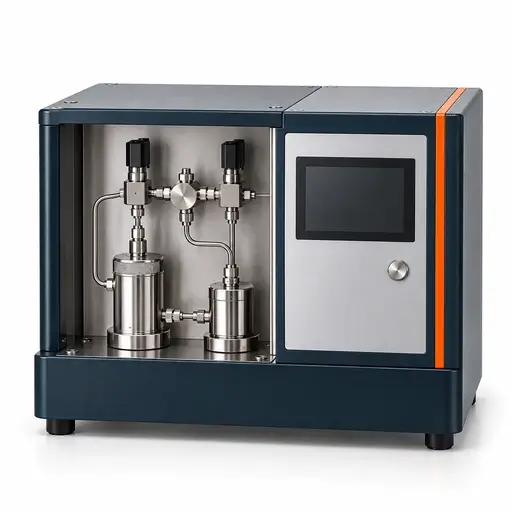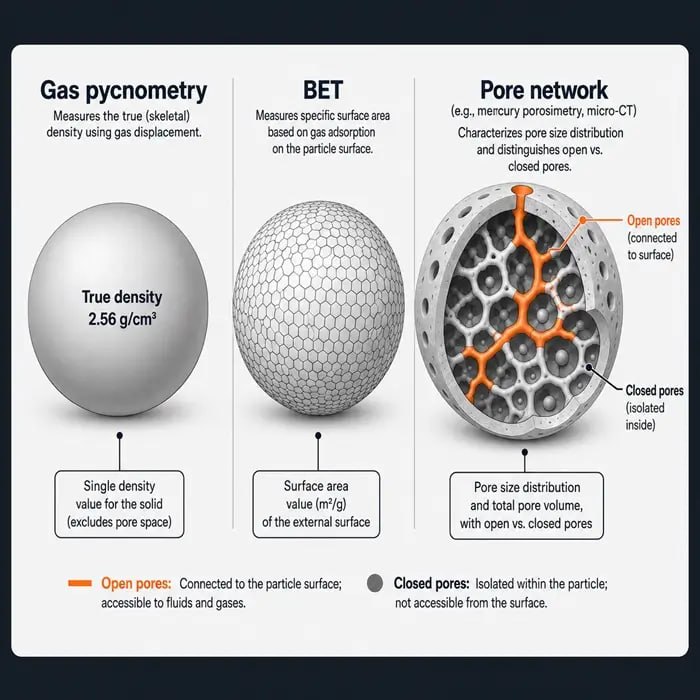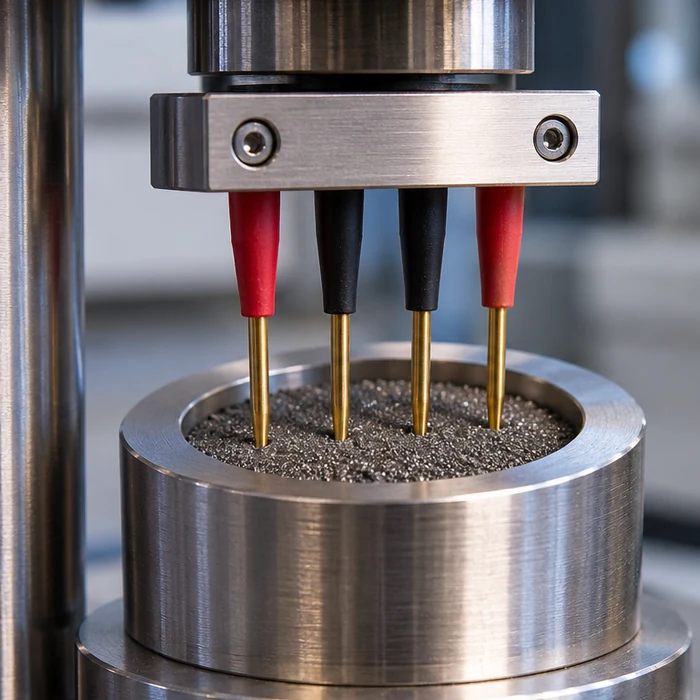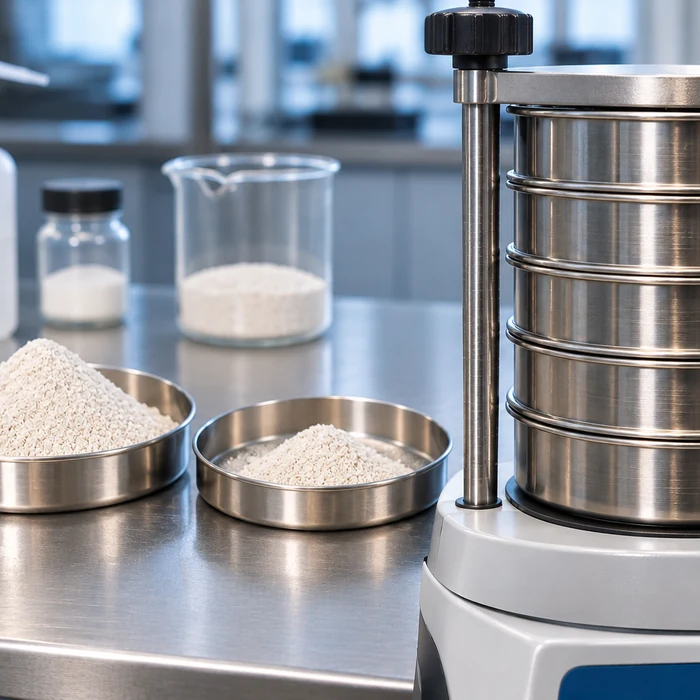
Gas pycnometry measures skeletal density from sample mass and gas-displaced volume. Smaller test portions require careful evaluation of measurement precision and reload variability.
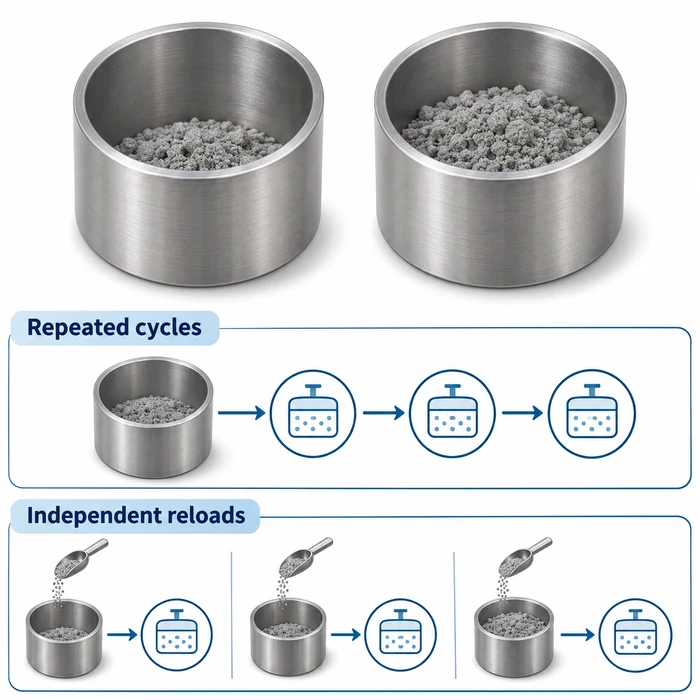
A small powder portion can give closely agreeing gas-pycnometer cycles yet leave uncertainty about whether its density suits a lot comparison. A loading comparison can reveal changes in cycle repeatability, variation between independently prepared portions, and shifts in mean density, but it cannot establish accuracy by itself. The practical question is how much variation a loading introduces, and whether that variation is small enough for the required comparison.
Why a Small Displaced Volume Matters
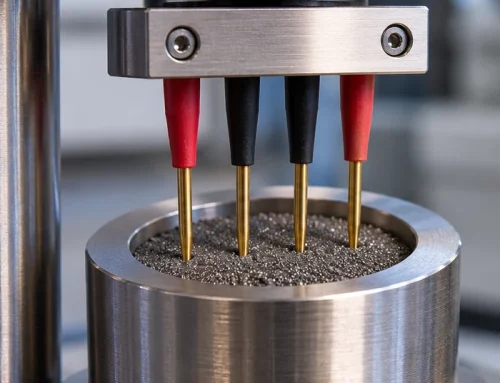
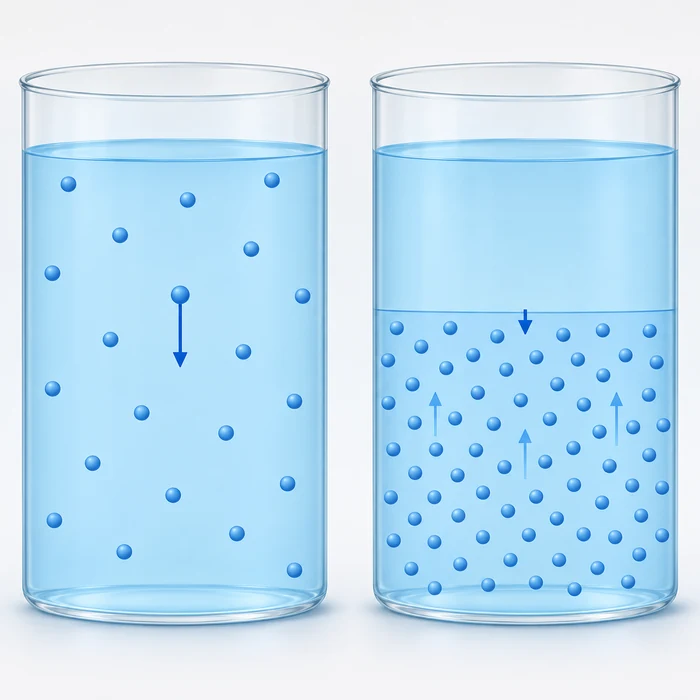
Gas pycnometry calculates skeletal density as mass divided by gas-displaced skeletal volume. Pores the gas can reach are excluded from that volume; pores it cannot reach remain part of it. Powder-bed occupancy also includes interparticle voids. PTI’s density definitions and measurement controls explain which pores and voids enter each measurement.
For the AccuPyc configurations addressed in Application Note 174, Micromeritics expresses the absolute volume-specification magnitude using nominal instrument volume VN and displaced sample volume VS. With both volumes in cm³, dividing that magnitude by VS gives:
EV = 0.0003(VN + VS); eV = EV/VS = 0.0003(VN/VS + 1)
For a nominal 10 cm³ AccuPyc, this gives about 0.63% at a 0.5 cm³ displaced volume, 0.18% at 2.0 cm³, and 0.075% at 6.7 cm³. These are calculated specification values, not measured errors or a recommended minimum loading.
This manufacturer specification addresses volume alone, not a complete density uncertainty budget. At 100 mg sample mass, a 0.1 mg balance increment represents 0.1% of that mass. Balance readability is not verified weighing uncertainty; both mass and volume contributions matter.
The AccuPyc II 1345 Standard Method recommends a cup at least two-thirds full. That is cup-occupancy guidance, not a minimum skeletal-volume fraction.
Separate the Three Sources of Scatter
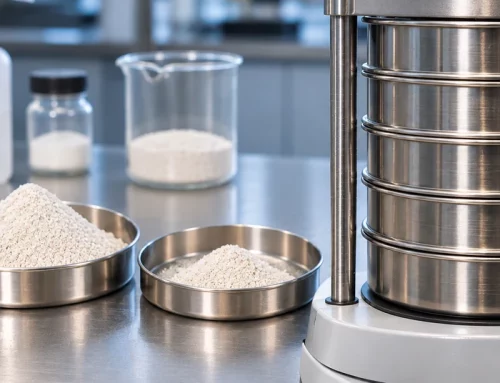
Plan representative portions from one documented lot with common subdivision, storage, and conditioning histories. Initially change portion mass within one chamber’s permitted range. Keep the instrument, gas, pressure program, purge settings, and equilibrium criteria consistent. Record mass, displaced volume, and apparent cup occupancy separately.
First, run repeated cycles on one loading without unloading the sample, keeping cycle order. Lower scatter at greater displaced volume indicates better within-loading repeatability; a trend across cycles instead suggests stabilization or a changing sample state. Because the cycles share one loading, they say nothing about reload or subdivision variation.
Second, unload and reload the same portion repeatedly, reweighing after each transfer. This adds handling and loading variation without introducing another subdivision. Third, prepare and load several independent representative portions from the same lot, balancing measurement order and matching exposure times to control moisture uptake. This third comparison includes subdivision, material heterogeneity, and reloading. These comparisons characterize precision under specified conditions (VIM 2.15); none independently establishes accuracy.
Before interpreting differences between loadings, compare them with the method’s documented precision and the laboratory’s measurement uncertainty. As an illustrative benchmark, the standard deviation among independent reloads should be clearly smaller than the smallest lot-to-lot density difference the laboratory needs to distinguish. Establish the actual threshold for the application. Inspect calibration, leak, temperature, and pressure records to rule out drift or operating problems.
Acting on the Result
If larger portions consistently reduce variation among independent reloads enough for the task, adopt that loading within the documented procedure. If mean density changes consistently between loadings, assess the difference against the uncertainty of the comparison. Subdivision, transfer losses, conditioning, and equilibration may all contribute. Use pressure traces and other records to test the likely contributor; incomplete stabilization, for example, calls for a controlled equilibration comparison.
When material availability limits portion size, evaluate a smaller compatible chamber separately using its own calibration and operating procedure. Verify the smaller chamber with a suitable reference before comparing reloads. Document the selected chamber and loading, demonstrated precision, uncertainty basis, and acceptance criterion before routine lot comparisons.