
🔑 Key Takeaway
If you qualify, reuse, or troubleshoot GRCop-42 powder, supplier chemistry and particle size data provide only part of the picture. Engineers should also consider morphology, oxygen, powder history, spreading behavior, and lot-to-lot variation against the actual LPBF process. Sandvik specifies oxygen at 0.05 percent maximum, while one Cu-Cr-Nb reuse study measured 0.053 percent in virgin powder and 0.143 percent after six reuse cycles. Those values come from different powders and conditions, but the comparison shows why incoming specifications cannot replace monitoring of powder state during reuse.
Table of contents

Laser powder bed fusion developed around steels, nickel superalloys, and titanium alloys that couple more readily with common near-infrared laser systems. Copper sits further outside that processing window. It reflects much of the incident energy and rapidly conducts absorbed heat away from the melt zone. As a result, small changes in powder condition can have a greater effect on process stability.
That makes the feedstock itself an important process variable. Particle morphology affects spreading and packing, while surface condition changes optical and interfacial behavior. Particle size distribution also influences layer formation, packing, and particle response during laser exposure. Storage, handling, blending, and reuse can change these properties even when nominal chemistry remains unchanged.
This article examines why copper behaves differently in laser powder bed fusion and which powder properties engineers can measure and control. Sandvik’s commercial Osprey GRCop-42 provides a current example. The product brings a NASA-developed high-conductivity alloy into a commercial powder supply chain with tighter requirements for consistency and traceability.
Why Copper Resists Laser Powder Bed Fusion
Copper’s difficulty in laser powder bed fusion is not the result of one dominant property. It comes from two properties working in the same direction at once: low absorptivity at the wavelengths most machines use, and thermal conductivity high enough to pull absorbed energy away from the melt zone before it can do useful work.
The Optical Mismatch at Common Laser Wavelengths
Most current industrial LPBF systems use ytterbium fiber lasers near 1060 to 1080 nm, while earlier systems also used Nd sources. Copper reflects a large share of incident energy at these wavelengths. Reported reflectivity ranges from roughly 83 percent to above 95 percent at these wavelengths. Surface finish and oxidation state explain much of that spread, with clean polished copper generally showing the highest reflectivity.
A powder bed behaves differently from a polished surface. Reflected light can strike neighboring particles instead of immediately leaving the layer, which increases effective absorption. Controlled experiments have reported around 39 percent absorptivity for pure copper powder at 1064 nm in comparable absorptivity measurements. However, powder-bed absorptivity is not a fixed material constant. It changes as particles melt, the layer consolidates, and the interaction regime evolves.
Shorter wavelengths improve the starting optical conditions. Green lasers around 515 nm couple more strongly with copper than near-infrared systems, and measurements on copper powders and solid substrates confirm stronger coupling. Blue laser systems operate at still shorter wavelengths and provide the same basic optical advantage. Better optical coupling widens the usable process window, but it does not remove copper’s high thermal conductivity. Powder condition, geometry, and process settings still matter.
Why Absorbed Energy Does Not Stay Localized
The energy copper absorbs does not remain concentrated around the laser spot for long. Copper has much higher thermal conductivity than many common LPBF alloys. Heat therefore moves quickly into surrounding material and previously consolidated layers.
For infrared LPBF systems, low optical coupling and rapid heat conduction work in the same direction. Engineers can increase laser power or adjust scan speed, overlap, and beam conditions. However, these changes also alter melt-pool geometry and defect formation.
Too little effective energy can produce incomplete melting and lack-of-fusion porosity. Excessive local energy can promote vaporization, spatter, or keyhole-type defects. Therefore, copper does not simply require “more power.”
The practical challenge is to maintain repeatable energy coupling across every deposited layer. Powder variation can shift that balance when the process already operates near a defect boundary.
Feedstock Properties That Shape Copper LPBF Reliability
Copper’s optical and thermal properties create the underlying processing challenge. However, the powder determines how that challenge appears on the machine.
Morphology, surface condition, and particle size distribution affect different parts of the feedstock-to-layer-to-melt sequence. Engineers should therefore assess them separately rather than rely on one flowability or particle-size specification.
Particle Morphology and Packing
Gas-atomized copper alloy powders generally target spherical particles with limited satellites, agglomerates, and irregular particles. Morphology affects both bulk behavior and deposited-layer quality.
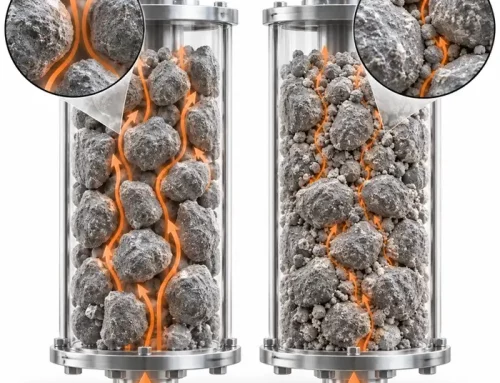
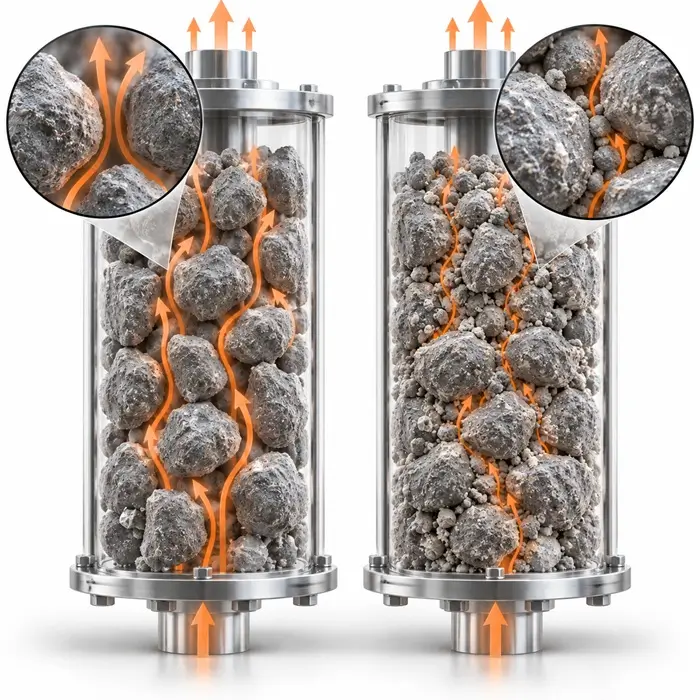
Particle shape changes the contact network and void structure within the powder bed. This can influence packing and the multiple-reflection pathways that retain laser energy within the layer. Irregular particles and satellites can also change recoater interaction. They may increase streaking, particle dragging, local depletion, or variation in layer thickness.
Morphology, purity, and packing density already matter for copper powders used in electrification applications. LPBF adds another requirement: the powder must form a thin and repeatable moving layer. Static density or Hall-flow data therefore cannot establish spreading performance on their own. Direct assessment of recoater interaction can reveal layer defects that bulk measurements may miss.
Oxide Content and Surface Chemistry
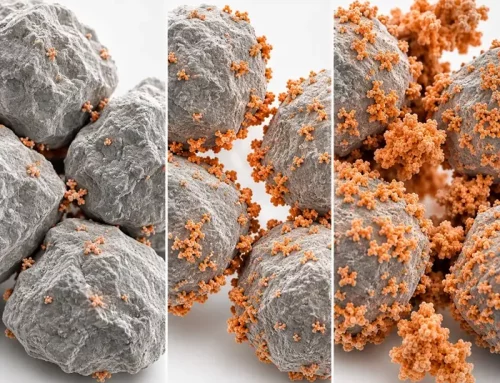
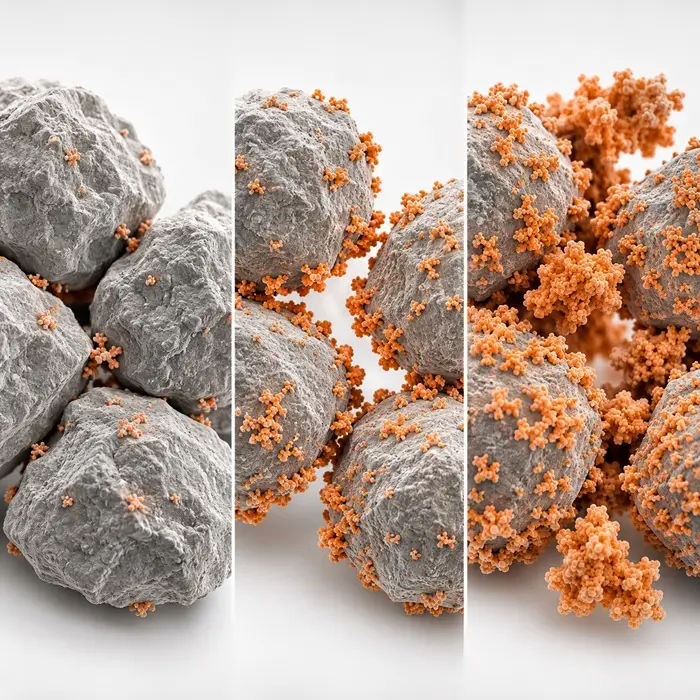
Copper alloy powder can change chemically and physically during repeated LPBF use. Engineers should therefore treat oxygen, particle size, morphology, and powder history as measured variables rather than assume the feedstock remains unchanged. The most relevant reuse evidence for this article comes from a 2025 study of Cu-Cr-Nb powder reused in laser powder bed fusion. After six reuse cycles, the researchers observed more spatter and agglomeration, a broader particle size distribution, and increased oxygen content.
Oxygen rose from 0.053 percent in the virgin powder to 0.143 percent after six cycles. Reflectance fell by about 15 percent. The resulting builds also showed changes in melt-pool geometry, increased porosity, lower density, and reduced ductility. Hardness and tensile strength remained largely stable. For context, Sandvik specifies oxygen at 0.05 percent maximum for its commercial Osprey GRCop-42 L-PBF powder. The reused Cu-Cr-Nb powder in the study therefore reached almost three times that incoming supplier limit. The comparison is directional rather than a direct acceptance test because the powders, suppliers, atmospheres, and reuse protocols differ. An incoming specification limit also does not automatically define a rejection limit for reused material.
Pure copper does not necessarily behave the same way. A separate pure-copper reuse study also followed six reuse cycles without adding virgin powder. That powder became slightly coarser and lost fines, but flowability and packing remained largely stable. Printed density stayed above 99.5 percent. The contrast matters. Reuse does not produce one universal response across copper feedstocks, and pure-copper results should not be transferred directly to Cu-Cr-Nb alloys. Alloy chemistry, atmosphere, handling, sieving, and reuse strategy can all change the outcome.
For GRCop-42 qualification, engineers should therefore track oxygen, PSD, morphology, and build response against the validated process window. Total oxygen can be measured by inert gas fusion, while particle size and morphology should be characterized separately. Surface condition also matters in other particulate deposition processes. Oxide layers can affect metallurgical bonding in cold spray deposition, although the joining mechanism differs from LPBF. Virgin-to-reused blending requires similar control. Guidance on where that blend-ratio decision actually sits can help define a suitable strategy.
Particle Size Distribution and Fines Balance
Particle size distribution affects several parts of the LPBF process at once. It changes packing, spreading, powder-bed structure, particle thermal mass, and laser interaction. For that reason, a narrower distribution does not automatically produce better copper parts. The complete distribution has to match the layer and process conditions.
Controlled LPBF studies using copper powders with different distributions have shown meaningful differences in density, surface condition, and final properties when the PSD was changed. In that study, the best-performing powder produced about 98.3 percent relative density. However, the powder lots also differed in impurity level. The authors identified those differences as another factor affecting processing behavior.
That distinction matters during qualification. More fines may improve interstitial packing and alter optical coupling. However, excessive fines can also increase cohesion and reduce spreading consistency. Coarser particles create different problems. They may alter packing and require more energy to melt completely within the available exposure time.
The useful target is therefore not a universally narrow PSD. Engineers need a controlled distribution that works with layer thickness, recoater design, laser parameters, and alloy condition. Reuse makes that requirement more important. Repeated processing can remove fines or shift the particle population.
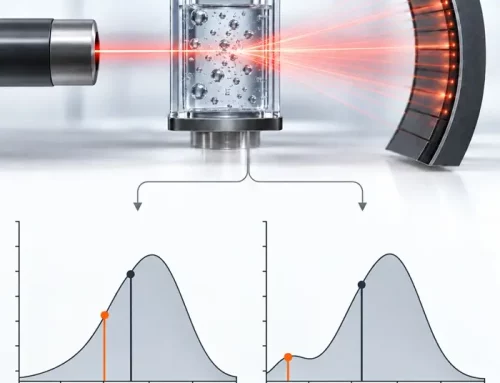
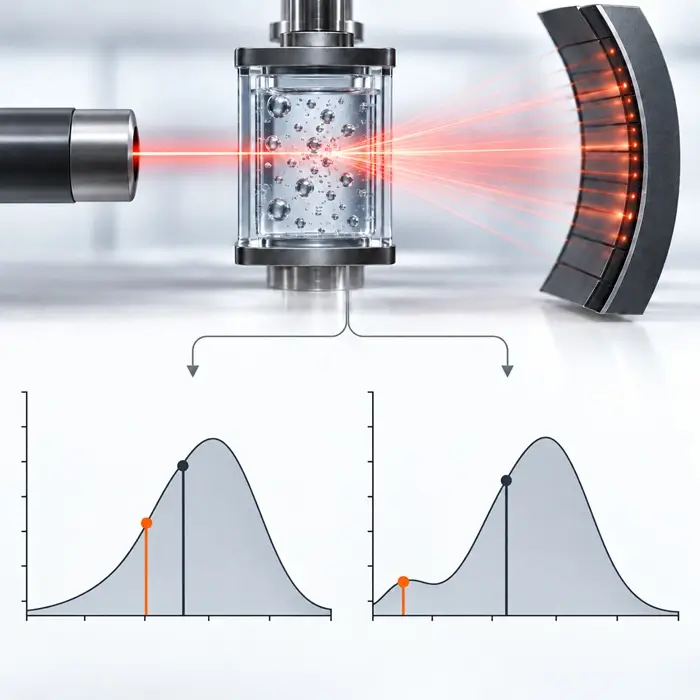
A PSD report should therefore be interpreted alongside process history. General guidance on interpreting D10, D50, and D90 in process context applies directly to copper AM powders. Combined laser diffraction and dynamic image analysis can add useful context. Measuring size and shape together can show whether a PSD shift also reflects morphology changes or agglomeration.
GRCop-42: From High-Conductivity Alloy to AM Feedstock
GRCop-42 belongs to NASA’s copper-chromium-niobium alloy family for high-heat-flux applications. These include regeneratively cooled rocket engine combustion chambers. NASA developed GRCop-42 as a higher-conductivity composition than GRCop-84. Lower chromium and niobium levels trade some strengthening potential for improved thermal conductivity.
The strengthening mechanism still relies on a stable Cr2Nb phase within a copper-rich matrix. The copper matrix provides high conductivity, while Cr2Nb contributes mechanical and elevated-temperature strength as described in the alloy family’s development literature. That alloy history differs from the later AM feedstock challenge. Powder producers still need to atomize the composition into a consistent and processable particle population.
That requires control of chemistry, oxygen, trace impurities, particle size distribution, and morphology. NASA’s AM development therefore involved both process development and maturation of a suitable powder supply chain. Reported GRCop-42 thermal conductivity exceeds that of GRCop-84, while the lower Cr2Nb fraction changes the strength-conductivity balance based on measured thermophysical property data.
However, suitable chemistry does not remove AM defect sensitivity. Published L-PBF work identifies porosity as an important fatigue-relevant defect. Geometry also matters. Increasing wall thickness from 0.7 mm to 2.0 mm substantially reduced measured porosity in fatigue and defect characterization work on thin-wall L-PBF GRCop-42. That result has a direct qualification consequence. A powder and parameter set that works in bulk coupons may behave differently in thin production features.
What the Osprey GRCop-42 Launch Signals for Feedstock Development
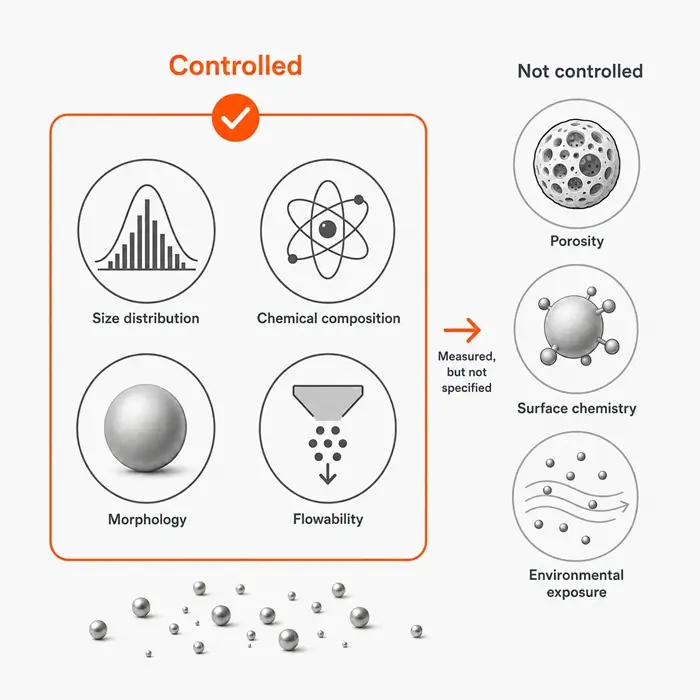
Sandvik’s Osprey GRCop-42 provides a useful example because the supplier publishes more than nominal alloy chemistry. For its L-PBF powder, Sandvik reports typical D10, D50, and D90 values of 20.5, 31.4, and 47.4 µm. It specifies oxygen at 0.05 percent maximum and reports a Hall flow time of 20 seconds. Sandvik also reports an Avalanche Energy of 36.7 ± 1 mJ/kg. The company states that a Malvern laser particle size analyzer produced the PSD values, while a Mercury Scientific rotating drum measured Avalanche Energy. It describes its production route as Vacuum Inert Gas Atomization, or VIGA.
The chemistry specification also matters. Sandvik publishes chromium at 3.1 to 3.4 percent, niobium at 2.7 to 3.0 percent, and a Cr/Nb ratio of 1.13 to 1.18. These values provide a credible starting specification. The Osprey GRCop-42 product data show that the supplier controls more than chemistry or D50 alone. However, the published data still leave qualification questions open. D10, D50, and D90 do not quantify satellite fraction, particle shape distribution, or agglomeration.
The Hall flow value is reported without a stated sample mass on the public product page. Sandvik also describes high packing density but does not publish numerical apparent or tapped density values there. Hall flow and rotating-drum measurements characterize aspects of powder flow, but they are not direct measurements of deposited-layer quality. ISO/ASTM TR 52952 addresses the relationship between rotating-drum measurements and powder spreadability in PBF-LB machines. Direct spreading assessment remains valuable when qualification depends on a specific recoater, layer thickness, and dosing strategy.
The PSD figures are also typical values rather than published lot-to-lot distributions or process-capability limits. Application-specific qualification therefore has to extend beyond the public specification.
Laser diffraction can track PSD, while dynamic image analysis can separate size changes from morphology changes. Direct spreading assessment can then show whether those powder properties translate into repeatable layer formation.
Seen this way, Sandvik’s launch signals the maturation of specialized AM powder supply. NASA developed the alloy, while commercial production adds another requirement: consistent feedstock manufacture at production scale. That direction matches the broader shift described in metal powder feedstock quality work for additive manufacturing. Chemistry and one particle-size range rarely describe feedstock behavior completely.
It also matches the gaps discussed in SAE AIR7359’s discussion of which properties are left out of AM specifications. Qualification must ultimately connect measurable powder variation with process and part performance.
Process Adaptations That Still Matter Beyond the Powder
Feedstock control cannot remove the thermal boundary conditions of an LPBF build. Laser configuration, geometry, atmosphere, and heat extraction all influence the same energy balance. Green and blue lasers improve optical coupling with copper compared with near-infrared systems. Infrared machines rely more heavily on power, beam, and scan optimization.
Build plate preheat also changes the thermal starting condition. Chamber oxygen can affect surface condition, while supports and geometry influence how quickly heat leaves the melt zone. A successful parameter set should therefore remain linked to its machine, atmosphere, preheat condition, support strategy, and geometry. Geometry deserves particular attention for GRCop-42. Published thin-wall work shows that defect populations can change substantially with section thickness. Do not infer thin-wall behavior from bulk coupons alone. Qualify representative wall thicknesses and critical production features separately.
Hot isostatic pressing adds another qualification variable. HIP can reduce internal porosity, but the thermal cycle also changes the final material state. GRCop-42 derives much of its strength from the Cr2Nb phase. Engineers should therefore verify mechanical and thermal properties after the actual HIP or heat-treatment cycle used in production.
The deposited powder layer remains equally important. A powder can meet chemistry, PSD, and bulk-flow requirements while spreading poorly under a specific recoater. Direct assessment of recoater interaction effects on layer defects should use production-relevant conditions wherever possible.
Practical Decision Points for Process and Qualification Engineers
ISO/ASTM 52907 provides a useful framework for characterizing metal powder feedstocks. For GRCop-42, supplier data provide the starting specification, while qualification determines whether variation remains inside the validated operating window.
Particle size and morphology: review the full PSD rather than D50 alone. Laser diffraction and image analysis provide complementary information because size and shape can change independently.
Oxygen and powder history: measure oxygen where oxidation matters and track changes during storage, handling, and reuse. Do not assume the original certificate still describes the current powder state.
Flow and spreading: bulk flow measurements can support qualification, but they do not prove recoater performance. Confirm layer formation under representative machine and layer conditions.
Chemistry and Cr/Nb ratio: confirm the Cu-Cr-Nb composition and relevant impurities. For GRCop-42, control of chromium, niobium, and their ratio matters because Cr2Nb provides the strengthening phase.
Reuse and blending: track changes in oxygen, PSD, morphology, and build response rather than relying on cycle count alone. Define virgin-to-reused limits from the validated process.
Geometry-specific qualification: include wall thicknesses and critical features representative of the production component. Do not infer thin-wall performance from bulk coupons alone.
Machine and process configuration: qualify the powder on the actual laser wavelength, atmosphere, preheat condition, layer thickness, recoater, and relevant process settings.
Lot-to-lot consistency: compare incoming lots using the powder properties that influence the validated build. Typical supplier values do not show the full production variation.
Selected References
- Sandvik. Osprey GRCop-42 copper metal powder. Product data for L-PBF feedstock, including PSD, oxygen, Hall flow, Avalanche Energy, morphology, chemistry, and VIGA production information. Updated May 21, 2026.
Sandvik Osprey GRCop-42 product page - Ellis, D. L. Conductivity of GRCop-42 Alloy Enhanced. NASA Glenn Research Center, 2004. NASA Technical Reports Server, Document ID 20050192166. Development background for GRCop-42 and the conductivity-strength trade-off relative to GRCop-84.
NASA Technical Reports Server record
NASA full PDF - Minneci, R. P., Lass, E. A., Bunn, J. R., Choo, H., and Rawn, C. J. “Copper-based alloys for structural high-heat-flux applications: a review of development, properties, and performance of Cu-rich Cu-Cr-Nb alloys.” International Materials Reviews 66, no. 6 (2021): 394 to 425. DOI 10.1080/09506608.2020.1821485.
Taylor & Francis article page - Jadhav, S. D., Goossens, L. R., Kinds, Y., Van Hooreweder, B., and Vanmeensel, K. “Laser-based powder bed fusion additive manufacturing of pure copper.” Additive Manufacturing 42 (2021): 101990. DOI 10.1016/j.addma.2021.101990.
ScienceDirect article - Lassègue, P., Salvan, C., De Vito, E., et al. “Laser powder bed fusion (L-PBF) of Cu and CuCrZr parts: Influence of an absorptive physical vapor deposition coating on the printing process.” Additive Manufacturing 39 (2021): 101888. DOI 10.1016/j.addma.2021.101888.
ScienceDirect article - Nordet, G., Gorny, C., Mayi, Y., et al. “Absorptivity measurements during laser powder bed fusion of pure copper with a 1 kW cw green laser.” Optics & Laser Technology 147 (2022): 107612. DOI 10.1016/j.optlastec.2021.107612.
ScienceDirect article - Bonesso, M., Rebesan, P., Gennari, C., et al. “Effect of Particle Size Distribution on Laser Powder Bed Fusion Manufacturability of Copper.” BHM Berg- und Hüttenmännische Monatshefte 166 (2021): 256 to 262. DOI 10.1007/s00501-021-01107-0.
Springer full article - Dai, Z., Chen, X., Liu, Y., Wang, J., Lu, J., and Liu, J. “Effect of reuse on Cu-Cr-Nb powder and bulks produced by laser powder bed fusion.” Powder Technology 457 (2025): 120930. DOI 10.1016/j.powtec.2025.120930.
ScienceDirect article - Seetharaman, S., Abdul Rahman, S. N., Venkatesan, C., et al. “Sustainable additive manufacturing of pure copper via powder reuse in laser powder bed fusion.” Next Materials 11 (2026): 101921. DOI 10.1016/j.nxmate.2026.101921.
ScienceDirect full article - Demeneghi, G., Gradl, P., Mayeur, J. R., and Hazeli, K. “Size effect characteristics and influences on fatigue behavior of laser powder bed fusion of thin wall GRCop-42 copper alloy.” Heliyon 10, no. 7 (2024): e28679. DOI 10.1016/j.heliyon.2024.e28679.
PubMed Central full article - ISO/ASTM 52907:2019. Additive manufacturing: Feedstock materials, Methods to characterize metal powders. Covers sampling, PSD, chemistry, characteristic densities, morphology, flowability, contamination, storage, traceability, and used powder.
ISO/ASTM 52907 standard page - ISO/ASTM TR 52952:2023. Additive manufacturing of metals: Feedstock materials, Correlating rotating drum measurement with powder spreadability in PBF-LB machines.
ISO/ASTM TR 52952 standard page - SAE International AIR7359. Additional Guidance for Metal Powder Feedstock for Additive Manufacturing. Issued April 13, 2026. DOI 10.4271/AIR7359.
Official SAE AIR7359 page