
🔑 Key Takeaway
Cold spray bonding depends on particles reaching a critical impact velocity, a threshold governed by the feedstock’s mechanical properties, particle temperature, and surface condition, as well as the particle-substrate combination during initial deposition. A powder’s particle size distribution and morphology determine what fraction of a batch can realistically reach that velocity in a given nozzle and gas set, not just its average diameter. PSD, morphology, and moisture testing done before a spray trial function as decision inputs that narrow risk; they do not replace deposition-efficiency and bond-strength verification once spraying starts.
Table of contents
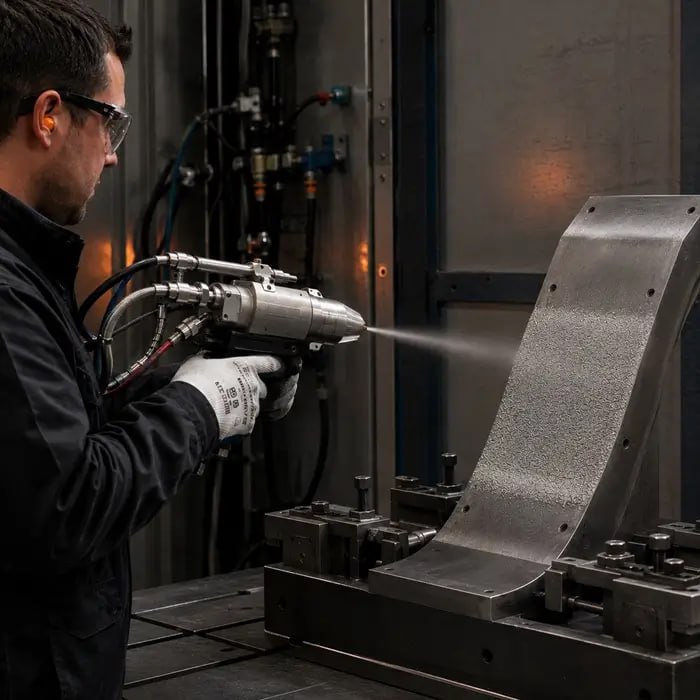
Cold spray builds a coating or a near-net shape by firing metal or metal-ceramic powder through a converging-diverging nozzle in a preheated, pressurized gas stream and letting the particles strike a substrate while staying below their melting point. Because there is no melt pool, the process sidesteps most of the oxidation and thermal distortion issues tied to plasma or flame spray. It replaces them with a different constraint: a particle only stays where it lands if it hits the surface fast enough.
That threshold is the cold spray critical velocity, and it is not a single number that applies across materials or even across a single powder lot. This article looks at what critical velocity actually represents, how particle size distribution and morphology set the range of velocities a real feedstock batch can achieve, why native oxide layers raise or lower that threshold, and what powder-side QC, run before committing gas, time, and substrate to a trial, can and cannot tell you about the outcome.
What Critical Velocity Actually Means in Cold Spray
In cold spray, a particle only becomes part of the deposit if it strikes the substrate or previously deposited material above a minimum impact velocity, generally referred to as the critical velocity. Below that threshold, particles largely rebound and contribute to overspray rather than coating buildup. Well above it, particle and substrate erosion can begin to compete with deposition, which is why practical cold spray operation targets a velocity window rather than simply maximizing gas speed.
Critical velocity depends on the material being sprayed, its temperature at the moment of impact, its mechanical properties, and, as covered later in this article, the condition of its surface oxide. Two powders of the same nominal alloy chemistry can have different practical critical velocities if their oxide condition or thermal history differs, which is one reason cold spray parameter sets rarely transfer cleanly between lots without verification.
Adiabatic Shear Instability and the Bonding Window
The most widely used explanation for what happens at critical velocity is adiabatic shear instability. At sufficiently high impact velocity, plastic deformation concentrates in a thin layer at the particle-substrate interface faster than heat can conduct away from it. That localized softening lets material jet outward from the contact zone, disrupting the native oxide and bringing clean metal surfaces into intimate contact under high local pressure. A finite-element analysis of cold-sprayed copper by Assadi and coworkers tied this instability closely to the experimentally observed critical velocity, and it remains the framework most subsequent cold spray literature builds on or argues against (Assadi et al., Acta Materialia).
The mechanism is not treated as a complete explanation by everyone working in the field. Later analyses have argued that pressure waves and hydrodynamic plasticity near a particle’s free edges can generate the interfacial strain needed for bonding without adiabatic shear instability necessarily being the trigger in every case. For process purposes the distinction matters less than the shared conclusion: bonding is a narrow-window impact event, and whether a given powder, nozzle, and gas combination reaches that window is a question about achievable particle velocity, not about gas temperature or pressure in isolation.
How Particle Size and Morphology Set the Velocity Window
Critical velocity is a property of the material and its surface condition, but the velocity a particle actually reaches at impact is a property of the process and the particle itself. Inside the nozzle, particles accelerate under drag from the expanding gas, and drag scales with a particle’s surface-area-to-mass ratio. Small particles present more surface area relative to their mass and accelerate faster than coarse particles of the same material and density, so a feedstock lot with a broad particle size distribution does not travel at one velocity; it travels as a spread, and the coarse tail of that distribution is the fraction most likely to sit below critical velocity even when the median particle size is well matched to the process (theoretical modeling of cold spray deposition efficiency, Thin Solid Films). Gas choice and preheat temperature are the main process-side levers for raising achievable particle velocity; helium’s lower molecular weight lets it reach higher gas velocity than nitrogen at comparable pressure, which is why helium or helium-nitrogen blends see use with higher-critical-velocity materials. Particle size and morphology then decide how much of that achievable gas velocity a given particle fraction actually picks up before impact.
Particle shape complicates the picture further. A largely spherical gas-atomized powder and an irregular or angular powder of the same nominal size do not present the same drag coefficient in flight, and they do not present the same local contact geometry at impact. PSD figures reported as D10, D50, and D90 alone do not fully describe how a batch will behave under acceleration; combined particle size and shape data give a more complete read on how much of a lot is likely to fall inside the workable velocity window before a trial confirms it. See reading D10, D50, D90, fines, and oversize in process context and how particle shape influences flow behavior for the underlying interpretation logic, which extends, with different emphasis, to aerodynamic behavior in a spray stream.
Why Smaller Isn’t Always Faster in Practice
The relationship between particle size and impact velocity is not linear all the way down. As particles approach the substrate, they cross a thin, compressed layer of gas that stands off the surface, commonly referred to as the bow shock. Very fine particles carry comparatively little momentum, and cold spray gas-dynamics work has described them losing enough velocity crossing that layer to be deflected around the substrate rather than striking it, even though the same particles were accelerated efficiently through the nozzle itself.
This effect, alongside the coarse-tail lag described above, is part of why cold spray feedstocks are typically supplied within a bounded size range rather than as a broad commercial powder cut. The practical implication for feedstock qualification is that both tails of a distribution, not just the average diameter, deserve attention: an otherwise well-centered PSD can still carry a fine fraction that never reaches the substrate and a coarse fraction that never reaches critical velocity.
Native Oxide Layers and Why They Control Adhesion
Almost every metal powder used in cold spray carries a native oxide skin, formed during atomization and thickened further by storage and handling in ambient air. That oxide is not a minor surface detail. Solid-state bonding requires direct metal-to-metal contact, and an intact oxide film mechanically and chemically separates the two surfaces that need to merge. For bonding to occur, the oxide has to be locally broken up during impact, whether through the shear jetting described above or through associated fracture and displacement of the oxide scale at the contact zone.
Because disrupting the oxide consumes part of the impact energy and strain available for bonding, a thicker or more continuous oxide layer effectively raises the critical velocity needed for the same base material. Work on cold-sprayed copper has shown that removing the surficial oxide scale from feedstock powder measurably improves both deposition efficiency and interparticle bonding at a fixed set of spray parameters, which points the same relationship in reverse: powder lots carrying more surface oxide need more impact energy to bond as well as a lower-oxide lot of the same alloy (oxide scale removal and cold-sprayed copper bonding, Surface and Coatings Technology). This is one reason two lots of nominally identical powder, matched on PSD and chemistry certificates, can still spray differently: a standard certificate of analysis does not typically report native oxide thickness.
Oxide Thickness, Powder Age, and Reused Feedstock
Feedstock surface condition is not necessarily fixed at the point of atomization. Depending on the alloy and storage environment, exposure to air and humidity can alter the chemistry or thickness of the surface oxide, which is why powder age and storage history can remain QC-relevant even when a lot still meets its original particle size and bulk chemistry specification. Reused or reclaimed powder raises a related concern: material collected as overspray and reintroduced into a spray run has typically been through at least one additional thermal and mechanical cycle. Comparable reuse questions have already forced formal qualification limits in other powder-fed processes; aerospace laser powder bed fusion programs, for example, have had to define acceptable virgin-to-reused blend ratios rather than treat reclaimed powder as equivalent to virgin stock (virgin-to-reused powder blend ratios in aerospace PBF-LB qualification). Cold spray has a different thermal history than powder bed fusion, so the specific ratios do not transfer, but the underlying logic, that cumulative oxide and morphology drift from reuse needs its own qualification data rather than an assumption of equivalence, applies just as directly.
Where feedstock oxide condition is uncertain, a combined PSD, morphology, and surface characterization panel run by an independent powder testing lab can establish a baseline before committing a lot to a spray trial. This is the kind of characterization work outfits such as Delft Solids Solutions provide as a testing service, though the resulting data still functions as an input to trial planning rather than a substitute for it.
Powder-Side QC Before a Spray Trial
None of the mechanisms above are visible on a standard certificate of analysis. A cold spray feedstock lot can pass a chemistry and nominal PSD check and still underperform in a trial because the velocity-relevant fraction of the distribution, the particle morphology, or the surface oxide condition sits outside what a previously qualified lot had. A powder-side QC panel run before committing gas, time, and substrate to a trial does not replace that trial, but it narrows where a problem is likely to originate if deposition efficiency or adhesion comes in low.
PSD and Morphology Checks
Because both the coarse tail and the extreme fine tail of a distribution carry separate risk, a PSD check for cold spray feedstock is most useful when it reports the shape of the whole distribution rather than D50 alone. Running laser diffraction alongside dynamic image analysis on the same sample adds aspect ratio and circularity data that a size-only measurement cannot provide, which matters here because morphology affects both aerodynamic drag and local contact mechanics at impact; see combined PSD-shape workflows for how that comparison is typically structured. For metal powders originally qualified for a different process, it is also worth checking whether the properties an existing specification tracks are the ones relevant to cold spray. Feedstock properties commonly left out of additive manufacturing powder specifications are not automatically irrelevant to impact-based deposition, and some can matter more in cold spray than in a melt-based process (metal powder feedstock properties left out of AM specifications).
Moisture, Flow Behavior, and Feeder Consistency
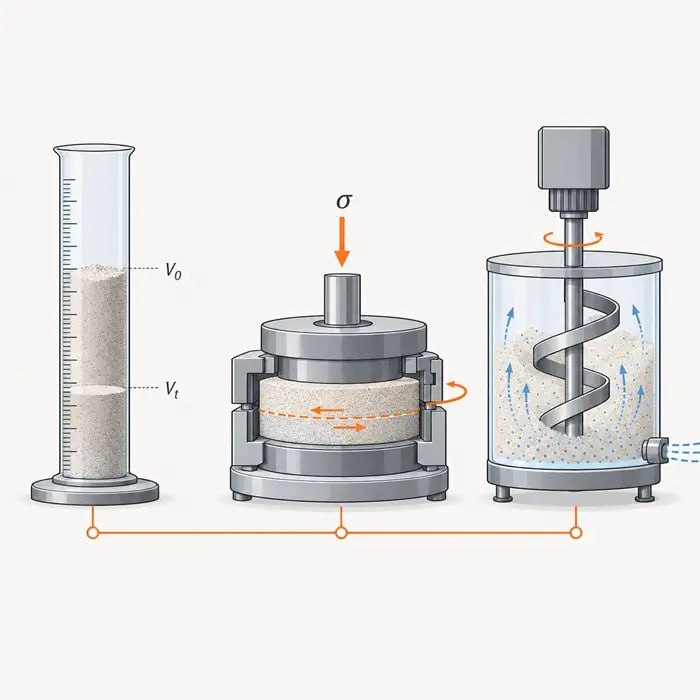
Moisture does not influence impact-velocity physics directly the way PSD and oxide condition do, but it affects whether the powder feeder can deliver a consistent mass flow rate into the gas stream in the first place. Surface moisture on a hygroscopic or reactive metal powder, aluminum and magnesium alloys in particular, can promote localized agglomeration in the hopper, and an inconsistent feed rate shows up downstream as an uneven, patchy deposit even when the underlying powder is otherwise within spec. Moisture checks on incoming lots, run to a defined method, catch this before it reaches the feeder rather than after a trial goes patchy (best practices for moisture content analysis in powders). Flow behavior under aeration and shear, assessed with the methods used for other powder-fed processes, is a useful secondary check on feeder consistency, though it speaks to hopper and feed behavior rather than to what happens at the point of impact; see shear cell testing for powder flow and Hausner ratio and Carr index interpretation for what these measurements do and do not predict.
What QC Can and Cannot Predict
PSD, morphology, and moisture data are contributing factors and supporting indicators. They inform where a lot is likely to sit relative to a known-good reference and can flag a lot worth holding before a trial, but none of them, alone or combined, determines deposition efficiency or coating adhesion with enough certainty to skip trial verification. Deposition efficiency, bond strength, and coating porosity still have to be measured on sprayed material; area percent porosity in thermal and cold sprayed coatings, for example, has a standardized metallographic test method precisely because porosity is not reliably predictable from powder-side data alone (ASTM E2109, area percentage porosity in thermal sprayed coatings). Powder-side QC earns its value by reducing how many trial iterations are needed to reach a qualified parameter set, not by replacing the parameter-setting trial itself.