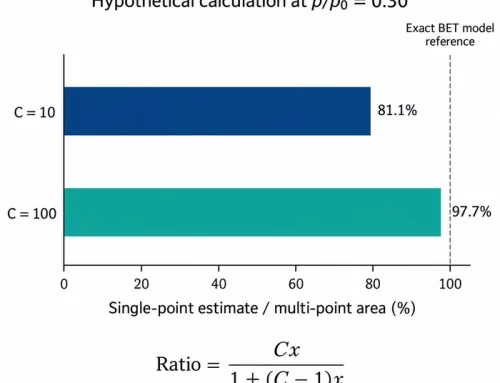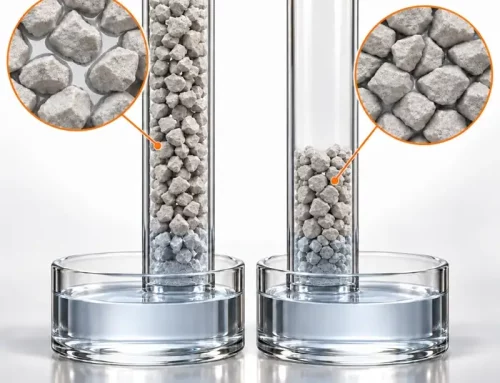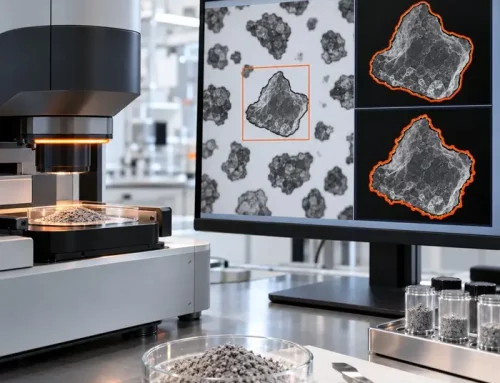
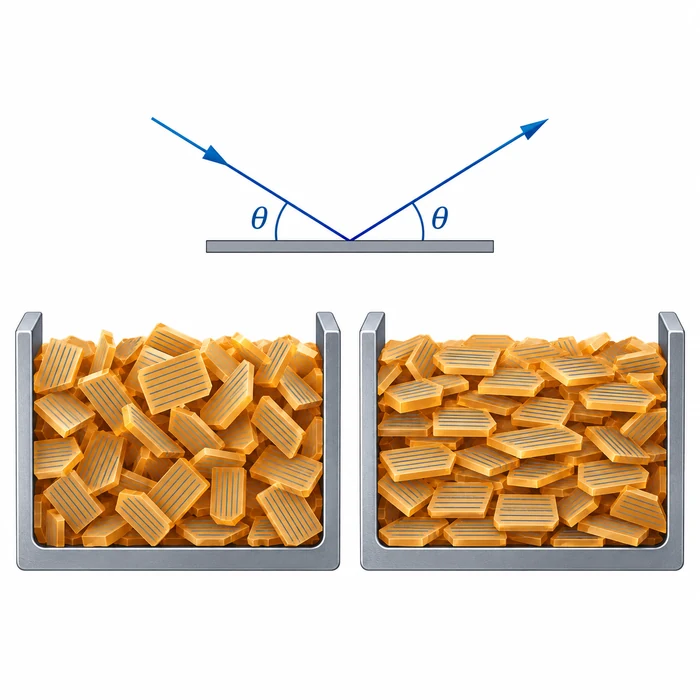
Plate-like crystallites can align during loading, changing reflection intensities without changing their lattice spacings. Conceptual illustration.
The powder lot is unchanged, but its XRD peak ratios shift after the holder is emptied and refilled. Before reporting phase conversion, investigate how preparation changed the population of crystallites contributing to diffraction.
Why Loading Changes Relative Intensities
Powder diffraction relies on sampling many crystallite orientations. Plate-like or needle-like crystals can align during filling, pressing, or surface leveling, strengthening some reflections while weakening others. External shape alone does not identify the affected reflections.
Repacking that preserves the material should leave its intrinsic lattice spacings unchanged, but unchanged peak positions do not prove unchanged phase proportions when the same phases remain present. The distinction between phase identity and crystalline fraction, covered in Crystallinity, matters here: a peak-ratio change is not a direct measure of either.
McCusker and colleagues treat strong reflection-family dependence, such as enhanced 00l and weakened hk0 intensities, as grounds to suspect orientation. Too few or oversized crystallites instead produce nonsystematic particle-statistics anomalies. A smooth intensity mismatch versus 2θ can motivate checks of roughness, thickness or transparency, absorption, and acquisition corrections; it does not uniquely identify a cause [1].
Compare Measurement and Preparation Repeatability
Use representative powder sampling and subdivision so segregation does not masquerade as a preparation effect.
- Repeat the scan on one undisturbed mount, holding radiation, optics, scan range, counting conditions, and spinning fixed, to establish measurement repeatability.
- Prepare independent mounts from the retained powder, recording loading direction, leveling or pressure, specimen height, humidity or air exposure, and mount identity.
- Compare resolved peak positions, widths, and several integrated-intensity ratios using consistent background treatment and fitting. Avoid peak heights when widths change. Fit overlapping reflections with a justified model.
- Compare a compatible alternative preparation, such as back- or side-loading a flat holder, or a rotating capillary where absorption and geometry permit, while preserving the material’s phase state.
Ratios that vary between mounts while repeat scans agree implicate preparation. Systematic changes among reflection families strengthen an orientation interpretation; isolated anomalies strengthen a particle-statistics interpretation. Check specimen displacement and calibration before assigning any position shift to lattice change, and review holder contributions when new features emerge [1].
For persistent isolated anomalies, suitable size reduction increases the number of crystallites in the specimen, improving particle statistics. This does not guarantee removal of preferred orientation. Check that grinding preserves the phases and that added line broadening remains acceptable [1].
Choose the Next Preparation From the Pattern
Back-loading and side-loading can leave residual orientation. Flat-plate spinning improves particle statistics but does not remove texture about the surface normal; rotating a horizontal capillary can substantially reduce preferred orientation, unlike in-plane flat-plate spinning, though long needles may stay aligned along its axis. March–Dollase corrections can approximate orientation during refinement, but experimental minimization remains preferable to treating a better fit as validation [1].
For persistent orientation, spray drying into spherical aggregates is a documented alternative: an air-brush method eliminated preferred orientation and gave patterns reproducible between operators [2]. Because the method uses a liquid suspension, confirm that soluble, hydrated or metastable phases survive. A synthetic-sandstone comparison reported Rietveld and reference-intensity-ratio accuracy within roughly ±3 wt% at 95% confidence, attributed largely to spray-dried preparation eliminating orientation [3].
Close the investigation with a preparation-comparison record: mount conditions, reflection assignments, positions, widths, integrated areas, and the chosen ratios. If sensitivity persists, improve loading or particle statistics before quantification; if a difference persists across controlled preparations, assess the pattern and phase model using the powder XRD route in Thermal, Solid-State and Reactivity. Stable ratios alone do not exclude reproducible texture.
Technical Basis / Sources
- McCusker, L. B., Von Dreele, R. B., Cox, D. E., Louër, D., and Scardi, P. (1999). Rietveld refinement guidelines. Journal of Applied Crystallography, 32, 36-50. https://doi.org/10.1107/S0021889898009856
- Hillier, S. (1999). Use of an air brush to spray dry samples for X-ray powder diffraction. Clay Minerals, 34(1), 127-135. https://doi.org/10.1180/000985599545984
- Hillier, S. (2000). Accurate quantitative analysis of clay and other minerals in sandstones by XRD: comparison of a Rietveld and a reference intensity ratio (RIR) method and the importance of sample preparation. Clay Minerals, 35(1), 291-302. https://doi.org/10.1180/000985500546666