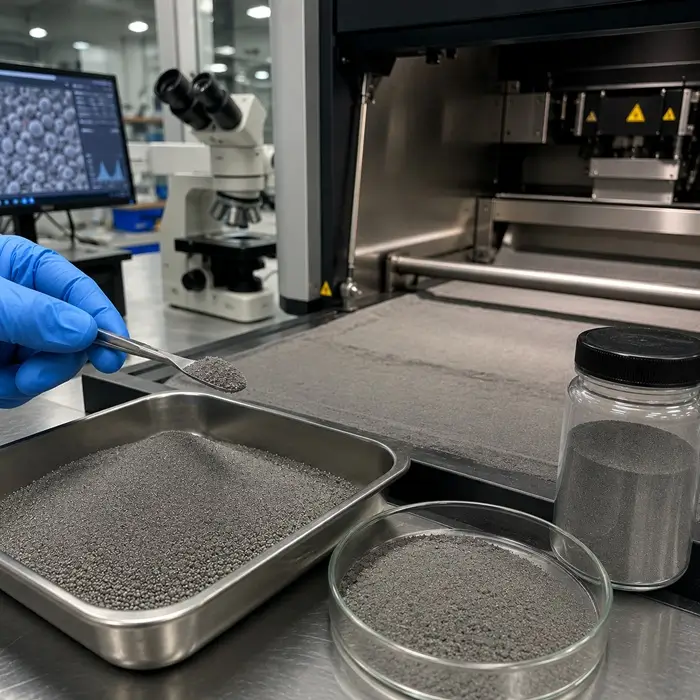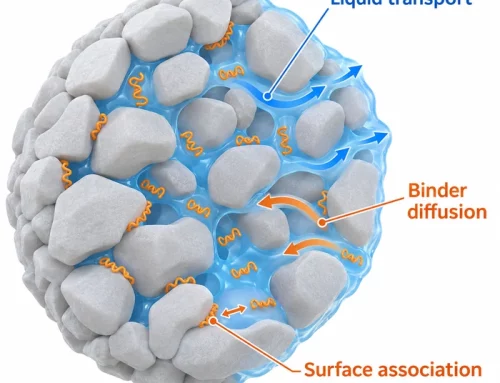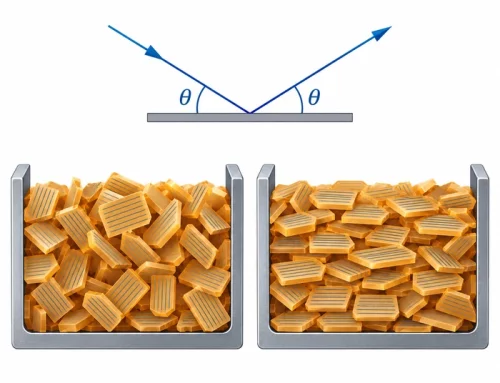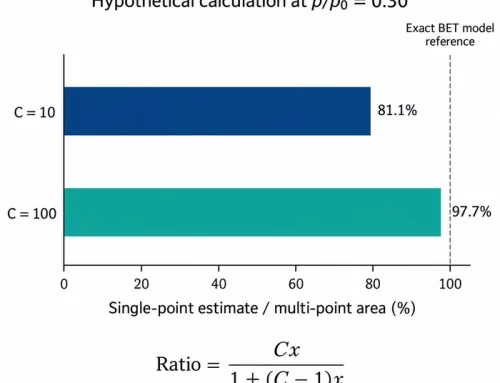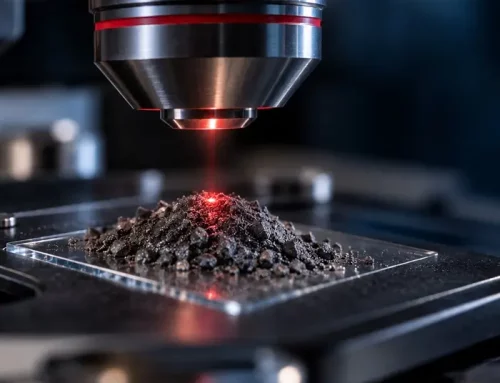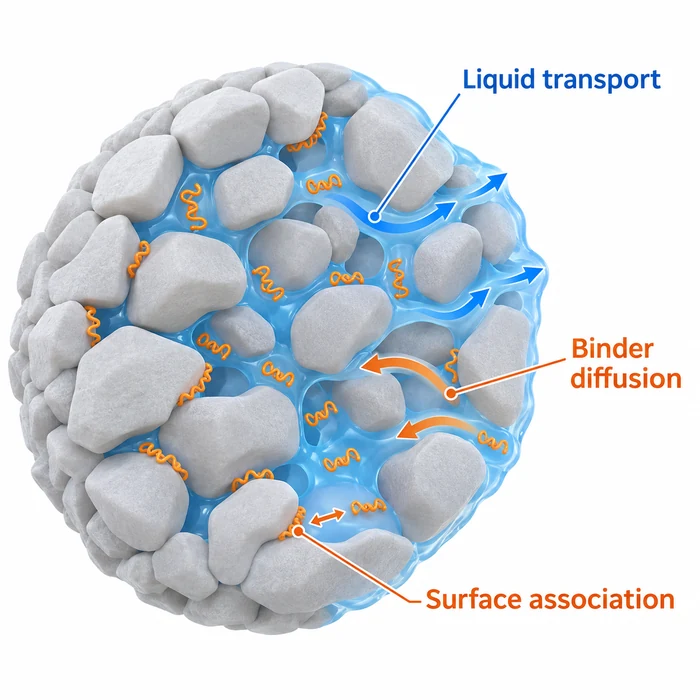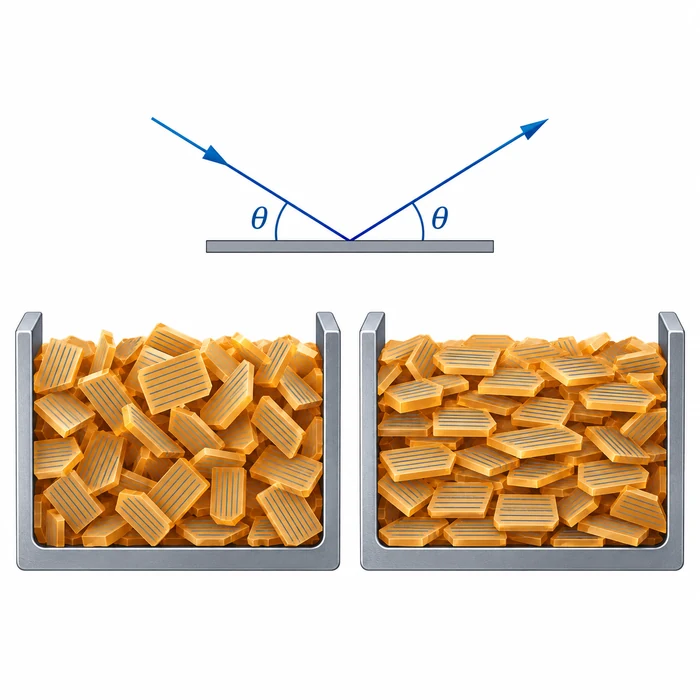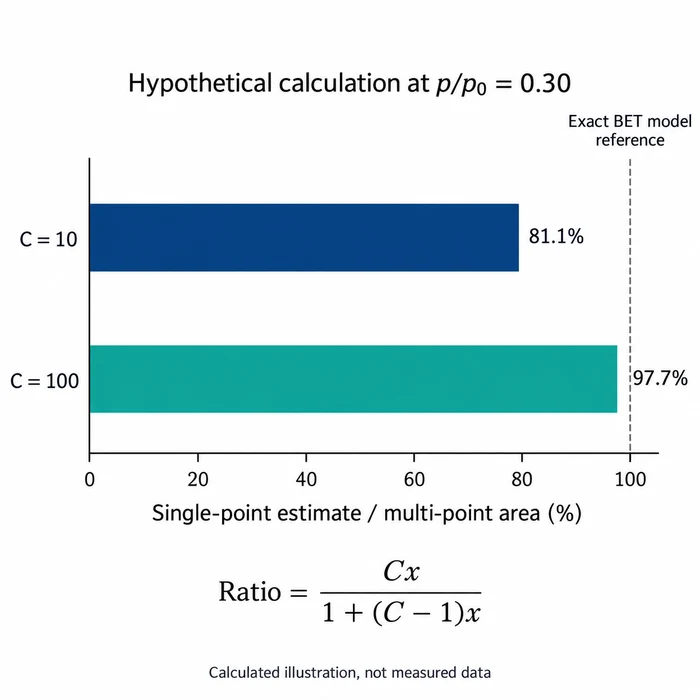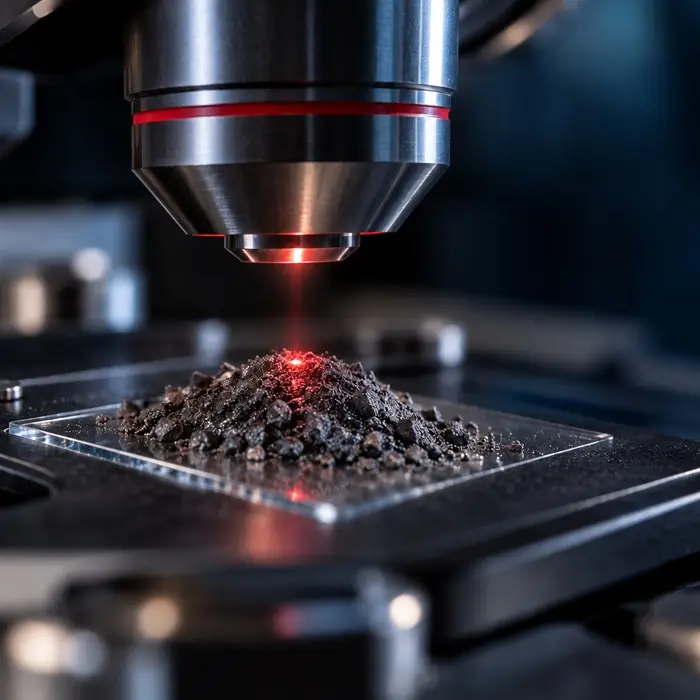
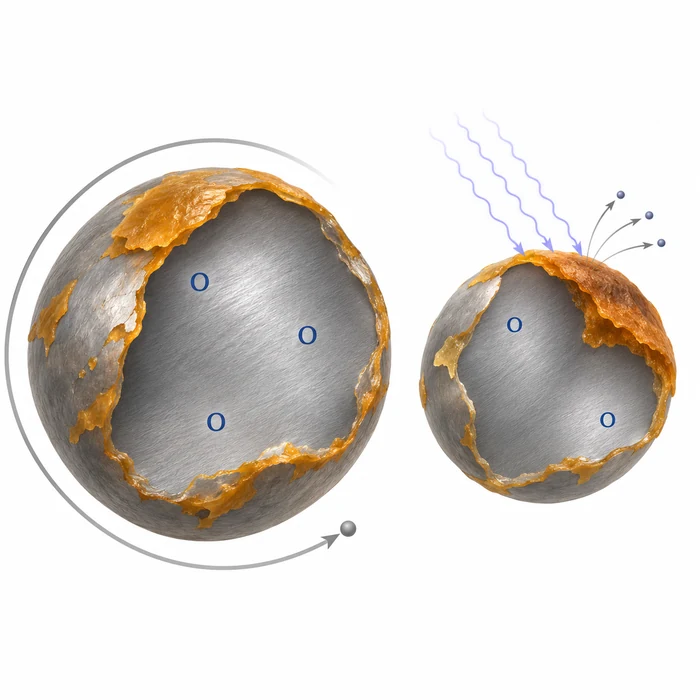
Bulk oxygen and surface-sensitive measurements describe different aspects of a powder particle. Schematic, not measured geometry or composition.
Two powder certificates both report oxygen within the purchasing limit. The immediate acceptance decision looks straightforward, but the next question remains open: can the lots be treated as having equivalent surface oxide? Passing the same limit answers neither whether their measured oxygen concentrations are equal nor where that oxygen resides.
For Ti-6Al-4V, published comparisons provide a useful way to separate those questions. Bulk oxygen analysis establishes a mass fraction. X-ray photoelectron spectroscopy, or XPS, adds information about surface composition and chemical states. Reading them together requires attention to what each result actually represents.
A close oxygen result still leaves a surface question
Derimow and colleagues compared Ti-6Al-4V powders with different production histories. Their manufacturer-supplied LECO inert-gas-fusion results included 0.186 wt.% oxygen for heavily reused RH powder and 0.180 wt.% for virgin VH powder, a difference of 0.006 percentage points (60 mg/kg).
These are similar, unequal reported concentrations. RH originated as gas-atomized Grade 23 material, but its reported oxygen concentration exceeded the Grade 23 oxygen limit; VH was virgin plasma-atomized Grade 5 material. Its useful lesson is that the authors explicitly separated similarity in bulk oxygen from comparison of microstructure, phase fraction, and surface chemistry. Measurement uncertainty would also be needed to judge whether the reported oxygen difference is statistically distinguishable.
The opening certificate decision is broader than this particular experiment: two results below one acceptance limit can occupy different positions within that limit. ASTM E1409 identifies compositional compliance as a purpose of titanium oxygen and nitrogen analysis by inert-gas fusion. Surface equivalence is a separate acceptance question and needs its own definition.
Oxygen mass fraction does not locate the oxygen
Oxygen can be associated with the particle interior and with surface compounds. A bulk result combines the oxygen recovered by the analytical procedure into one sample-level mass fraction. It does not allocate that result between dissolved oxygen and surface oxide, or distinguish a continuous film from chemically different surface regions.
Geometry adds another ambiguity. Smaller particles have more external area per unit volume than larger particles of the same shape. If the same amount of oxide-associated oxygen were spread over more area, its equivalent uniform-film thickness would be lower, provided composition, density, and coverage stayed fixed. The surface-area-to-volume ratio of a size distribution is captured by the Sauter mean diameter, d[3,2], which relates particle volume to external surface area for smooth spherical particles; a median particle diameter alone cannot describe this contribution. A measured specific surface area, however, can include surface roughness or accessible internal pores and is not automatically equivalent to the oxide-covered external area that a thickness calculation would need.
A separate Ti-6Al-4V thermogravimetric study by Derimow and colleagues illustrates why size deserves attention. During testing up to 800 °C in industrial-grade argon, smaller fractions accumulated greater percentage mass gain. The authors proposed their greater surface area per unit volume as the likely explanation. That observation supports checking size distributions when comparing oxidation behavior; it does not supply a conversion from certificate oxygen to oxide thickness.
Oxide composition matters too: different compounds contain different oxygen mass fractions and have different densities. Turning total oxygen into a thickness would require an oxygen-allocation assumption, relevant external area, oxide composition, density, and coverage. This is why surface chemistry belongs within the broader assessment of metal powder feedstock quality, alongside size, morphology, and reuse history.
What XPS adds, and what a thickness number means
XPS measures emitted photoelectron signals from the near-surface region. Binding energies and fitted spectral components support interpretation of the elements and chemical states present there. This can distinguish surface conditions that a whole-sample oxygen result leaves unresolved. The useful comparison concerns the spectra, their chemical interpretation, and the consistency of sampling and preparation.
Thickness requires an additional method. An attenuation-based estimate infers a film thickness from how an overlayer changes photoelectron intensities; its result depends on the assumed geometry, composition, coverage, and electron attenuation. Sputter-depth profiling instead follows signals as ion bombardment removes material. A time-to-depth conversion then depends on a removal-rate calibration.
Elambasseril and colleagues provide a concrete calibration example. They obtained XPS depth profiles using argon-ion sputtering and calibrated depth against an approximately 20 nm thermally oxidized Ta2O5 reference. They explicitly stated that oxide thickness in their work refers to Ta2O5 units. Retaining that basis prevents a reference-equivalent depth from being silently presented as independently measured geometric thickness of the actual powder oxide.
Commission the comparison around the decision
First define what must be comparable: oxygen concentration, surface chemical states, a depth-profile feature, or an operationally defined thickness. The distinction between elemental content and chemical identity helps frame the laboratory request. Ask for the bulk method, reporting basis, uncertainty, and supporting quality controls rather than assuming that an instrument name establishes extraction performance for the powder matrix.
Then split representative lot samples for bulk analysis and XPS, documenting size distribution, handling, storage, and exposure history. Match XPS mounting and acquisition conditions, examine multiple sampled areas, and request the fitting approach with the reported results. For thickness, require the laboratory to identify whether the value comes from attenuation modeling or sputter profiling and to state the model or calibration basis.
Use the combined results to decide whether the lots meet the defined chemistry comparison or need further investigation. If the purchasing decision concerns interchangeability in production, carry the selected lots into process-specific qualification with explicit acceptance criteria. Bulk oxygen and XPS provide complementary inputs to that decision; processing performance still needs to be measured in the relevant process.
Technical Basis / Sources
- Derimow, N.; Gorham, J. M.; Martin, M. L.; Benzing, J. T.; White, R. M.; Hrabe, N. Surface chemistry in Ti-6Al-4V feedstock as influenced by powder reuse in electron beam additive manufacturing. Applied Surface Science 602 (2022), 154280. doi:10.1016/j.apsusc.2022.154280. Supporting version: author manuscript dated June 13, 2022.
- Elambasseril, J.; Song, T.; Mendis, S.; Lui, E.; Leary, M.; Brandt, M.; Qian, M. Effect of powder characteristics on layer density, defects, and tensile properties of Ti-6Al-4V via laser powder bed fusion: establishing benchmark parameters for quality. Progress in Additive Manufacturing 10 (2025), 7449–7470. doi:10.1007/s40964-025-01046-z.
- Derimow, N.; Mansfield, E.; Holm, J.; Hrabe, N. Additive manufacturing titanium powder oxygen variation within a single powder bed due to differences in powder size and oxygen content. Additive Manufacturing Letters (2023), 100125. doi:10.1016/j.addlet.2023.100125.
- ASTM International. ASTM E1409-13(2021), Standard Test Method for Determination of Oxygen and Nitrogen in Titanium and Titanium Alloys by Inert Gas Fusion. doi:10.1520/E1409-13R21. Public scope and Significance and Use; complete standard not accessed.