Table of contents

Engineers usually begin with familiar suspects such as settling, poor mixing, or handling history. Those are fair starting points. However, thermal gradient segregation deserves a place on the shortlist whenever a particle containing fluid, slurry, melt, or coating is exposed to uneven heating during storage, hold time, drying, or solidification.
The issue reaches further across industry than many teams realize. Pigmented coatings can dry with the wrong through thickness distribution. Additive containing thermal media can drift over repeated thermal cycles. Slurries may become less uniform during a static hold beside a warm wall. In crystal growth, even moderate thermal and solutal asymmetry can create composition gradients that later show up as performance variation. The mechanism changes from system to system. The result does not. Uniformity moves.
For dry blend problems that show up after transfer or filling, the best starting point is the related diagnosis article below.
Why thermal gradient segregation usually starts with internal convection
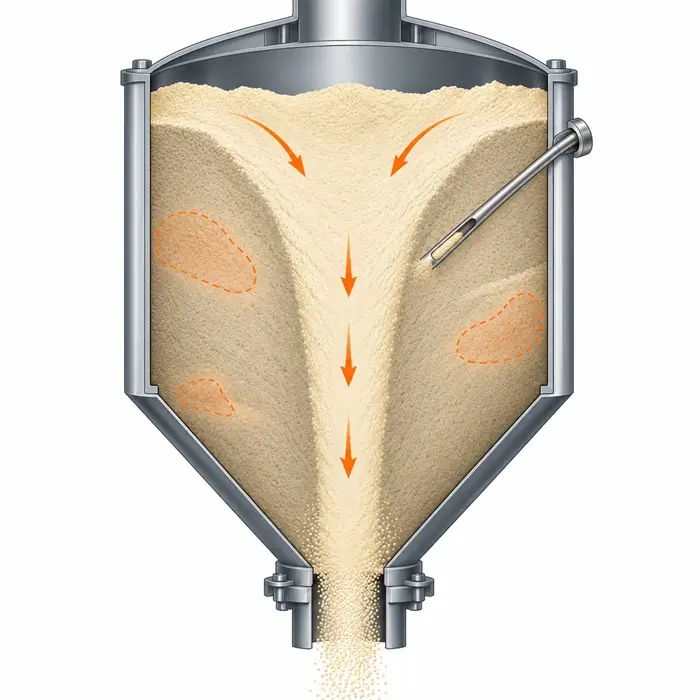
In bulk systems, thermal gradient segregation is usually driven first by natural convection rather than by a more exotic particle force. The logic is straightforward. A hotter fluid region expands and becomes less dense. A cooler region stays denser. Gravity then turns that density contrast into circulation.
Sidewall heating matters for exactly that reason. A tank in sunlight, a vessel near a warm utility line, a reactor with uneven jacket performance, or a drying setup with strong substrate to air differences can all create a persistent temperature asymmetry. Once that asymmetry lasts long enough, the fluid begins to recirculate. Suspended material follows those flow paths.
At first, the effect is rarely dramatic. It builds slowly, which makes it easy to miss. A system may still look visually stable while the local solids fraction, additive concentration, or particle residence history has already started to drift. Then a sample returns off spec, a dried film looks different, or product performance shifts across the batch.
Mechanical stillness does not guarantee internal stillness. When the material is fluid enough to circulate and the thermal asymmetry survives conduction, internal flow can develop.
For powder professionals, this is the key bridge. Once powders enter a liquid, melt, or solvent rich formulation, the problem is no longer only about classic dry powder segregation. It becomes a transport problem inside a temperature field. The right question is no longer “did it settle?” but “what moved the concentration field during the hold?”
When thermophoresis matters in thermal gradient segregation
Thermophoresis is real, but it needs proper framing.
In thermal gradient segregation, thermophoresis means particles move relative to the surrounding fluid because of a temperature gradient. In gases, the explanation is often framed in terms of asymmetric molecular momentum transfer. In liquids, the mechanism is more complex and more system dependent. The practical point is simpler. Thermophoresis becomes more relevant when particles are small, gradients are steep, and the geometry is tight.
That is why it is easier to defend in colloidal systems, microfluidic devices, thin drying films, and highly controlled analytical separations than in every ordinary process tank. Micron scale thermophoretic devices, for example, deliberately use strong local thermal gradients to move particles and molecules inside very small channels. That is not a vague theory. It is already a working class of tools and measurements.
Drying stratification in particle suspensions follows the same logic. During drying, evaporative cooling and substrate heating can create through thickness temperature gradients. Under those conditions, particle distribution may no longer follow the pattern expected from diffusion or evaporation rate alone.
That matters for coatings, printed layers, functional films, and other systems where particle placement through the thickness controls performance. Optical properties, barrier behavior, conductivity, and wear resistance can all shift when the particle distribution drifts during drying.
The practical rule is simple. In large bulk systems, start with convection. In thin films, fine suspensions, or steep micro scale gradients, add thermophoresis to the diagnosis.
Where dissolved species change the picture
Not every thermally driven segregation problem is a particle problem.
When the composition of interest is dissolved rather than suspended, thermal diffusion of solutes, often called the Soret effect, becomes relevant. A temperature gradient can shift one component toward the warmer region and another toward the cooler region. The direction and magnitude depend on the system. It is not something you infer confidently from intuition alone.
This matters most in systems where small composition shifts change density, crystallization behavior, or final performance. Semiconductor and alloy crystal growth are classic examples. In those systems, thermal and solutal transport couple to each other. Convection changes concentration. Concentration then changes density and feeds back into the flow field.
For industrial readers, the lesson extends beyond crystal growth. Once a dissolved additive, solvent fraction, or ionic species changes local density or phase behavior, composition stops being a passive output. It becomes part of the transport problem itself.
A thermally stressed formulation can therefore drift even when the visible particle pattern still looks acceptable. The solids may appear fairly uniform while the dissolved component distribution is already shifting the local environment.
Where thermal gradient segregation shows up in real processes
The strongest industrial cases usually share three traits. The system contains suspended solids or composition sensitive dissolved species. Heating is uneven. The hold time is long enough for transport to matter.
Coatings, inks, and drying films
Drying films are highly sensitive because evaporation, substrate temperature, air flow, and particle size all interact. When the thermal profile shifts the particle distribution through the thickness, color variation, conductivity drift, surface hardness changes, or poor barrier performance can follow. In these systems, thermal gradient segregation can alter the final structure even when the wet formulation looked fine at the start.
Thermal storage fluids and additive containing media
Storage systems that cycle between hot and cooler states can slowly drift if additive rich regions migrate over repeated exposure. That does not mean every thermal storage tank will fail through this mechanism. It means systems carrying dispersed or dissolved functional components should not assume long term uniformity without checking.
Slurries and formulated suspensions during static hold
Battery slurries, ceramic slurries, pigment dispersions, catalyst suspensions, and similar products often spend time in tanks, feed vessels, lines, or holding loops. Once that happens, asymmetrical heating can create a redistribution problem on top of normal settling, flocculation, or rheology effects. Diagnosis therefore has to separate thermal transport from the rest.
Crystal growth and composition sensitive melts
This is the most established example of coupled thermal and solutal transport. Here, the penalty can be severe because composition gradients become locked into the product.
How to diagnose thermal gradient segregation before quality drifts
Diagnosis should start with temperature asymmetry rather than with a guess about the particles.
Begin by asking where heat enters and where it leaves. Look for solar loading, hot jackets, trace heating, warm walls, poorly insulated sections, hot substrates, or evaporation driven cooling. Then ask whether the composition drift appears only after a static hold, thermal cycle, or drying step. When that pattern is present, you already have a strong clue.
Next, compare samples by location and time. One grab sample is not enough. In a bulk vessel, compare hot side versus cool side positions where practical, top versus bottom, and fresh mixed versus post hold conditions. In a film or coated layer, compare through thickness structure rather than only average composition. If the sampling plan is weak, fix that first.
After that, choose measurements that match the failure mode. The right route depends on the system, but useful tools may include particle size analysis, microscopy, solids concentration profiling, viscosity checks, solids content by location, spectroscopy for additive concentration, or cross section analysis for dried films.
A simple plant test can already be revealing. Mix the system to a known baseline, hold it under the suspect thermal condition, then repeat the same hold under a more uniform temperature condition. If the composition drift weakens sharply, the temperature field is part of the cause.
How to reduce thermal gradient segregation in practice
Start with the thermal field.
When the temperature asymmetry is strong, reduce it. Insulate the vessel. Shade outdoor tanks. Correct jacket maldistribution. Reduce wall hot spots. Control substrate temperature more tightly. Avoid unnecessary static holds near warm equipment.
Then decide whether gentle turnover is required. In some systems, mild recirculation is enough to prevent concentration drift without damaging the formulation. In others, recirculation can worsen shear exposure, entrain air, or change particle state. That tradeoff has to be judged against the formulation, not by rule of thumb.
Shorter hold times help as well. Better control of solids loading and rheology also slows convection driven redistribution and reduces the damage it can cause. In coatings and films, drying conditions need to be tuned as a transport problem. Air temperature, substrate temperature, solvent loss rate, and film thickness all matter together.
Most important, do not over assign the mechanism. In a bulk vessel containing larger particles, convection and settling will usually matter before thermophoresis does. In a fine system with a steep local gradient, thermophoresis deserves more attention. When dissolved composition controls product quality, include the Soret effect in the reasoning.
Thermal gradient segregation is a transport problem, not a mystery
The best way to think about thermal gradient segregation is as a hierarchy.
In bulk vessels and long static holds, start with natural convection. In finer dispersions, thin films, and micro scale geometries, add thermophoresis. In melts and true solutions where composition affects density or solidification, include thermal diffusion of solutes as well.
That hierarchy gives engineers a better starting point than blaming every problem on settling or treating every gradient as a thermophoresis story. It also aligns the diagnosis with the real geometry and time scale of the process.
There is one final twist. The same physics that causes trouble in products is also used deliberately in separation science. Thermal field flow fractionation, for example, exploits thermally driven migration to separate and characterize complex materials, polymers, and nanoparticles.
Once a thermal gradient starts changing composition, the system is already sorting material. The only open question is whether it is doing so in a way you want.
FAQ: Thermal gradient segregation
Check out these related articles


Advertisement
[the_ad id=”7029″]