

Powder waste in manufacturing rarely happens in one big spill. The drain is quieter. A thin layer left on hopper walls, a film inside a transfer pipe, a handful lost to the filter system. On a daily basis, nobody notices. Yet across a year, those small amounts grow into tonnes.
The problem is sharper when powders are valuable. Pharmaceutical actives, specialty metals, or engineered additives carry a high cost per gram. Even basic commodities, though cheaper, hit margins when consistent losses push yield down.
Where powder waste in manufacturing occurs
The sources of powder waste are rarely dramatic. They tend to be routine.
-
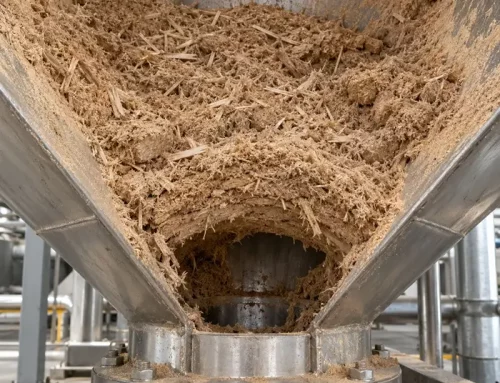
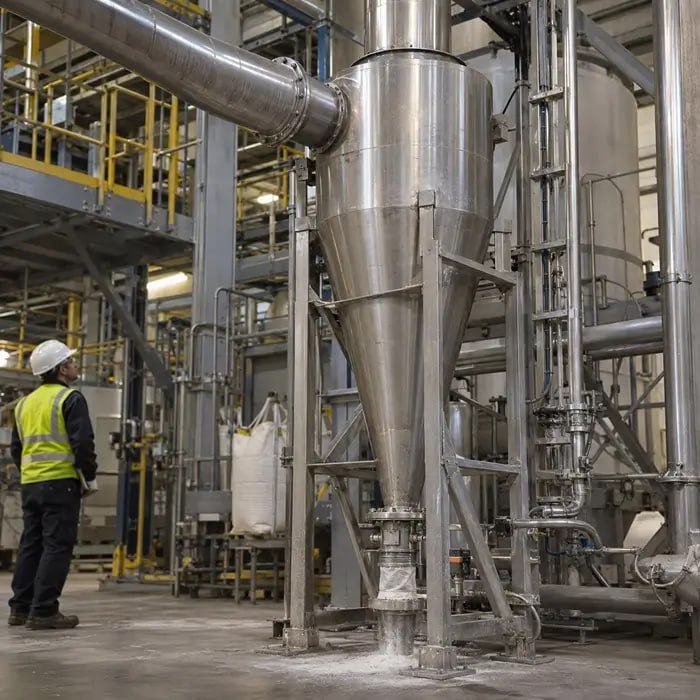
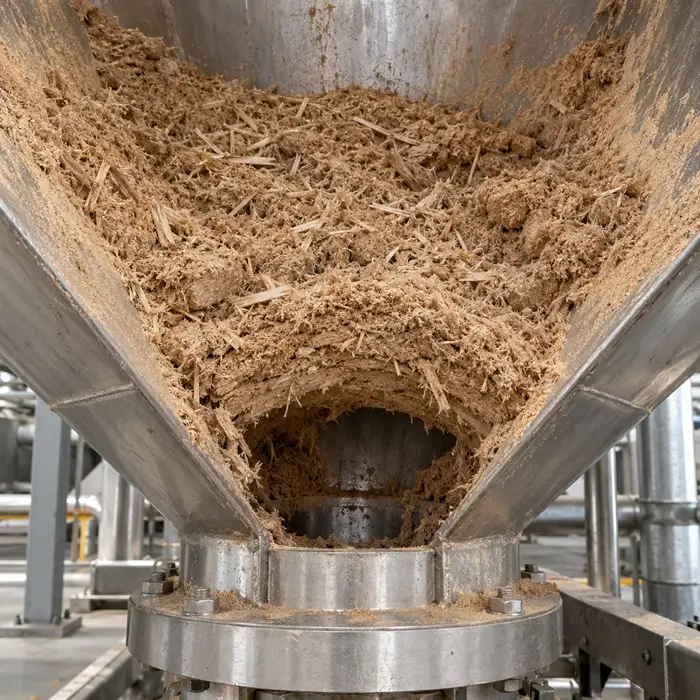
Adhesion inside mixers, silos, or feeders.
-
Segregation leading to batches that fail spec.
-
Dust collected by extraction systems, often discarded.
-
Residual hold-up during changeovers.
-
Moisture uptake that ruins sensitive stock.
Individually, none of these will bankrupt a plant. Together, they quietly define operating margin.
Numbers Change the Picture
Imagine a line running 5,000 tonnes a year. A 0.5% loss sounds trivial until you convert it: 25 tonnes gone. If the product is worth €500 per tonne, that’s €12,500 out the door. In higher-value systems — inhalable APIs, titanium alloys, engineered ceramics- the figure is far greater.
And that is only direct loss. Every kilogram wasted is consumed in drying, milling, conveying, and labour hours. Reprocessing costs more time and energy. Disposal adds another bill. Hidden multipliers mean the true economic impact is often double the first calculation.
Scale-Up Makes It Worse
Pilot runs usually underestimate waste. Small test rigs have less surface area, shorter transfer paths, and simple cleaning. Once the process scales, every factor compounds.
That thin layer on a bench mixer becomes kilograms in a 10-m³ vessel. A short pilot conveyor turns into a complex plant network with bends and drops. Even bagging and silo discharge introduce new loss points.
Companies often learn this the hard way: yield projections made in the lab collapse under production conditions.
How to Limit Loss
There is no single cure, but small steps add up.
-
Map every transfer step and track hold-up.
-
Improve changeover routines to reduce residual product.
-
Where feasible, recycle captured fines instead of discarding them.
-
Consider smoother equipment surfaces or coatings for cohesive powders.
-
Train operators, since many losses occur in manual handling.
Plants that treat waste as a measurable KPI often unlock savings faster than expected. The investment in monitoring usually pays back within a year.
Beyond Cost
Powder loss is not only about balance sheets. Each wasted kilogram carries an environmental footprint: mined, transported, and processed only to be discarded. Lowering loss reduces both emissions and energy use, which increasingly matters for compliance and reporting.
There’s also a quality dimension. Off-spec batches that require blending back in add variability. Consistency improves when waste declines, and so does customer trust.
From Background Noise to Control Point
Too often, waste is accepted as background noise. Plants focus on throughput and assume a certain tolerance. But tolerance is not free. Once you measure and benchmark actual loss rates, the numbers often shock.
The real step change comes from reframing powder waste as a process parameter to control. Plants that take this view usually see a margin lift, smoother production, and fewer disputes downstream.
Closing Insight
Powder waste rarely makes headlines in a factory. It doesn’t look dramatic, yet it shapes both cost and efficiency more than most teams realise. In a competitive industry, cutting that hidden loss can be the fastest route to stronger margins.