
Powder property
Surface energy
Surface chemistry controls interaction even when particles look similar
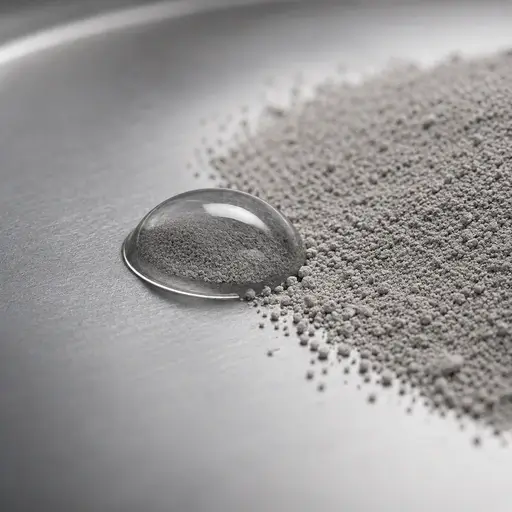
Surface energy describes the excess free energy associated with a particle surface and helps explain how that surface interacts with solids, liquids, and gases. It influences adhesion, cohesion, wetting, coating, dispersion, and reaction, but its practical effect depends on surface chemistry, roughness, contamination, environment, and the contacting phase.
Powder property
Surface energy
Surface chemistry controls interaction even when
particles look similar
Surface energy describes the excess free energy associated with a particle surface
and helps explain how that surface interacts with solids, liquids, and gases.
It influences adhesion, cohesion, wetting, coating, dispersion, and reaction,
but its practical effect depends on surface chemistry, roughness, contamination,
environment, and the contacting phase.




Core concept
Surface energy controls surface interaction
Surface energy reflects the excess free energy associated with a surface relative to the bulk. When another phase contacts that surface, the resulting behavior depends on the interfacial energies and chemistry of both phases, so one surface-energy value cannot predict every solid-solid or solid-liquid interaction. Particle size and porosity determine how much surface is available, while chemistry and contamination determine the character of that surface. Roughness changes real contact and may either increase mechanical interlocking or prevent close molecular contact. Use surface-energy evidence to explain a defined interaction, then confirm the bulk or process consequence under relevant humidity, temperature, stress, and contact conditions.
What controls it
Six groups of variables govern surface energy
The effective surface seen by the process can differ from the underlying material because the outermost molecular layers respond strongly to treatment and environment.
States and interpretation
Different probes reveal different surface interactions
Match probe chemistry and measurement scale to the interface responsible for the process behavior.
| Measurement view | What it represents | Main limitation | Best decision use |
|---|---|---|---|
| Contact angle | Wetting of a prepared surface by a defined liquid | Surface roughness, porosity, absorption, and preparation can distort the angle | Comparing liquid-solid compatibility |
| Inverse gas chromatography | Dispersive surface energy and specific interactions across probe coverage | Results depend on probes, coverage, and surface accessibility | Surface-energy distributions and batch comparison |
| Vapor or liquid sorption | Affinity and uptake under controlled vapor or liquid activity | Combines surface interaction with pore access and bulk absorption | Moisture or solvent sensitivity |
| Adhesion-force measurement | Force between selected particles, probes, or substrates | Small contact population may not represent the bulk network | Validating a specific interface mechanism |
How to measure it
Choose a method by the interface under investigation
No single method captures every surface interaction. Use a probe and preparation route that represent the actual contacting phase and decision.
Where it matters
Surface energy becomes an interaction and compatibility constraint
Surface condition matters where particles must contact, separate, coat, wet, bond, or react with another phase.
Go deeper
Three practical routes into particle surfaces
Explore how geometry, wetting behavior, and energetic state combine to control surface-driven powder performance.



Need the measurement, not just the guidance?
If the remaining uncertainty concerns surface-energy distributions, wetting, adhesion, coating effects, surface chemistry, or interaction changes after processing, select the measurement around the material state and process decision. PowderTechnology.info can help define the test sequence, sample conditions, and interpretation route. For laboratory support, explore our Delft Solids Solutions partner page or visit Delft Solids Solutions directly.