
Powder property
Particle shape and morphology
Geometry and surface form change how particles contact, move, and transform
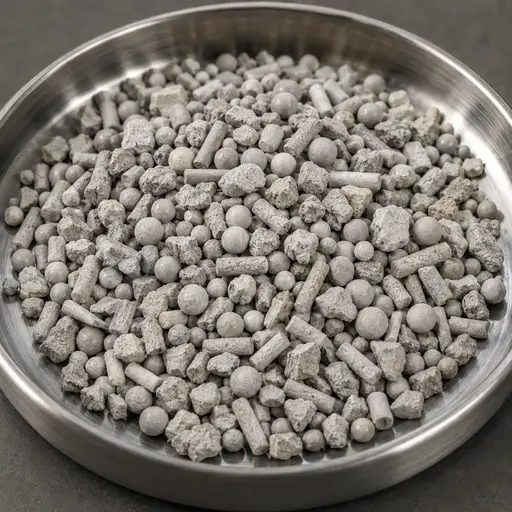
Particle morphology describes external particle form, including sphericity, aspect ratio, angularity, roundness, convexity, and surface texture. Shape changes contact geometry, packing, mobility, breakage, and interfacial behavior even when the particle size distribution remains similar.
Powder property
Particle shape and morphology
Geometry and surface form change how particles contact,
move, and transform
Particle morphology describes external particle form, including sphericity, aspect ratio,
angularity, roundness, convexity, and surface texture. Shape changes contact geometry,
packing, mobility, breakage, and interfacial behavior even when the particle size
distribution remains similar.




Core concept
Shape belongs with size, not behind it
Particles with the same equivalent diameter can be spherical, flaky, needle-like, angular, porous, or rough. Those forms create different contact networks and respond differently to gravity, shear, impact, and liquid interfaces. A single average shape value can hide a small population of elongated fragments or irregular agglomerates that controls screening, spreading, or visible defects. Describe the relevant dimensions and shape distribution rather than labeling a powder simply spherical or irregular.
What controls it
Six morphology features influence particle behavior
Morphology affects performance through several linked geometric features. The controlling descriptor depends on the process mechanism.
States and interpretation
Morphology depends on scale and observation method
Choose descriptors and imaging scale that reveal the feature controlling the process.
| Observation route | What it reveals | Main limitation | Best use |
|---|---|---|---|
| Dynamic image analysis | Population distributions for projected size and shape | Two-dimensional orientation and finite counts | Routine comparison and rare-shape screening |
| Optical microscopy | Direct visual form, agglomerates, and defects | Limited depth and smaller sampled population | Targeted confirmation |
| SEM | High-resolution external morphology and texture | Small field of view and vacuum preparation | Surface and fracture detail |
| X-ray micro-CT | Three-dimensional external and internal structure | Resolution, scan time, and segmentation limits | Internal pores, shells, and 3D morphology |
How to measure it
Choose a measurement by the morphology question
No single method resolves population statistics, surface texture, and internal three-dimensional structure equally well.
Where it matters
Particle morphology becomes a contact and mobility constraint
Shape changes how particles pack, orient, transmit stress, contact surfaces, and respond to separation forces.
Go deeper
Three practical routes into particle morphology
Explore how particle form changes flow, industrial performance, and the interpretation of surface-driven behavior.


Need the measurement, not just the guidance?
If the remaining uncertainty concerns particle morphology, shape distributions, surface texture, internal structure, or a process-dependent shape effect, select the measurement around the material state and process decision. PowderTechnology.info can help define the test sequence, sample conditions, and interpretation route. For laboratory support, explore our Delft Solids Solutions partner page or visit Delft Solids Solutions directly.