
Powder property
Chemical reactivity
Reaction depends on the accessible surface, contact, and conditions
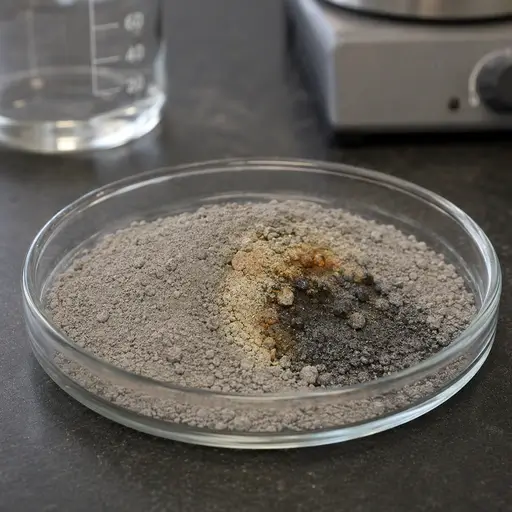
Chemical reactivity describes the tendency and rate of a material to undergo chemical change under defined conditions. Composition establishes what reactions are possible, while particle size, surface state, defects, moisture, atmosphere, mixing, temperature, impurities, and heat and mass transfer determine where and how quickly those reactions occur.
Powder property
Chemical reactivity
Reaction depends on the accessible surface, contact,
and conditions
Chemical reactivity describes the tendency and rate of a material to undergo
chemical change under defined conditions. Composition establishes what
reactions are possible, while particle size, surface state, defects, moisture,
atmosphere, mixing, temperature, impurities, and heat and mass transfer
determine where and how quickly those reactions occur.




Core concept
Bulk composition does not reveal where a reaction begins
Powder reactions frequently start at surfaces, defects, fine fractions, phase boundaries, or locally enriched contaminants. These regions can react faster than the bulk average because they combine accessible area, mobility, catalytic species, and favorable temperature or moisture. Processing changes that landscape. Milling exposes fresh surfaces, segregation concentrates fines, moisture migrates, coatings wear, and thermal gradients create local reaction conditions. A composition result can remain within specification while reactivity changes. Measure the material state and the reaction response under representative atmosphere, temperature, time, contact, and scale.
What controls it
Six groups of variables govern chemical reactivity
Observed reactivity reflects intrinsic chemistry combined with accessible interface, species mobility, activation energy, catalytic sites, and removal of heat or products.
States and interpretation
The same composition can show different reactive behavior
Identify whether the change comes from surface state, transport, catalysis, phase identity, or thermal history.
| Reactive state | Possible driver | Useful evidence | Main risk |
|---|---|---|---|
| Freshly milled | New surface, defects, heat, contamination, and smaller particles | Surface analysis, PSD, temperature, and comparative reactivity | Unexpected rate increase or oxidation |
| Moisture conditioned | Species mobility, hydration, hydrolysis, or capillary contact | Water activity, DVS, phase, and thermal response | Storage drift and localized reaction |
| Locally contaminated | Catalytic trace species or incompatible carryover | Spatially resolved composition and fraction testing | Hot spots hidden by bulk analysis |
| Thermally aged | Oxidation, phase conversion, decomposition, or passivation | DSC/TGA, evolved gas, phase, and surface chemistry | Loss of function or self-heating |
How to measure it
Choose a reactivity method by the reaction pathway
Use complementary composition, surface, thermal, gas, and kinetic measurements when one bulk result cannot locate the active mechanism.
Where it matters
Chemical reactivity becomes a stability, conversion, and selectivity constraint
The process controls which surfaces meet, how species move, and whether heat and reaction products can escape.
Go deeper
Three practical routes into powder reactivity
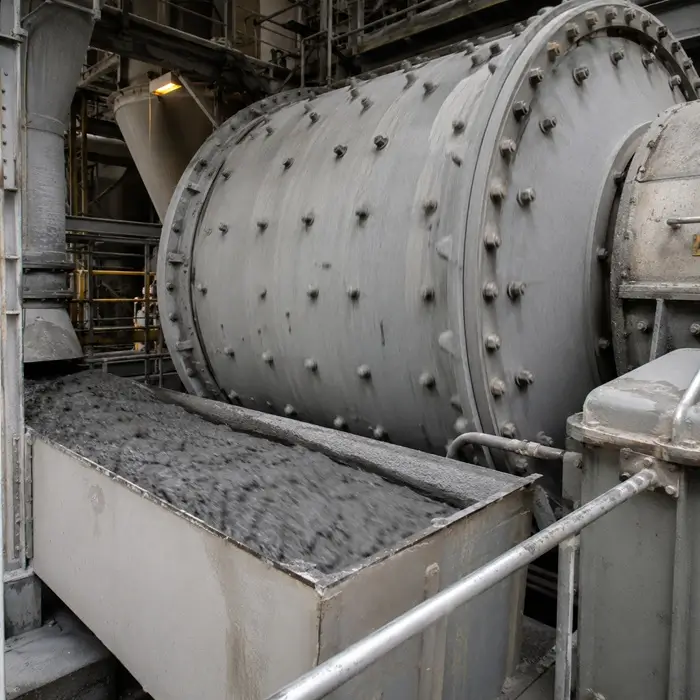
Explore localized catalytic hot spots, gradual chemical and surface aging, and an applied case where fineness and grinding history influence cementitious reaction.


Need the measurement, not just the guidance?
If the remaining uncertainty concerns thermal reactivity, oxidation, compatibility, kinetic response, evolved gases, catalytic hot spots, or process-conditioned stability, select the measurement around the material state and process decision. PowderTechnology.info can help define the test sequence, sample conditions, and interpretation route. For laboratory support, explore our Delft Solids Solutions partner page or visit Delft Solids Solutions directly.