
Powder property
Wettability
Initial liquid contact determines whether powder wets, floats, or clumps
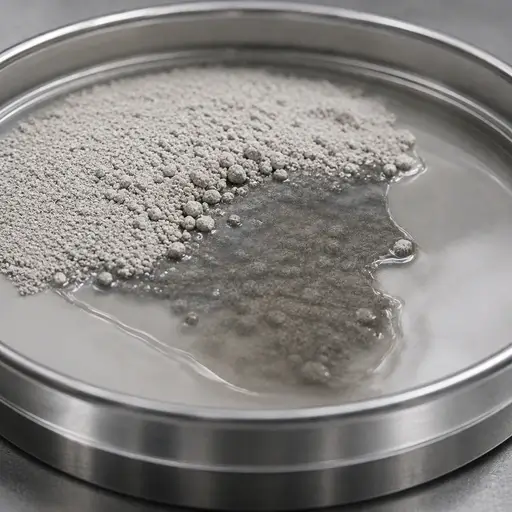
Wettability describes how readily a liquid establishes and spreads contact across a solid surface while displacing air. Surface chemistry, liquid surface tension, particle morphology, porosity, roughness, agglomeration, and the method of liquid addition determine whether powder wets rapidly or forms floating layers and persistent dry cores.
Powder property
Wettability
Initial liquid contact determines whether powder
wets, floats, or clumps
Wettability describes how readily a liquid establishes and spreads contact across
a solid surface while displacing air. Surface chemistry, liquid surface tension,
particle morphology, porosity, roughness, agglomeration, and the method of liquid
addition determine whether powder wets rapidly or forms floating layers and persistent dry cores.




Core concept
Wetting is the first liquid-solid contact event.
A powder must first establish contact with the liquid. It may then deagglomerate, disperse, dissolve, react, or remain as a suspended solid. Failure at the first step creates floating powder, fisheyes, dry cores, and long incorporation times. Contact angle is useful on a suitable surface, but real powders present rough, porous, chemically heterogeneous beds that absorb liquid and trap air. The observed response therefore combines surface affinity with capillary structure and preparation. Use a method that preserves the relevant surface state and matches the liquid, temperature, addition route, and timescale of the process.
What controls it
Six groups of variables govern wettability
Wetting begins when liquid-solid affinity and capillary pressure overcome air displacement, unfavorable surface chemistry, and structural resistance.
States and interpretation
Different wetting routes reveal different aspects of liquid contact
Choose the specimen geometry and endpoint that represent the process rather than forcing one universal wetting value.
| Wetting view | What it represents | Main limitation | Best decision use |
|---|---|---|---|
| Sessile drop | Spreading on a prepared compact or flat surface | Compaction changes roughness and porosity | Comparative surface affinity |
| Capillary penetration | Liquid uptake through a prepared powder bed | Packing and pore structure affect the result | Powder-bed penetration and Washburn analysis |
| Immersion or sink time | Time to submerge under defined agitation | Couples density, air, and surface effects | Rapid formulation screening |
| Dynamic incorporation | Wetting during controlled addition and mixing | Equipment and energy are method-specific | Process-scale addition strategy |
How to measure it
Choose a wettability method by the contact event
Distinguish intrinsic surface affinity from bed penetration and process-assisted incorporation.
Where it matters
Wettability becomes an incorporation and uniformity constraint
Wetting matters wherever dry particles first meet a liquid, binder, coating, melt, or biological medium.
Go deeper
Three practical routes into powder wettability
Explore the mechanisms behind floating and clumping, food and feed reconstitution, and dissolution where surface contact controls performance.


Need the measurement, not just the guidance?
If the remaining uncertainty concerns contact angle, capillary penetration, sink time, trapped air, surfactant response, or process-assisted powder incorporation, select the measurement around the material state and process decision. PowderTechnology.info can help define the test sequence, sample conditions, and interpretation route. For laboratory support, explore our Delft Solids Solutions partner page or visit Delft Solids Solutions directly.