
Troubleshooting

Adhesion, sticking and fouling

Wall films, localized deposits, and bulk cohesion point to different mechanisms
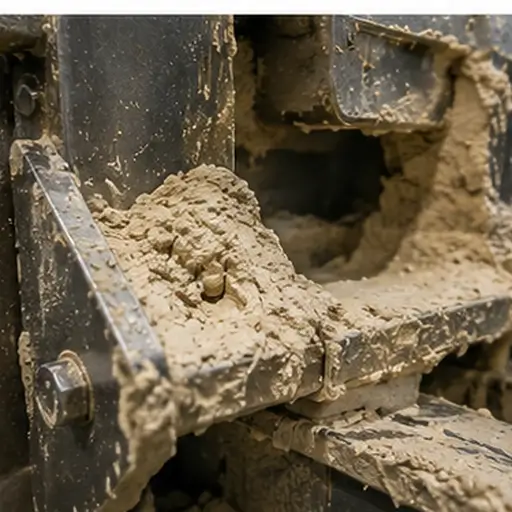
Illustration of adhesion, sticking and fouling in powder processing.

Start with deposit location, texture, removability, and growth rate. Separate adhesive powder-wall forces from cohesive buildup, softening, condensation, electrostatics, reaction films, and mechanical trapping.


Troubleshooting

Adhesion, sticking and fouling

Wall films, localized deposits, and bulk cohesion point to different mechanisms

Start with deposit location, texture, removability, and growth rate. Separate adhesive powder-wall forces from cohesive buildup, softening, condensation, electrostatics, reaction films, and mechanical trapping.

By what you see

By what you see

A thin film coats a surface; deposits thicken during operation; powder sticks to tools, screens, walls, or repeated contact points.

By what changed

By what changed

After storage, transfer, cleaning, or a shift in temperature, humidity, contact surface, batch, particle size, composition, or recycle.

By likely mechanism

By likely mechanism

Separate adhesive surface interaction, softening or tack, electrostatic adhesion, condensation films, and reaction or binder buildup.

By measurement route

By measurement route

Choose measurements that distinguish wall interaction, thermal or moisture thresholds, electrostatics, and changes in deposit composition.

Find your route

Start with the observed failure, then add context

Start with deposit location, texture, removability, and growth rate. Separate adhesive powder-wall forces from cohesive buildup, softening, condensation, electrostatics, reaction films, and mechanical trapping.

  1. 1Observation
  2. 2Change or context
  3. 3Route

Step 1  What are you seeing?

Step 2  What changed, or when does it happen?

The same adhesion, sticking and fouling pattern can come from a different mechanism after refill, storage, conveying, a humidity shift, or a change in the powder itself.

Step 3  Your diagnostic route

Quick diagnostic comparison

Separate the leading routes before changing the process

Use the pattern and event history to select the first discriminating measurement. The table is a triage aid, not a substitute for reproducing the failed state.

Use the observed pattern and the change that preceded it to select the first discriminator. The pattern does not prove the mechanism.

What you observeWhat changedLikely mechanismMeasurement that separates it
A thin film coats a specific surfaceAfter feeding and dosing settings or contact surfaces changedAdhesive surface interactionWall interaction: Does adhesion change with the actual surface finish or coating?
A deposit thickens during operationAfter storage and hopper dischargeSticky or softened materialThermal and moisture window: Is there a threshold for sticking?
Sticking is localized to warm surfacesAfter surface temperature, humidity, or cleaning changedElectrostatic adhesionElectrostatics: Does charge correlate with deposition?
Sticking is localized to cold surfacesAfter pneumatic conveying and receiversCondensation and liquid filmsDeposit composition: Is the fouling layer chemically or physically different from the feed?

Use the measurement under the material state and process conditions that produced the failure.

Likely mechanisms

Separate surface attraction, tack, electrostatics, liquid films, and persistent deposits

A deposit does not identify its cause. Use where it forms, how quickly it grows, whether it is removable, and what changed before the failure to choose the first discriminating measurement.

Adhesive surface interaction

Powder-wall attraction exceeds the forces removing material from the boundary, so deposition follows the actual surface finish, roughness, coating, and contact history.

Separate it with: comparison with the real process surface and wall-interaction testing.
Sieve Blinding: Why Powder Screens Fail Before the Particle Size Spec Does

Sticky or softened material

Temperature, moisture, binder state, or another formulation change moves part of the powder into a tackier condition that persists under repeated contact.

Separate it with: conditioned testing across the suspected temperature and moisture window.
Moisture Control for Powders

Electrostatic adhesion

Charge generated during transfer or repeated contact can increase deposition on insulating or poorly dissipative surfaces without changing bulk composition.

Separate it with: charge generation, relaxation, humidity, and the actual powder-surface contact pair.
Triboelectric Charging in Powders: Why Humidity Matters

Condensation and liquid films

A cold surface crossing the local dew point can create a thin liquid film that sharply increases adhesion even when average room humidity looks acceptable.

Separate it with: surface temperature, local dew point, and matched environmental conditioning.
Moisture Control for Powders

Reaction or binder buildup

A chemical change, binder redistribution, or reacted first layer can create a persistent film that then captures additional powder during operation.

Separate it with: deposit chemistry compared with the feed and a known-good reference.

ⓘ Diagnostic note

The deposit is evidence, not the mechanism

Preserve a representative sample of the deposit before cleaning. Location, layer structure, composition, and removability can distinguish a surface-force problem from softening, condensation, electrostatics, or a chemically changed film.

Measurement routes

Measure the interaction that creates the deposit

Match the measurement to the uncertainty. Surface interaction, temperature and moisture history, electrostatics, and deposit composition answer different questions and should not be treated as interchangeable.

Surface interaction

Check whether adhesion changes with the actual wall, liner, coating, roughness, or tooling surface rather than assuming the powder has one fixed sticking tendency.

Thermal, moisture & electrostatics

Reproduce the failed temperature, humidity, dew-point, and contact conditions to determine whether tack, condensation, or charge correlates with deposition.

Deposit identity & composition

Compare the deposit with the feed to determine whether the retained layer is compositionally enriched, physically different, contaminated, or chemically changed.

Process context

Where the deposit forms changes what to check first

Keep the surface, temperature, residence time, contact history, stress, and environment attached to the diagnosis. The same powder can foul for a different reason at a different process step.

01

Storage & discharge

Wall films can increase friction, retain product, and change discharge where long residence time and surface condition amplify the interaction.

02

Conveying & transfer

Bends, chutes, pipes, and receivers add repeated contact, impact, temperature change, and electrostatic charging that can localize deposits.

03

Feeding & dosing

Fouling on screws, hoppers, tools, or refill surfaces can change effective geometry, channel fill, and low-rate delivery as buildup develops.

04

Screening & classification

Mesh blinding and surface coating can reduce open area or alter separation even when the incoming particle-size distribution remains acceptable.

05

Mixing & blending

Binder distribution, local heating, repeated contact, or component differences can create tack and surface retention during mixing and discharge.

06

Forming & packaging

Tooling, dies, rolls, filling equipment, and package walls can create new contact pairs or pressure and temperature conditions that promote sticking.

Go deeper

Guides and articles for adhesion, sticking, and fouling

Use the deeper technical material to separate surface interaction, moisture and temperature effects, electrostatic deposition, and equipment-specific blinding or buildup.

Powder sieve blinding caused by adhesion and particle buildup

Sieve Blinding: Why Powder Screens Fail Before the Particle Size Spec Does and How to Solve it

Shows how adhesion, agglomeration, particle shape, and loading reduce open mesh area and change separation before the incoming size specification necessarily changes.

Triboelectric charging and powder adhesion under changing humidity

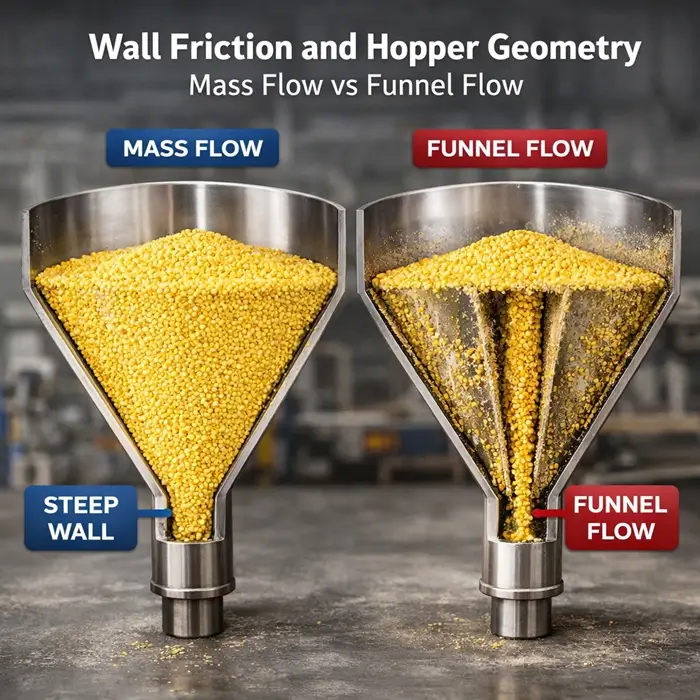
Wall Friction and Hopper Geometry: Why Some Bins Mass Flow and Others Funnel Flow

Explains how powder-wall friction, surface condition, and hopper geometry determine whether material moves cleanly or leaves retained zones and buildup.

Moisture control for powders using dew point and water activity

Changeover Losses in Continuous Powder Lines: 5 Fast Wins to Boost Efficiency

Shows how retained powder, difficult-to-clean contact surfaces, and line hold-up increase changeover losses, carryover risk, and cleaning demand in continuous processing.

Understand adhesion

Use the Particle Behavior child for surface attraction, sticking, fouling, and the variables that control powder-wall interaction.

Browse adhesion articles

Open the Adhesion filter in the central PTI article archive for related technical articles and applied examples.

Choose the right test

Compare surface, electrostatic, moisture, and composition methods to separate the mechanism behind the deposit.

Follow the process route

Use Process & Equipment when the deposit is tied to storage, transfer, feeding, screening, tooling, or repeated surface contact.

FAQ

Adhesion, sticking and fouling questions

Adhesion is primarily a particle-to-surface interaction, while cohesion describes attraction within the powder bed or between particles. If the problem follows a specific wall, liner, tool, or mesh and changes when that surface changes, adhesion is more plausible. If the powder forms self-supporting lumps or strong bulk structures away from the wall, investigate cohesion and consolidation as well.
Warm surfaces can reveal softening, melting, binder activation, or temperature-driven reaction. Cold surfaces can cross the local dew point and form a thin liquid film that increases adhesion. Map the actual surface temperature and environmental history before treating both patterns as the same sticking problem.
Yes. Repeated contact can generate charge, and insulating or poorly dissipative surfaces can retain an electric field long enough to increase deposition. Compare charge generation and relaxation under the actual contact pair and humidity rather than assuming a fixed electrostatic tendency for the powder.
Yes. Cleaning residues, roughness, coatings, liner changes, and surface wear can alter powder-wall interaction or the triboelectric contact pair. Compare the failed surface with a known-good surface under the same powder state and process conditions.
The deposit may be compositionally different from the feed because fines, binder-rich material, reacted species, wear debris, or another fraction is preferentially retained. Deposit-versus-feed comparison can therefore separate simple surface retention from chemical change, contamination, or fractionation.
Start with the process location and deposit pattern. Use surface or wall-interaction testing when the boundary is suspect, moisture and temperature conditioning for tack or condensation, electrostatic testing for charge-assisted deposition, and composition or morphology analysis when the deposit may differ from the feed.

Independent diagnostic support

Need the measurement, not just the guidance?

PowderTechnology.info works closely with Delft Solids Solutions, a contract research organization specializing in the physical behavior of powders and granules. DSS provides contract testing and characterization, with its laboratory working in accordance with ISO 17025. Contact Delft Solids Solutions.