
Powder property
Moisture sensitivity
Moisture sensitivity depends on water availability
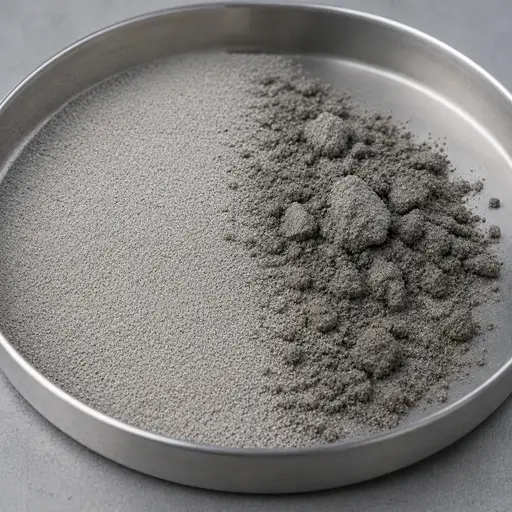
Moisture sensitivity describes how a powder responds to water vapor, liquid water, and changes in relative humidity or temperature. Adsorption, absorption, capillary condensation, deliquescence, hydrate formation, plasticization, dissolution, and recrystallization can alter flow, caking, stability, charge, density, and product performance.
Powder property
Moisture sensitivity
Moisture sensitivity depends on water availability
Moisture sensitivity describes how a powder responds to water vapor, liquid water,
and changes in relative humidity or temperature. Adsorption, absorption, capillary
condensation, deliquescence, hydrate formation, plasticization, dissolution, and
recrystallization can alter flow, caking, stability, charge, density, and product performance.




Core concept
Moisture sensitivity is a response curve, not a single value
Moisture content reports how much water is present under a defined method. Water activity describes the effective availability of that water. Hygroscopicity describes uptake from the surrounding atmosphere, while deliquescence is a transition to a solution above a critical humidity. Two powders with the same water content can therefore behave differently because water is bound differently or distributed across surfaces, pores, and phases. Temperature changes equilibrium, kinetics, transition thresholds, and local relative humidity when vapor content is fixed. Define the exposure path and the resulting functional change. Uptake alone does not show whether the consequence is caking, softening, reaction, loss of charge, altered dissolution, or no meaningful process effect.
What controls it
Six groups of variables govern moisture sensitivity
The relevant moisture state emerges from material affinity, accessible structure, environmental driving force, and exposure time.
States and interpretation
Similar moisture contents can represent different risks
Interpret water amount together with its availability, location, phase, and effect on performance.
| Moisture state | What may occur | Interpretation risk | Useful confirmation |
|---|---|---|---|
| Surface adsorption | Reversible uptake on accessible surfaces | Small mass change may still alter cohesion or charge | Sorption isotherm with functional testing |
| Capillary condensation | Liquid forms in fine pores or particle contacts | Bulk moisture content may hide localized bridges | Humidity cycling and pore-structure context |
| Absorption or plasticization | Water enters the material and changes mobility or softness | Drying may not restore the original physical state | DSC, mechanical response, and sorption kinetics |
| Deliquescence or hydrate transition | Dissolution, crystallization, or phase conversion occurs | A threshold response can be missed by one RH point | Controlled RH scan with phase analysis |
How to measure it
Choose a method by the moisture mechanism
Combine water amount with activity, sorption behavior, phase response, and the process property that changes.
Where it matters
Moisture sensitivity becomes an environmental operating-window constraint
Control the local material environment across every step where exposure or temperature can change powder state.
Go deeper
Three practical routes into powder moisture response
Explore formulation risk, environmental operating windows, and the measurement of hygroscopic response under controlled conditions.


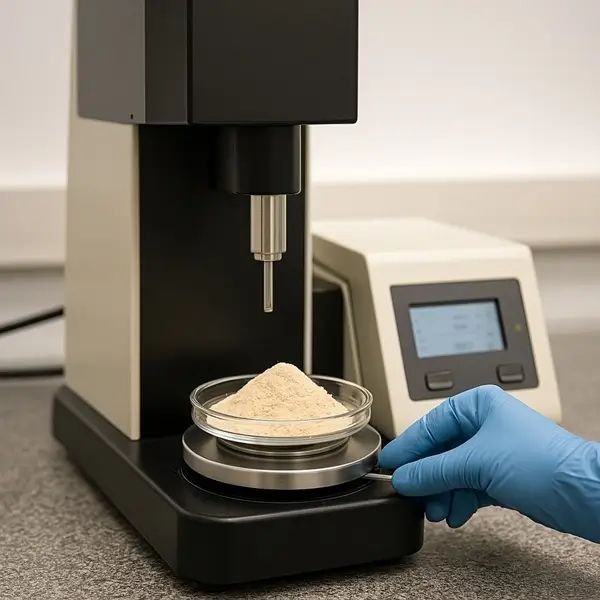
Need the measurement, not just the guidance?
If the remaining uncertainty concerns water content, water activity, sorption behavior, deliquescence, humidity-conditioned flow, packaging exposure, or moisture-driven transformation, select the measurement around the material state and process decision. PowderTechnology.info can help define the test sequence, sample conditions, and interpretation route. For laboratory support, explore our Delft Solids Solutions partner page or visit Delft Solids Solutions directly.