
Troubleshooting
Bonding and transformation problems
Weak bonds, incomplete cure, uneven reaction, and unwanted phase change begin with contact and transport
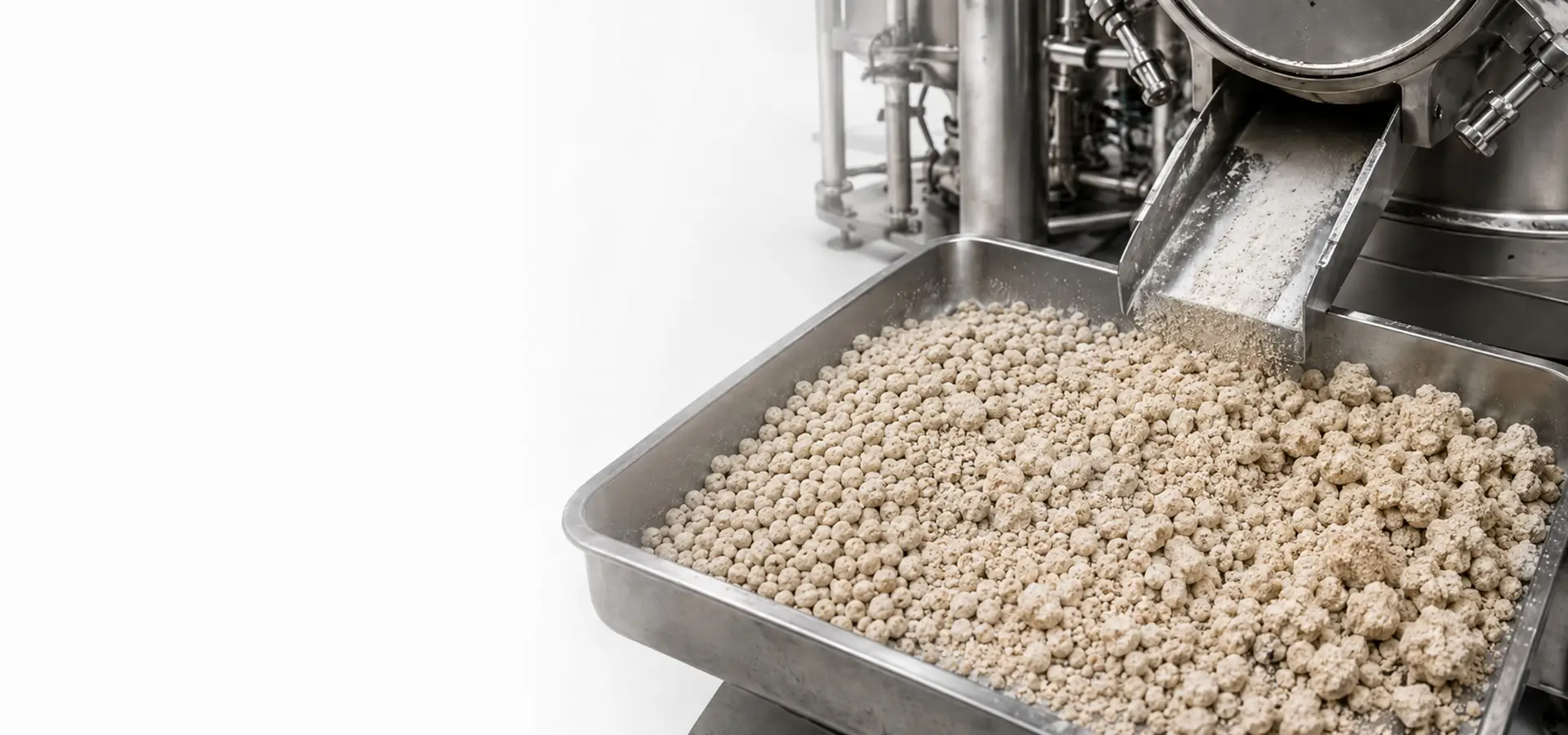
Locate whether failure begins at particle contact, binder distribution, heat or mass transfer, reaction kinetics, or post-process exposure. Bulk composition can be correct while local interfaces remain wrong.
Troubleshooting
Bonding and transformation problems
Weak bonds, incomplete cure, uneven reaction, and unwanted phase change begin with contact and transport
Locate whether failure begins at particle contact, binder distribution, heat or mass transfer,
reaction kinetics, or post-process exposure. Bulk composition can be correct while local
interfaces remain wrong.




Find your route
Start with the observed failure, then add context
Locate whether failure begins at particle contact, binder distribution, heat or mass transfer, reaction kinetics, or post-process exposure. Bulk composition can be correct while local interfaces remain wrong.
- 1Observation
- 2Change or context
- 3Route
Step 1 What are you seeing?
Step 2 What changed, or when does it happen?
The same bonding and transformation problems pattern can come from a different mechanism after refill, storage, conveying, a humidity shift, or a change in the powder itself.
Step 3 Your diagnostic route
Quick diagnostic comparison
Separate the leading routes before changing the process
Use the pattern and event history to select the first discriminating measurement. The table is a triage aid, not a substitute for reproducing the failed state.
Use the observed pattern and the change that preceded it to select the first discriminator. The pattern does not prove the mechanism.
| What you observe | What changed | Likely mechanism | Measurement that separates it |
|---|---|---|---|
| The product forms but lacks strength | After powder preparation and blending | Poor contact or binder distribution | Conversion and bond strength: Does mechanical performance track reaction extent? |
| Surface transforms while the interior remains incomplete | After the time-temperature path or binder distribution changed | Heat-transfer limitation | Thermal history: Did all locations experience the intended time-temperature path? |
| Properties vary spatially or between batches | With a changed batch, PSD, composition, or recycle fraction | Mass-transfer limitation | Permeability and gas transport: Can reactants and products move through the bed? |
| Discoloration, degradation, or excess transformation occurs | After heating, curing, or reaction settings or contact surfaces changed | Reaction-kinetic variation | Surface and phase analysis: Is a film, polymorph, or degradation product controlling the interface? |
Use the measurement under the material state and process conditions that produced the failure.
Likely mechanisms
What can create this bonding or transformation failure
Separate interface contact, heat and mass transport, intrinsic reaction rate, and competing transformation before changing formulation, cycle time, or equipment.
Measurement routes
Measure the uncertainty, not the symptom
Use measurements that distinguish interface quality, temperature history, transport through the bed, and material transformation under the actual failed process state.
Process context
Where the problem appears changes what to check first
Keep preparation, contact formation, heat and mass transport, residence time, atmosphere, and post-process exposure attached to the failed state.
Go deeper
Guides and articles for bonding and transformation failures
Use the deeper material to separate interface chemistry, reaction behaviour, degradation, and process-specific bonding before changing the full manufacturing route.

FAQ
Bonding and transformation questions
Independent diagnostic support
Need the measurement, not just the guidance?
PowderTechnology.info works closely with Delft Solids Solutions, a contract research organization specializing in the physical behavior of powders and granules. DSS provides contract testing and characterization, with its laboratory working in accordance with ISO 17025. Contact Delft Solids Solutions.