
Table of contents

Introduction: From Static Particles to Dynamic Systems
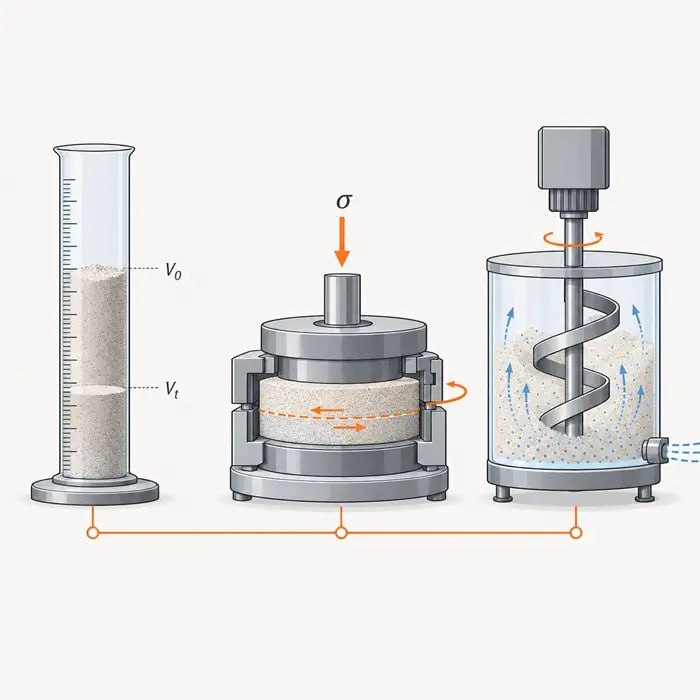
Modern powder systems do more than just flow. They respond to energy. Whether undergoing compression, shear, thermal exposure, or mixing, powders store, release, and transform energy. These transitions affect flowability, stability, and reactivity.
To understand these behaviors, we must first explore how powders behave as dynamic, energy-distributing systems, rather than as static solids. Energetic states and chemical dynamics form the hidden framework behind powder transformations. From surface activation during coating to caking during storage, each outcome is driven by the interplay of particle-level energy modes, force chains, and thermodynamic gradients.
Therefore, we delve into the transitions that link granular mechanics and surface chemistry. By doing so, we clarify how particle-level energy distributions shape real-world powder behavior. As a result, we gain a deeper understanding of the full flow-to-failure continuum.
Coherent vs. Chaotic Powder Motion
What defines energetic states in powder systems is not merely how much energy is applied. Instead, it depends on how that energy is managed internally. In practice, the way energy moves through the system determines whether powders flow smoothly, separate, compact, or lock up.
Calm Energy and Particle Alignment
When energy within a powder system remains low, particle interactions stabilize and align predictably. Contact points distribute force evenly, surface charges decay, and motion reflects a coherent structure. As a result, this equilibrium supports reliable flow and minimizes resistance to external forces.
Consequently, powder cohesion increases. Electrostatic charges decay rapidly. The system continues to respond to external forces without significant resistance buildup.
From a theoretical standpoint, these behaviors are modeled using granular temperature, contact force distribution, and entropy mapping. Equilibrium systems conserve energy and maintain predictable force pathways. As a result, powders flow more uniformly and develop less charge during processing.
Biological Analogy and Homeostasis
In biological systems at rest, energy remains regulated. Heart rate, respiration, and muscle tone synchronize. Powder systems with similar energetic conditions exhibit minimal entropy gradients and maintain structural order. This analogy helps frame the role of coherence in flow behavior.
Transition to Disorder and Non-Equilibrium
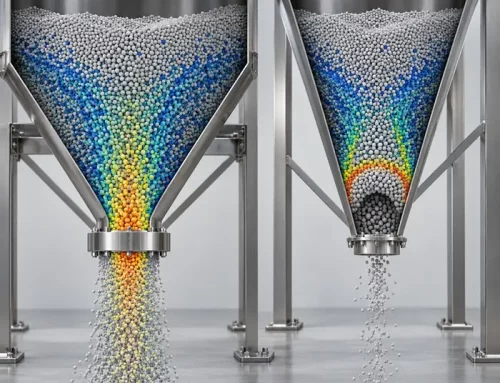
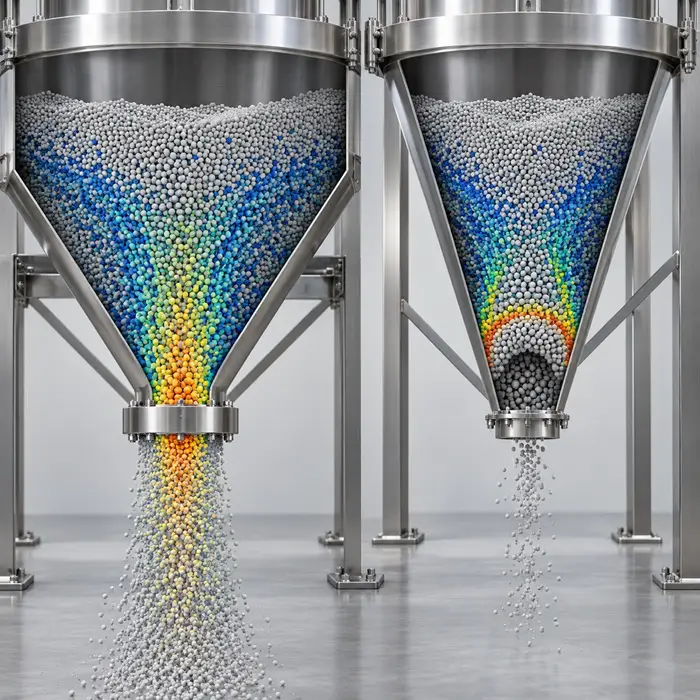
When energy input increases, particles shift toward disordered states. Motion becomes erratic. Flow paths fracture. Triboelectric charging intensifies as particle motion becomes more chaotic. Collisions lose symmetry. The smooth distribution of energy breaks down. As a result, the powder system shifts into a non-equilibrium state.
This often leads to jamming, arching, or segregation. These transitions are influenced by dynamic heterogeneities, where localized fluctuations in energy or density drive structural breakdowns. Theoretical models such as Edwards’ compactivity or dissipative particle dynamics (DPD) help describe such shifts.
Directed vs. Chaotic Response
In overstressed biological systems, signal coherence fails. Muscles spasm. Ion gradients collapse. The equivalent in powder systems is a breakdown in force networks. Without coordinated energy transfer, flow behavior becomes unstable.
Under certain stress conditions, powders retain coherence. Instead of scattering energy, particles align and transfer it directionally. These ordered responses correlate with low entropy spikes and stable surface chemistry. Researchers use motion tracking and force chain imaging to assess how stress propagates through a powder bed.
Energy Distribution and Surface Disruption in Powder Systems
In high-speed mixing or vibro-fluidized transport, particles undergo continuous collision. Energy transfers rapidly. Not all of this energy contributes to uniform motion. Some local spikes exceed activation thresholds, especially near surface defects or catalytic sites. This can initiate reactions like oxidation or surface rearrangement.
Post-mixing, energy does not immediately equalize. Local hot spots and gradients persist, affecting how powders behave during handling and storage. Ignoring these effects in process design can lead to flow variability, surface degradation, or chemical instability.
Thermal, mechanical, and electrostatic inputs create non-uniform energy distributions. This leads to bond disruption, contact rearrangements, and unpredictable flow behavior. Examining these interactions at the surface level improves our ability to forecast degradation, agglomeration, or powder stability.
Cascading Effects and Caking
In compressed powders, energy input alters the crystal structure and interparticle bonds. These transformations release heat, introduce surface strain, and shift charge distribution. Brittle powders tend to fracture. Ductile ones deform. Analytical tools like X-ray diffraction and Raman spectroscopy reveal these changes.
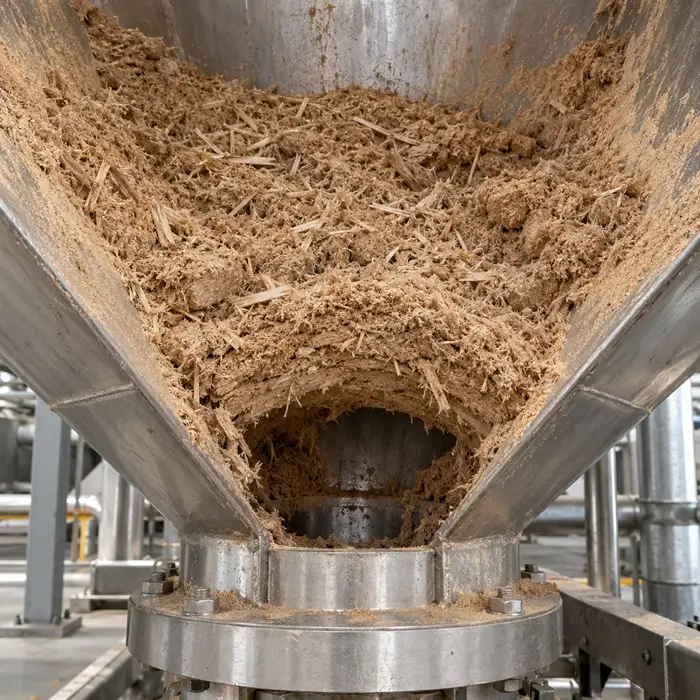
When energy dissipation is slow, structural recovery fails. Entropy increases. The system locks into an unstable configuration. The result: caking, jamming, or persistent clustering. These outcomes define the dynamic boundaries between reversible flow and irreversible transition.
Recent research also emphasizes how amorphous content and humidity interplay to drive caking through time-dependent structural relaxation and surface mobility.
Energetic Activation of Surface Chemistry
Reactivity in powders often starts at high-energy surface sites. Undercoordinated metal centers, strained hydroxyls, or oxygen vacancies are common initiation points. Stress exposure alters their electron structure, enabling redox shifts, decomposition, or catalytic activation.
Materials such as perovskites, silicates, and transition metal oxides are particularly susceptible due to orbital electron configurations. Mechanical treatment like milling increases surface defects. These interact with moisture or gases, affecting flow and chemical behavior.
Powder surfaces evolve under energy exposure. This changes performance. Whether the application is catalysis or stable storage, surface-level dynamics determine reliability.
Activation Sites and Structural Disruption
Surface reactions often begin at defects. Stress modifies electron structure. This promotes chemical shifts. Surface characterization techniques like EPR, XPS, and temperature-programmed desorption (TPD) measure these effects directly.
Interparticle Forces and Energy-Modulated Cohesion
Particles interact via capillary forces, van der Waals attraction, and electrostatics. These interactions shift under energetic influence. For example, humidity alters capillary bridge strength. Triboelectric effects introduce surface charge. Donor-acceptor chemistry can create semi-permanent bonding.
When water adsorbs to particle surfaces, it releases latent heat and raises local temperature. This thermal input promotes liquid bridge formation and accelerates caking, especially in cohesive powders. As bonds form, irreversible agglomerates may develop. Understanding these thermal effects allows for better control of powder flow and stability.
Storage, Aging, and Energy Relaxation
After processing, powders keep evolving. Environmental conditions like moisture, light, and gas exposure modify their surface. In TiO₂, UV light increases photocatalytic activity. This may degrade adjacent components. CO₂ exposure can shift surface acidity in alumina.
Energy relaxation happens unevenly. Chemisorption and desorption release stored energy at different rates. Internal gradients arise. These can lead to unwanted migration, delamination, or aging-related flow changes.
Disordered Energy States and Irreversibility
Powders don’t always return to their original state. In many cases, energy input induces sintering, caking, or polymorph shifts. These changes trap energy and alter both reactivity and morphology. For example, lactose under pressure loses water and undergoes a chemical transformation.
As a result, such transitions produce a disordered yet stable form. The powder may appear solid, but it behaves differently. This shift impacts everything from tablet dissolution to coating adhesion.
Explicit Energy Budgeting and Thermodynamic Modeling
Effective powder design begins with energy accounting, not just mass or composition. At every stage, it is essential to track energy: applied, stored, or lost. Techniques such as microcalorimetry and inverse gas chromatography quantify surface energy and transformation heat. In addition, entropy modeling provides further clarity.
Today’s most advanced approaches integrate non-equilibrium thermodynamics with machine learning. Together, these methods predict powder behavior under stress, in storage, or during flow. Consequently, they enable engineers to optimize process parameters and avoid unexpected transitions.
Conclusion: Making Energy Central to Powder Design
Powders are dynamic systems, not passive materials. Moreover, every applied force—whether mechanical, thermal, or electrostatic—alters their internal energy landscape and surface behavior. As a result, these changes propagate through mixing, conveying, storage, and product use.
Therefore, to design predictable systems, energy must become a tracked and modeled input. By clearly measuring where energy enters, how it spreads, and what responses follow, engineers can shape outcomes rather than merely react to them. Consequently, flowability, caking, reactivity, and shelf stability all reflect how energy is absorbed, redirected, or trapped.
Ultimately, energetic modeling turns powder processing into a science-driven workflow. It effectively links experimental tools, theoretical frameworks, and real-world results. As this mindset takes hold, powders will be designed not just for composition, but for how they move, transform, and age under energy stress.