Why this test
Segregation hides in routine moves. A blend leaves the mixer in spec. Then it falls through a chute, hits a hopper, and enters a feeder. Soon the lot drifts out of spec. A fast powder segregation test exposes the risk before the line runs.
The quick test
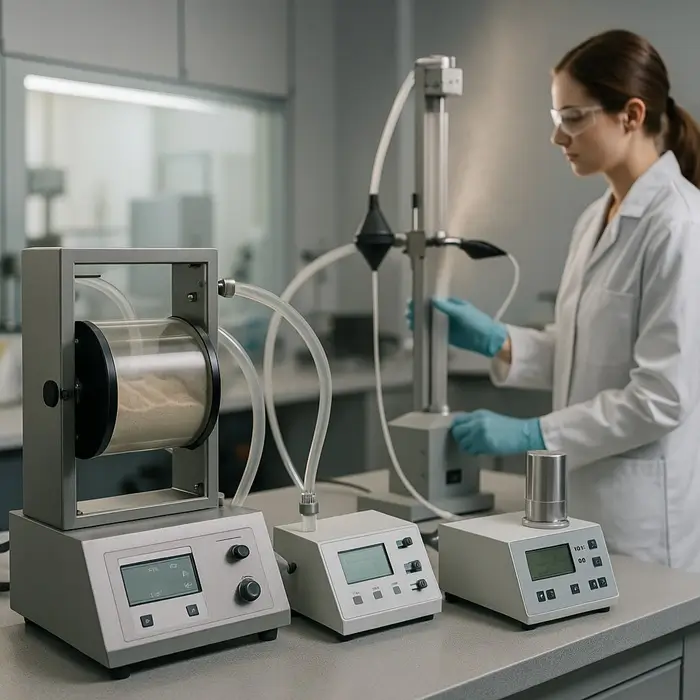
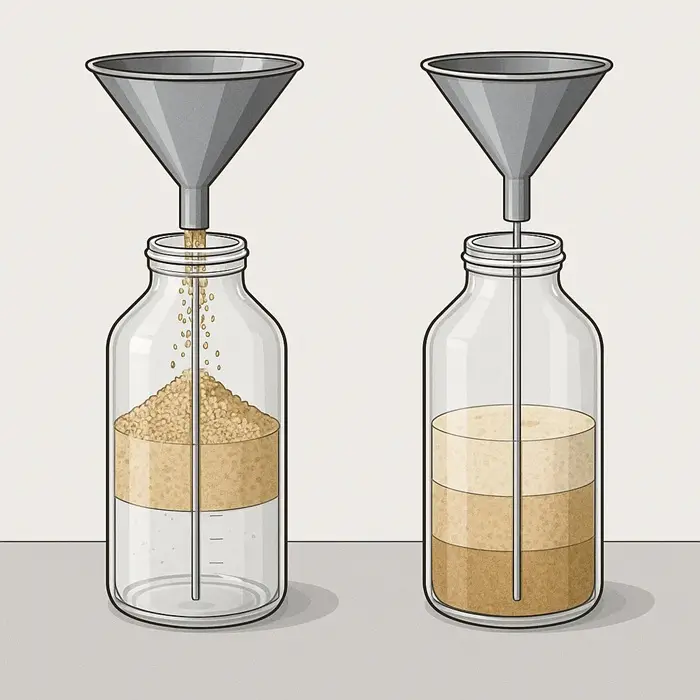
Use two clear 1 liter bottles. Mark fill lines at 25, 50, 75, and 100 percent. Place a funnel with a 10–15 mm throat above each bottle. Hold the funnel 30–40 cm above the mouth. Mimic a small drop height.
Pour the blend two ways. First, a fast free-fall. Second, a slow trickle. Cap each bottle. Label time, rate, and drop height. Core each bottle with a thin tube. Take top, middle, and bottom samples.
If you use a tracer, run a quick UV or optical read. If not, a short sieve split or loss-on-screen will do. You need relative numbers, not absolute values. You want the pattern.
What the pattern tells you
Percolation occurs when fines slip through voids. Trajectory sorting happens when coarse particles carry farther. In addition, air drag amplifies both. This powder segregation test shows the dominant mechanism. It also indicates whether rate control helps.
Set an internal trigger. Treat top-to-bottom variance above 5 to 10 percent as risk. When fast fill fails and slow fill passes, velocity is the lever. Otherwise, change geometry or particle design.
Fast fixes that work now
-
Shorten the drop. Add a sock, spout, or baffle. Aim for less than 10 cm at impact.
-
Slow the stream. Use a slide gate or small damper. Keep a thin, steady sheet.
-
Hit the wall. Land on a chute and wash into the mass. Avoid drilling a cone.
-
Switch to mass-flow. Steeper walls and smooth liners cut stagnant zones.
-
Pre-mix fines. Pre-coat the coarse fraction or add a wetting step if allowed.
-
Tame the air. Vent the receiver. Use a small sock filter near the inlet.
Each change is cheap and measurable. You aim for repeatable fills.
Proving the fix
Repeat the bottle method after each change. Next, log the same top, middle, and bottom reads. Typically, variance should fall below your trigger. Then run a short plant check. Afterwards, fill the hopper with the new settings. During the first meter of fill, pull top and bottom samples. If the pattern holds, lock the SOP.
When to escalate
If fixes fail, particles drive the problem. Moreover, broad PSDs, large size ratios, and density splits cause stubborn segregation. First, tighten the PSD. Then reduce the density gap. If needed, granulate a minor fraction. Alternatively, consider point-of-use blending at the feeder.
Common pitfalls
First, do not tap bottle walls. Tapping masks percolation risk. Also, do not pour in a drafty room. Gusts can fake air lift effects. Moreover, do not scale conclusions without a plant check. The test screens risk. Therefore, it does not replace a site trial.
Quick checklist
-
Set pass/fail variance for the powder segregation test.
-
Limit drop height to under 10 cm.
-
Control fill rate to a thin, steady sheet.
-
Use mass-flow geometry where possible.
-
Vent the receiver to calm air.
-
Confirm in plant with early-fill sampling.