
Why Catalytic Hot Spots in Powders Matter
Powders may look uniform. Their chemistry rarely is. Local regions accelerate reactions and shift outcomes. These small sites create outsized risk during storage and processing. Early detection prevents avoidable failures such as catalytic hot spots in powders.
How Catalytic Hot Spots in Powders Form
Migration concentrates species at interfaces. Moisture moves first, guided by pores and defects. Oils, salts, and plasticisers then follow established pathways. Trace metals or acidic residues meet these migrants at contact points. There, reaction rates increase, even when bulk tests seem acceptable.
First-Line Diagnostics
Start with moisture and thermal profiling.
-
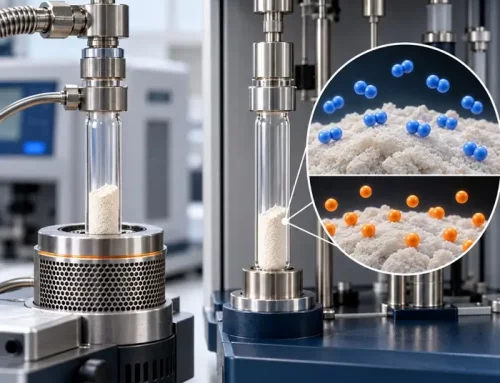
Karl Fischer (KF): Quantify free and bound water. Use gentle sampling to avoid artifacts.
-
Dynamic Vapor Sorption (DVS): Map sorption and desorption. Hysteresis often signals pore-level transport.
-
Differential Scanning Calorimetry (DSC): Apply slow ramps. A lower onset suggests catalytic influence.
These screens build a quick picture of mobility and reactivity. They also guide the next, more specific steps.
Surface and Interface Evidence
Surface methods clarify mechanism.
-
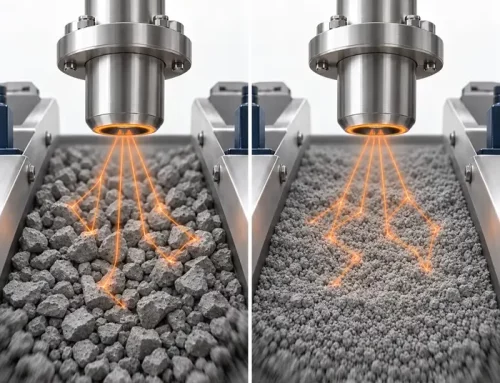
Inverse Gas Chromatography (IGC): Track dispersive energy and acid–base character over cycles.
-
XPS: Identify oxidised species and residues at interfaces.
-
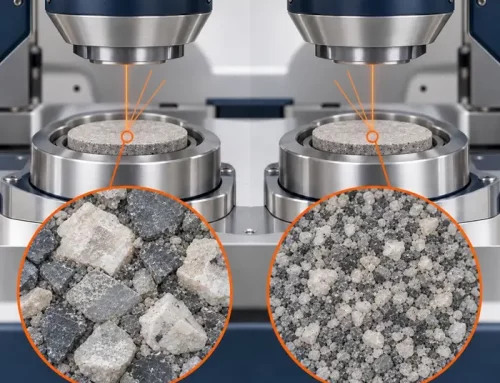
SEM-EDS: Localise chemistry on defects, coatings, and fines.
Together, these techniques reveal local behaviour that bulk averages miss.
Mechanical Drivers to Check
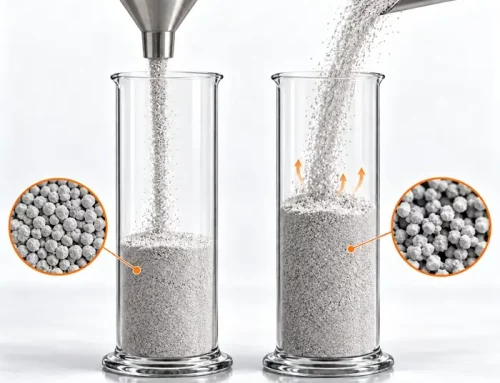
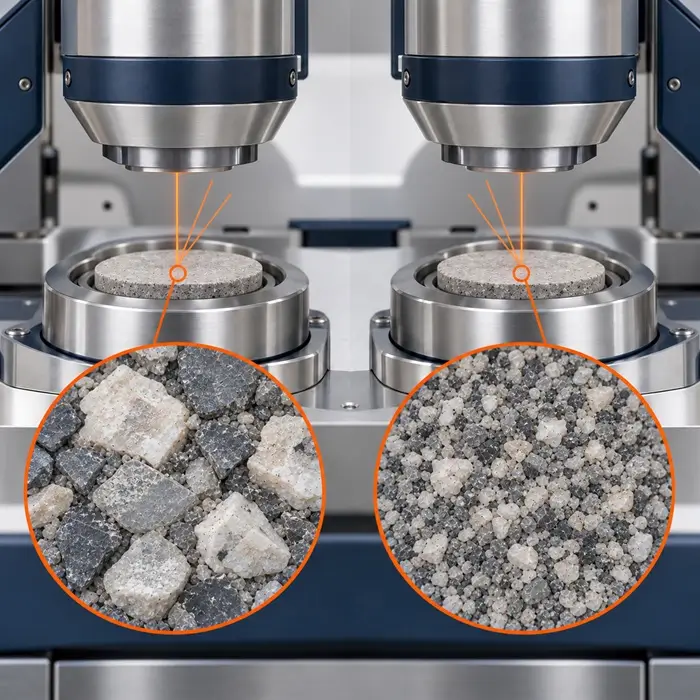
Segregation enriches fines in corners and crevices. Fines carry more surface area and more additives. They frequently host catalytic sites. Conduct a simple fraction study. Measure moisture and oxidation markers across size cuts. Differences confirm non-uniform risk.
Break the Reaction Triangle
Control contact, mobility, and energy.
-
Separate pairs: Use liners, spacers, or inert coatings to block contact.
-
Reduce mobility: Lower humidity and temperature. Stabilise the headspace consistently.
-
Quench catalysts: Apply suitable passivators for metals or acids. Verify compatibility before scale-up.
Small process adjustments often deliver immediate gains.
Practical Process Tweaks
Shorten residence near warm areas. Smooth transfer paths that smear additives. Ground tools and maintain cleanliness to manage static. Consider nitrogen purging for sensitive lots. Each step reduces the chance of local acceleration.
A Lean Confirmation Loop
Design a repeatable loop for speed and confidence.
-
Run KF, DSC, and DVS as triage.
-
Add IGC when surface shifts appear.
-
Use SEM-EDS only when localisation is needed.
-
Apply a defined stress, hold, and retest.
Validation locks in the improvement and prevents regression.
Document Context Rigorously
First, record batch moisture, ambient dew point, and time since drying. Then, note container materials and prior contents. Additionally, capture handling steps and dwell times. Ultimately, these details explain many outliers.
Build a Prevention Plan
First, audit raw materials for catalytic species. Next, set storage corridors for humidity and temperature. Then, define hold times that respect migration rates. Additionally, train operators should be trained to recognise signatures. Consequently, tacky surfaces, odours, or early clumping should trigger checks.
Quick Actions This Week
-
Compare KF and DSC for fines versus coarse fractions.
-
Run a 48-hour humidity step test, then repeat DSC.
-
Trial a passivator or barrier coating on a pilot batch.
-
Start a dew point log for storage areas.
Check out these related articles


Advertisement
[the_ad id=”7029″]