Why This Confusion is Costly in terms of Time
powder caking vs compaction – both failure modes create lumps, poor discharge, and unstable feeding. Yet the drivers differ. Caking builds strength while the powder sits at rest. Moisture pickup and temperature cycling often accelerate the bonding process. Compaction builds strength when stress and vibration densify the bed. If you mislabel the mechanism, you will pull the wrong lever.
What Caking Is and What Compaction Is
Caking is a time-dependent strength increase during storage. Bonds develop between particles during rest. Compaction is a stress-driven strength increase. The bed densifies under load and handling energy. Both mechanisms raise unconfined yield strength. The difference lies in whether time at rest matters at a fixed stress level.
One Test That Separates Them Quickly
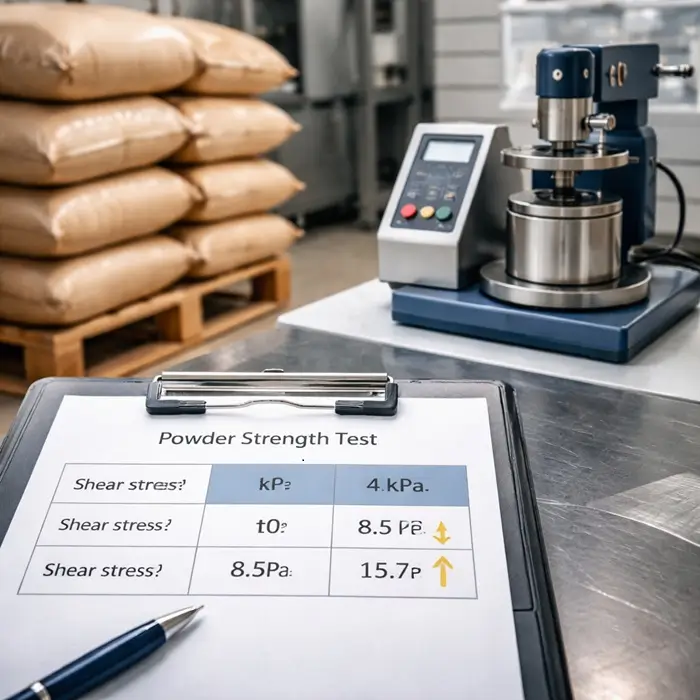
Use a two-point time consolidation shear check. It is the quickest way to separate “time at rest” effects from “stress and handling” effects. You measure unconfined yield strength at the same consolidation stress twice. First, measure it immediately after consolidation, which is t0. Then measure it again after a defined hold time, such as 8 hours or 24 hours, which is t24.
This works because caking expresses itself as time-dependent strength growth. Bonds form while the bed sits. Compaction expresses itself as stress-driven strength growth. The bed densifies under load and vibration. By holding stress constant and changing only time, you isolate the caking contribution.
Run the test at one stress level that matches your real storage load. Keep preconditioning identical for both time points. Then compare t24 to t0. If strength rises at fixed stress, caking dominates under your conditions. If strength stays similar at fixed stress, but rises strongly when you increase stress, compaction dominates.
What You Need
You need a shear cell method, Jenike style, or ring shear. You also need a repeatable preconditioning routine. Use the same routine every time. Otherwise, your t0 to t24 comparison is meaningless. Lock sample mass, sieve step, fill method, and rest time.
How To Run It in Production Terms
-
Pick one consolidation stress that matches real storage load. Use bag stacks, bin fill height, or silo stress as reference.
-
Run the test immediately after consolidation. Call this t0. Record unconfined yield strength. Record flow function class if you use it.
-
Repeat at the same consolidation stress after a hold time. Many teams use 8 hours or 24 hours. Call this t24. Keep humidity exposure controlled.
-
Compare t24 to t0 at the same stress. Then decide which driver dominates.
How To Read the Result Without Overthinking It
Calculate a simple ratio.
Strength ratio = t24 strength divided by t0 strength, at the same stress.
If the ratio stays close to 1, compaction usually dominates.
If the ratio rises clearly above 1, caking dominates under your storage conditions.
If both stress sensitivity and time sensitivity look strong, you likely have a mixed mechanism.
Mini Case You Can Recognize on a Real Line
A detergent powder formed hard lumps in bags after two weeks. The t24 to t0 strength ratio jumped at fixed stress. That pattern pointed to caking. The plant switched to a higher barrier liner and tightened warehouse humidity control. Strength growth dropped, even though pallet stacking stayed unchanged.
When This Test Can Mislead You
Do not change humidity and stress at the same time. You will blur the mechanism. Also, do not keep raising pressure or stress if the curve never settles. Keep the protocol consistent and gentle. Fragile agglomerates can break during handling and distort trends.
If You Do Not Have a Shear Cell Yet
You can still screen the mechanism. Run a confined column hold test with a fixed load. Then use a consistent failure test. Apply a fixed compression load for a fixed time in a fixed-diameter tube. After the hold, push the compacted plug out with a plunger at a constant speed. Record the peak force on a force gauge. Repeat three times and report the average and range. Treat it as screening only. Confirm later with a shear cell when you can. The logic still holds because time dependence still signals caking.
What To Fix, Based on the Outcome
If the Test Points to Caking
Start with environment and surface chemistry. Reduce humidityexposure during storage and transfer. Improve barrier performance of liners and seals. Watch temperature cycles in warehouses and containers. Cycling often accelerates bridge formation. If you consider anticaking agents, validate them using the same t0 and t24 method. Do not rely on a fresh powder check.
If the Test Points to Compaction
Start with stress and handling energy. Reduce pallet stack height and storage duration under load. Reduce vibration hotspots on conveyors and forklift routes. Lower drop heights during filling and rework loops. Strengthen packaging stiffness if bags deform under stacking. Review hopper geometry only after you reduce stress and vibration at the source.
If You See a Mixed Mechanism
Stabilize humidity and storage conditions first. Then reduce stress and vibration in the load path. This order works because moisture-driven bonding often amplifies compaction effects.
Common Mistakes That Keep the Problem Alive
-
Teams test fresh powder only, then miss storage time effects.
-
People change their humidity and stress together, so they cannot separate the drivers.
-
Operators judge success by appearance, not by repeatable strength metrics.
-
Reports omit conditioning details, so nobody can reproduce the outcome.
A Practical Checklist To Run This Next Week
-
Define one consolidation stress and one hold time.
-
Lock a preconditioning routine and document it.
-
Measure t0 strength, then t24 strength at the same stress.
-
Calculate the strength ratio and write one sentence conclusion.
-
Apply fixes that match the mechanism, then retest after changes.