
Powder property
Caking
A powder bed can gain strength during storage without obvious bulk change
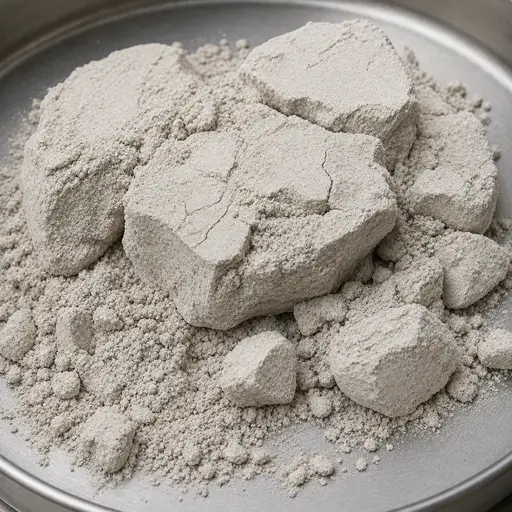
Caking is the time-dependent formation of lumps, crusts, or hardened beds within a particulate material. It develops when particle contacts strengthen through moisture migration, capillary bridges, crystallization, softening, pressure, chemical reaction, temperature cycling, or prolonged consolidation.
Powder property
Caking
A powder bed can gain strength during storage without obvious bulk change
Caking is the time-dependent formation of lumps, crusts, or hardened beds within a particulate material. It develops when particle contacts strengthen through moisture migration, capillary bridges, crystallization, softening, pressure, chemical reaction, temperature cycling, or prolonged consolidation.




Core concept
Caking is strength growth within a stored powder structure
A powder may enter storage in a mobile state and leave as strong lumps or a consolidated bed. The change occurs at particle contacts, where pressure, moisture, temperature, dissolved material, softening, or reaction creates stronger bonds over time. Caking differs from general agglomeration because storage history and bulk-bed stress are central. It also differs from simple cohesion because the structure often gains strength progressively and may not recover when the original environment returns. A useful investigation reproduces the relevant load, temperature, humidity, time, and release condition. Short screening tests can miss the transition or rank materials incorrectly when the real failure develops slowly.
What controls it
Six groups of variables govern caking
Caking develops when contact formation and strengthening outpace stress relaxation, redistribution, or natural breakup.
States and interpretation
Different caking mechanisms require different controls
Identify how contacts strengthen before changing formulation, storage conditions, or mechanical intervention.
| Caking regime | Contact mechanism | Diagnostic pattern | Useful confirmation |
|---|---|---|---|
| Moisture-assisted | Capillary bridges, deliquescence, or dissolved solids | Threshold response to humidity, dew point, or drying | Conditioned storage and sorption analysis |
| Pressure and time | Contact deformation, creep, interlocking, or consolidation | Strength increases with load and residence time | Time-consolidated strength testing |
| Thermal or softening | Tack, phase transition, condensation, or binder migration | Caking follows temperature excursions or gradients | Thermal analysis and controlled cycling |
| Crystalline or reactive bridging | Recrystallization, hydrate change, sublimation and redeposition, or reaction products | Persistent bonds remain after environmental recovery | Phase and deposit-composition analysis |
How to measure it
Choose measurements by the strength-growth mechanism
Reproduce the storage history first, then measure bed strength, lump strength, and recovery under relevant conditions.
Where it matters
Caking becomes a storage and recovery constraint
The operational consequence appears when stored material must restart, discharge, dose, dissolve, or meet a final-size specification.
Go deeper
Three practical routes into powder caking
Explore direct strength testing, mechanism-led diagnosis, and the controls used to prevent contact strengthening during storage.


Need the measurement, not just the guidance?
If the remaining uncertainty concerns caking strength, time consolidation, humidity thresholds, thermal cycling, lump breakup, or storage-condition simulation, select the measurement around the material state and process decision. PowderTechnology.info can help define the test sequence, sample conditions, and interpretation route. For laboratory support, explore our Delft Solids Solutions partner page or visit Delft Solids Solutions directly.