
Powder property
Thermal properties
Heat capacity, conductivity, transitions, and reactions determine how powder responds to temperature
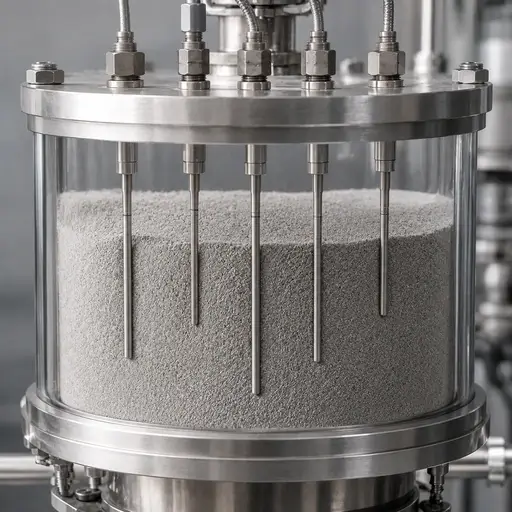
Thermal properties describe how a particulate material stores, conducts, generates, and responds to heat. Particle composition, solid form, packing, porosity, moisture, atmosphere, contact resistance, and scale determine temperature gradients, transitions, flow changes, sintering, degradation, and self-heating behavior.
Powder property
Thermal properties
Heat capacity, conductivity, transitions,
and reactions determine how powder
responds to temperature
Thermal properties describe how a particulate material stores,
conducts, generates, and responds to heat. Particle composition,
solid form, packing, porosity, moisture, atmosphere, contact resistance,
and scale determine temperature gradients, transitions, flow changes,
sintering, degradation, and self-heating behavior.




Core concept
Powder-bed thermal behavior depends on structure.
Bulk powder contains particles, contact resistance, voids, and gas. Its effective thermal conductivity and diffusivity therefore depend on packing, pressure, atmosphere, moisture, and particle contact, not only on the conductivity of the solid phase. Temperature can also change the material while it is being measured. Moisture leaves, polymers soften, crystals transform, surfaces oxidize, binders react, and particles sinter. Heat generation and heat removal may then evolve together. Choose measurements that reproduce the relevant atmosphere, ramp, dwell, bed state, and scale, and separate reversible physical properties from irreversible transitions or reactions.
What controls it
Six groups of variables govern thermal properties
Thermal response emerges from intrinsic material properties, powder-bed structure, heat-transfer boundaries, and temperature-driven transformations.
States and interpretation
Thermal measurements answer different parts of the heat problem
Distinguish property measurement, phase transition, kinetic stability, and process-scale heat balance.
| Thermal view | What it describes | Main limitation | Useful decision |
|---|---|---|---|
| Heat-flow analysis | Transitions, melting, crystallization, cure, and heat capacity | Small samples and programmed ramps | Identify thermal events and compare states |
| Mass-change analysis | Moisture, volatile loss, oxidation gain, and decomposition | Does not alone identify evolved species | Locate mass-changing events |
| Thermal transport | Effective conductivity or diffusivity of a defined bed | Highly sensitive to packing and contact | Model heating, cooling, and gradients |
| Stability and self-heating | Heat generation under defined time, atmosphere, and scale | Screening method may not represent bulk storage | Assess runaway and storage risk |
How to measure it
Choose a thermal method by the uncertainty
Combine heat flow, mass change, evolved species, transport, and scale-sensitive stability testing where the mechanism requires it.
Where it matters
Thermal properties become a heat-transfer and transformation constraint
Temperature changes both the powder bed and the material surfaces that control later handling and function.
Go deeper
Three practical routes into thermal powder behavior
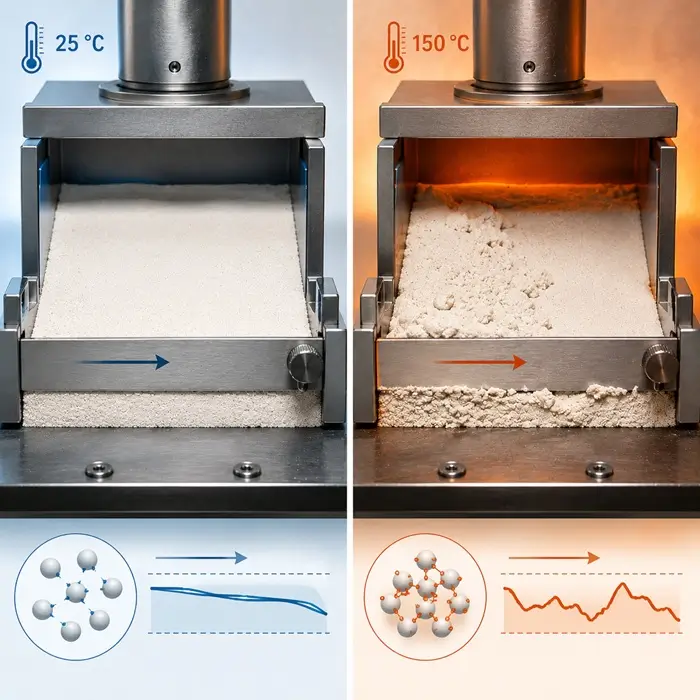
Explore hot-state flowability, particle movement through temperature gradients, and contact-level sintering during agglomeration.


Need the measurement, not just the guidance?
If the remaining uncertainty concerns thermal transitions, heat capacity, conductivity, mass loss, elevated-temperature flow, self-heating, or process-scale thermal response, select the measurement around the material state and process decision. PowderTechnology.info can help define the test sequence, sample conditions, and interpretation route. For laboratory support, explore our Delft Solids Solutions partner page or visit Delft Solids Solutions directly.