
Powder property
Cohesion
Interparticle attraction becomes a bulk constraint through the contact network
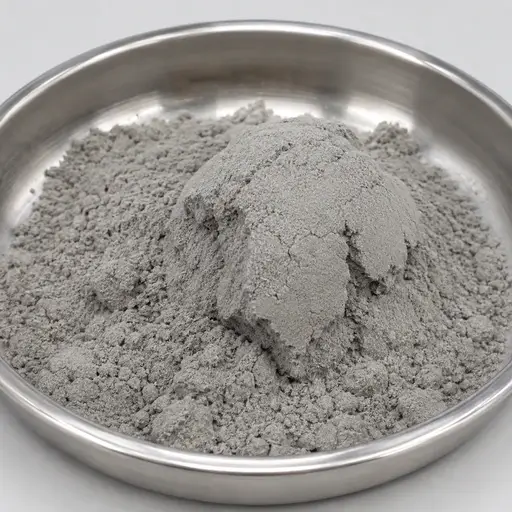
Cohesion arises from attractive forces and bonds between particles. Van der Waals forces, liquid bridges, electrostatics, and solid bridges can be amplified by fine-particle contacts and consolidation, causing a powder to behave as a connected bulk material rather than as freely moving individual particles.
Powder property
Cohesion
Interparticle attraction becomes a bulk
constraint through the contact network
Cohesion arises from attractive forces and bonds between particles.
Van der Waals forces, liquid bridges, electrostatics, and solid bridges
can be amplified by fine-particle contacts and consolidation, causing
a powder to behave as a connected bulk material rather than as freely
moving individual particles.




Core concept
Cohesion depends on contacts and stress history
An attractive force at one contact may be small, but a powder contains a network of many contacts. Fine particles increase the number of contacts per unit mass, while consolidation increases contact area and the forces required to initiate movement. Cohesion is not the same as adhesion. Cohesion acts within the powder; adhesion describes attraction between powder and another surface. Both can occur together and may respond differently to moisture, charge, roughness, and surface treatment. Measure the powder in the stress, humidity, aeration, and time state relevant to the failure. A low-stress aerated bed and a consolidated hopper bed are not equivalent materials in use.
What controls it
Six groups of variables govern cohesion
Cohesion changes when either the contact force or the structure and number of contacts changes.
States and interpretation
Different mechanisms can produce the same cohesive symptom
Separate the dominant contact mechanism before selecting a corrective action.
| Contact regime | Likely driver | Diagnostic change | Useful confirmation |
|---|---|---|---|
| Dry surface attraction | Fine size, high surface energy, or close contact | Strong sensitivity to size, surface treatment, or consolidation | Shear testing with PSD and surface context |
| Capillary or moisture-assisted | Humidity, condensation, dissolved solids, or liquid bridges | Behavior changes across controlled humidity or drying | Humidity-conditioned testing and moisture sorption |
| Electrostatic | Contact electrification and slow charge dissipation | Behavior changes with grounding, humidity, or contact material | Charge magnitude, polarity, and decay testing |
| Solid or time-dependent bridges | Caking, crystallization, sintering, or binder hardening | Strength grows with storage time or temperature | Time-consolidation and controlled storage study |
How to measure it
Choose measurements by the cohesive mechanism
Combine bulk response with environmental and surface evidence when more than one contact mechanism is plausible.
Where it matters
Cohesion becomes a movement and structure constraint
Cohesion matters wherever gravity, gas, mechanical force, or a moving surface must overcome the contact network.
Go deeper
Three practical routes into powder cohesion
Explore how contact networks, small fine fractions, and processing history turn particle-scale attraction into bulk behavior.


Need the measurement, not just the guidance?
If the remaining uncertainty concerns cohesive strength, contact mechanism, humidity sensitivity, electrostatic contribution, consolidation history, or low-stress movement, select the measurement around the material state and process decision. PowderTechnology.info can help define the test sequence, sample conditions, and interpretation route. For laboratory support, explore our Delft Solids Solutions partner page or visit Delft Solids Solutions directly.