
Powder property
Particle strength and fracture
Failure depends on particle structure, loading mode, and the stress history of the process
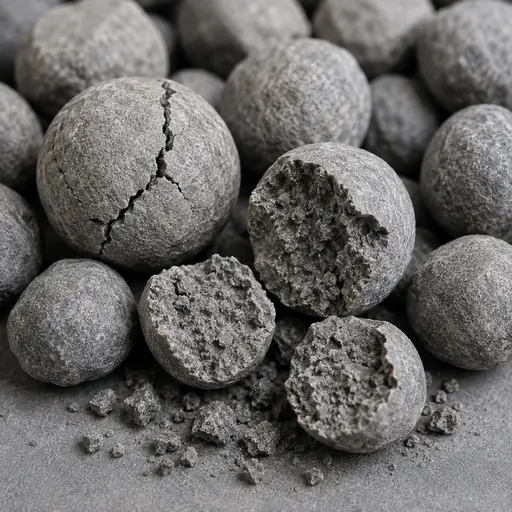
Particle strength and fracture describe how individual particles, granules, agglomerates, and coatings deform or fail under compression, impact, abrasion, and shear. The relevant strength is not one universal number because failure changes with structure, flaws, moisture, loading rate, and stress mode.
Powder property
Particle strength and fracture
Failure depends on particle structure,
loading mode, and the stress history
of the process
Particle strength and fracture describe how individual particles,
granules, agglomerates, and coatings deform or fail under compression,
impact, abrasion, and shear. The relevant strength is not one
universal number because failure changes with structure, flaws,
moisture, loading rate, and stress mode.



Core concept
Strength is conditional on how the particle is loaded
A particle may survive slow compression but fragment under impact, or resist impact while losing material through repeated abrasion. Granules and agglomerates can also rearrange or deform before they fracture. Measured strength therefore combines material behavior, particle geometry, internal defects, and the test stress path. Larger particles may contain more critical flaws, while porous or layered structures can fail progressively rather than through one clean break. Match the test to the dominant process contact and compare the resulting fragment population, not only the force at first failure.
What controls it
Six groups of variables govern particle strength and fracture
Breakage emerges from the interaction between intrinsic material response and the particle’s structure, environment, and applied load.
States and interpretation
Different stress modes produce different damage signatures
Select the loading mode and endpoint that reproduce the failure observed in the operation.
| Stress mode | Typical response | Useful output | Interpretation risk |
|---|---|---|---|
| Quasi-static compression | Deformation, crushing, splitting, or progressive collapse | Failure-force distribution and force-displacement curve | Platen geometry and particle orientation may not represent process contacts |
| Impact | Fragmentation or chipping during rapid energy input | Breakage probability and daughter particle-size distribution | Impact velocity, energy, and target geometry strongly affect the result |
| Abrasion and attrition | Surface loss, rounding, coating damage, and fines generation | Mass loss, fines generation, and morphology change | Laboratory contact conditions may not reproduce process severity |
| Shear and repeated contact | Edge damage, fatigue, and progressive weakening | Damage rate over cycles and fragment population evolution | A single endpoint can miss cumulative or progressive damage |
How to measure it
Choose a test by the failure mechanism
Use a stress path that represents the operation and analyze both intact survivors and generated fragments.
Where it matters
Particle fracture becomes a yield and consistency constraint
The relevant damage route is the one that changes product function or creates a downstream handling problem.
Go deeper
Three practical routes into particle failure
Explore how transport contacts, pressure response, and deformation mode determine whether particles survive or generate damaging fragments.


Need the measurement, not just the guidance?
If the remaining uncertainty concerns single-particle strength, impact breakage, attrition, deformation behavior, coating damage, or process-generated fines, select the measurement around the material state and process decision. PowderTechnology.info can help define the test sequence, sample conditions, and interpretation route. For laboratory support, explore our Delft Solids Solutions partner page or visit Delft Solids Solutions directly.