
Powder property
Shear properties
Yield behavior must be measured over the stress range the powder will experience
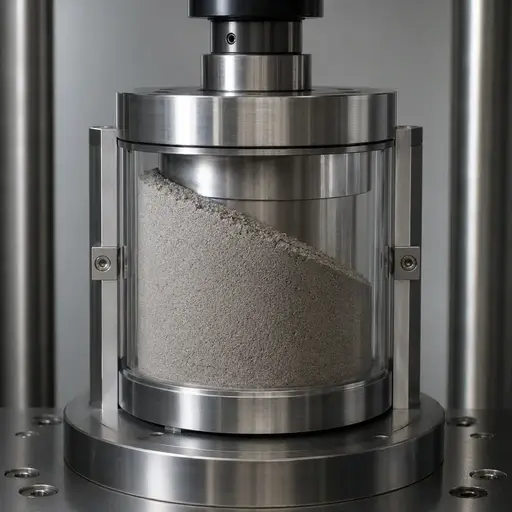
Powder shear properties describe how a consolidated bulk solid yields and flows under applied normal and shear stress. Yield loci, unconfined yield strength, major consolidation stress, flow function, internal and wall friction, and time- consolidated strength support hopper design and troubleshooting when the test state represents the operation.
Powder property
Shear properties
Yield behavior must be measured over the stress
range the powder will experience
Powder shear properties describe how a consolidated bulk solid yields and flows
under applied normal and shear stress. Yield loci, unconfined yield strength,
major consolidation stress, flow function, internal and wall friction, and time-
consolidated strength support hopper design and troubleshooting when the test
state represents the operation.




Core concept
Shear properties depend on stress state
A shear cell consolidates a specimen under controlled normal stress and then determines the stress required for steady shear or incipient yield. Results at several stress levels form yield loci from which unconfined yield strength and major consolidation stress are derived. The flow function relates these values across the tested range. It is more informative than one flow label, but it remains conditional on sample preparation, consolidation, time, humidity, temperature, and the selected analysis method. Wall friction is a separate measurement using the actual wall material and surface condition. Internal shear and wall friction are both needed for many hopper-design decisions.
What controls it
Six groups of variables govern shear properties
Shear results change when the powder state or the stress path changes, even if the material identity remains constant.
States and interpretation
Shear outputs answer different design questions
Use the output that corresponds to the failure mode and retain the stress range behind every reported value.
| Shear output | What it represents | Primary use | Common misuse |
|---|---|---|---|
| Yield locus | Failure shear stress across normal stresses for one consolidation state | Deriving strength and friction parameters | Treating one locus as valid at every consolidation state |
| Unconfined yield strength | Major principal stress at unconfined failure, derived from the yield locus | Assessing arching and cohesive strength | Comparing values without the corresponding major consolidation stress |
| Flow function | Relationship between major consolidation stress and unconfined yield strength | Classifying stress-dependent flow and supporting design | Reducing the complete curve to one universal flow label |
| Wall-friction locus | Shear stress between powder and a defined wall surface across normal stresses | Hopper angle and surface selection | Substituting internal friction or using the wrong surface finish |
How to measure it
Choose a shear test by stress range and decision
Cell geometry, stress range, preparation, and analysis must match the operation closely enough to support the intended design or diagnosis.
Where it matters
Shear properties become a design and operating constraint
Use shear data where equipment must initiate or sustain movement after a defined consolidation history.
Go deeper
Three practical routes into shear testing
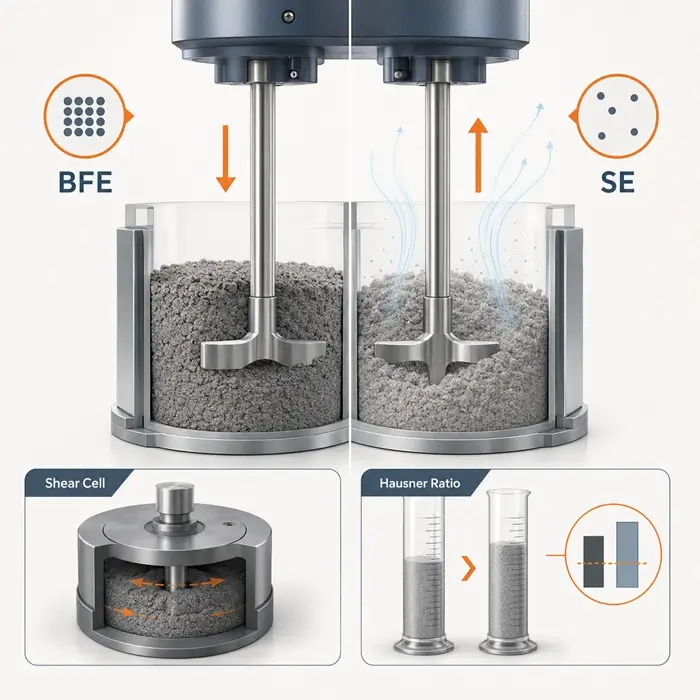
Explore how shear cells, complementary flow methods, and dynamic testing reveal different parts of powder behavior.


Need the measurement, not just the guidance?
If the remaining uncertainty concerns yield loci, unconfined yield strength, wall friction, time consolidation, low-stress flow, or hopper-design inputs, select the measurement around the material state and process decision. PowderTechnology.info can help define the test sequence, sample conditions, and interpretation route. For laboratory support, explore our Delft Solids Solutions partner page or visit Delft Solids Solutions directly.