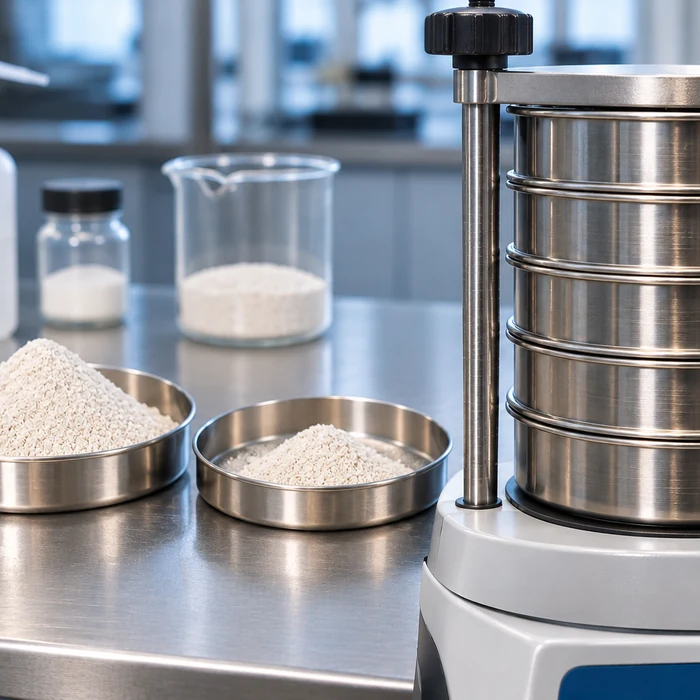
Laboratory sieving setup with two powder sample loads. Comparing controlled, replicated runs can reveal whether excessive loading increases the apparent coarse fraction.
A powder passes its sieve specification in one laboratory but fails in another. Both laboratories use the same nominal apertures, yet one reports substantially more material in the coarse fraction. Before blaming the material, check the test load. Also confirm that both laboratories use sieves verified against the applicable requirements, such as ISO 3310-1 for woven-wire sieves.
Why Sample Mass Affects Particle Passage
A particle smaller than a sieve opening does not necessarily pass through it. It must reach the mesh and encounter an opening in a suitable orientation.
With an excessive charge, particles crowd the sieve surface. The deeper bed restricts movement, leaving some undersize particles above the mesh when sieving ends. Their mass is then included in a coarser fraction.
Overloading can occur lower in the sieve stack, even when the initial charge appears reasonable. Material passing through larger apertures may accumulate on a finer sieve.
A heavily loaded sieve is not the only reason undersize particles remain above the mesh. Near-size particles may lodge in apertures and blind the mesh. Moisture or cohesive forces can hold fine particles together as agglomerates. Excessive agitation may also break fragile particles, increasing the apparent fine fraction.
First Check Whether Sieving Is Complete
Before changing sample mass, check whether the original sieving procedure reached its prescribed end point.
After the normal run, check how much additional material passes the suspect sieve during the end-point test specified by the applicable method. Where appropriate, a further one-minute sieving interval can serve as a diagnostic check. Increasing sieving time without validation can introduce particle breakage or other changes.
If appreciable material continues to pass, the original procedure may have ended prematurely. This does not establish overloading as the cause, but it identifies incomplete separation.
Compare Normal and Reduced Loads
If the end-point check suggests incomplete separation, repeat the test with smaller charges to determine whether loading contributes to the result.
Prepare representative portions from a homogenized bulk sample using a suitable sample divider. Test both conditions at least in duplicate, preferably in triplicate:
- Normal load: Sieve each full test portion as one charge.
- Reduced load: Divide an equivalent test portion into smaller charges and sieve them separately. Combine the corresponding retained masses before calculating the distribution.
Maintain the prescribed sieving conditions for each charge. Record the masses retained on individual sieves, cumulative percentage passing, and any visible blinding or particle damage.
Define acceptable mass recovery and test repeatability before starting, using the governing method where available. Compare the difference between conditions with the variation among replicate measurements.
A difference between two individual runs cannot reliably distinguish loading bias from sampling variation.
When Should the Loading Limit Change?
If reduced charges repeatedly produce more passing material than normal charges, with differences exceeding established test variability, overloading becomes a credible explanation.
If the results agree, investigate other causes, including sieve condition, sampling, agglomeration, and shaker settings.
Published methods provide useful loading limits. For example, ASTM C136/C136M-19 specifies a maximum retained mass of 7 kg/m² of sieving surface for sieves with openings smaller than 4.75 mm. That limit applies to aggregate testing and should not be treated as universal guidance for industrial powders.
For cohesive fine powders, particularly around or below 45 µm, conventional dry vibratory sieving may be unsuitable regardless of sample mass. Wet sieving or air-jet sieving may provide a more appropriate separation, provided the method is suitable for the material.
Any revised loading limit should be verified through replicate tests. The resulting procedure must provide adequate separation without excessive particle breakage or loss of sample representativeness. Establish a loading condition that gives reproducible separation without compromising sample representativeness or changing the material during the test.
Technical Basis / Sources
- ISO 2591-1:1988, Test sieving, Part 1. General test-sieving principles and factors influencing results.
- ISO 3310-1:2016, Test sieves of metal wire cloth. Aperture tolerances and sieve verification requirements.
- ASTM C136/C136M, Sieve Analysis of Fine and Coarse Aggregates. Loading limits, test adequacy, and mass recovery. The numerical example above is from the 2019 edition.
- RETSCH, Sieving Methods of Sieve Analysis. Dry, wet, and air-jet sieving principles and application ranges.