🔑 Key Takeaway
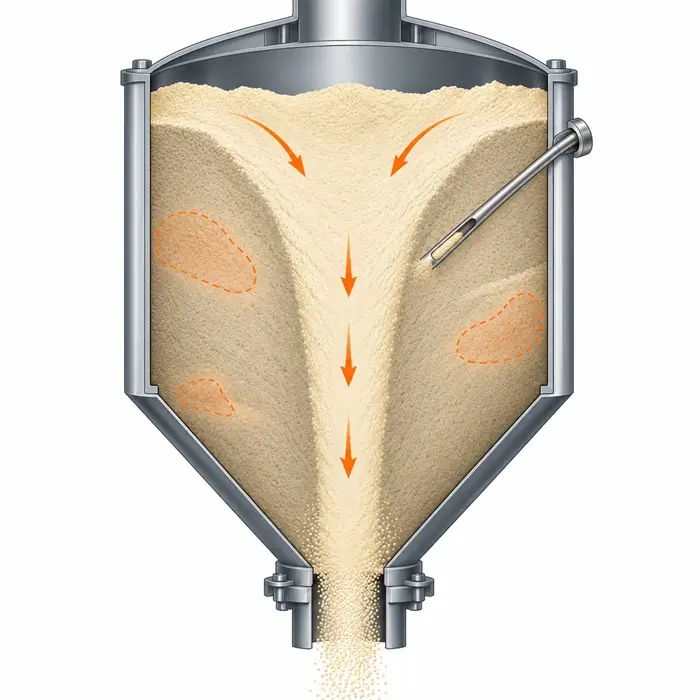
In powder-fed laser cladding, stable powder delivery does not guarantee stable deposition. Deposited mass depends on both the actual powder mass flow reaching the nozzle and the fraction captured by the melt pool. Catchment efficiency can change with powder-stream geometry, gas flow, standoff distance, nozzle condition, and melt-pool state, while feeder-side flowability introduces a separate upstream source of variation. Diagnose the two separately: first establish whether actual powder delivery is stable, then investigate catchment if deposition still changes.

Powder delivery in laser cladding is often reduced to two readily checked values: particle size distribution and the mass feed rate set at the feeder. Yet stable values at these points do not guarantee stable deposition. Bead height, dilution, or porosity can still vary because the amount of powder incorporated into the track depends on what happens between the feeder and the melt pool.
Two questions therefore need to be separated. Is the actual powder mass flow reaching the nozzle stable? And, if it is, is the same fraction of that powder still being captured by the melt pool? The first points upstream toward powder behavior, feeder performance, and transport through the line. The second points downstream toward powder-stream geometry, standoff distance, nozzle condition, and the state of the interaction zone.
Catchment Efficiency Is Not the Same Number as Feed Rate
Catchment efficiency is the fraction of supplied powder that becomes part of the deposited track. It is therefore distinct from the powder mass flow delivered by the feeding system:
Deposited powder mass rate = delivered powder mass flow rate × catchment efficiency
A feeder can maintain a stable mass flow while deposited mass changes because the fraction captured by the melt pool has changed.
Ancalmo and Narra (2025) investigated whether particle-stream and laser-spot geometry could be used to predict catchment efficiency in laser directed energy deposition of AISI 316L. Their geometry-based model used the ratio between laser spot diameter and measured particle-stream diameter to predict single-track catchment efficiency with an RMSE of 11.5 percentage points over the conditions tested, according to their study in the Journal of Manufacturing Processes.
For context, Ancalmo and Narra note that feedstock utilization in the DED-LB literature is commonly reported in the range of 50–85%. Their own experiments used a powder mass flow of 9.98 ± 0.83 g/min, carrier gas flows from 2 to 10 L/min, a constant shielding gas flow of 10 L/min, a 12 mm nozzle operating distance, and laser spot diameters from 1.5 to 3.5 mm. These values provide scale for the reported catchment behavior, but they are not universal operating targets: nozzle design, powder characteristics, laser conditions, and standoff all shift the achievable catchment efficiency.
The distinction is operationally important. If actual powder delivery is stable while deposited mass changes, changing the feeder setpoint or tightening the particle size distribution specification may address the wrong part of the process.
Powder Stream Divergence Couples Gas Flow to Particle Behavior
Between the nozzle exit and the melt pool, powder-stream geometry depends on the gas flow field, nozzle geometry, particle properties, and the position of the interaction zone relative to the powder focus. Carrier and shielding gas settings can therefore change where and how tightly the stream converges. Wang et al. (2024), for example, found that lower carrier gas flow combined with higher shielding gas flow reduced powder-stream divergence in the annular LDMD head with an inside-laser coaxial two-airflow powder-feeding nozzle they investigated. The direction and magnitude of this response depend on nozzle design.
Particle size and density influence the same process through particle inertia relative to aerodynamic drag. Stokes number expresses this relationship: lower values indicate greater responsiveness to the surrounding gas flow, while higher values indicate greater particle inertia. In the Ancalmo and Narra (2025) study, lower-Stokes-number conditions produced smaller particle-stream diameters than higher-Stokes-number conditions for the nozzle and powders tested.
Standoff distance adds another variable. A coaxial powder stream converges toward a focal region, so moving the melt pool relative to that region changes the fraction of powder available for capture. Donadello et al. (2022) showed that catchment efficiency varies with the relative position of the melt pool, powder cone, and laser beam. In multilayer deposition, this creates a feedback loop: a change in captured mass alters layer height, which changes the nozzle-to-surface distance for subsequent layers and therefore changes catchment again. Under suitable conditions, this coupling can become self-stabilizing as layer height and standoff converge toward a regular operating state.
This means particle size can influence deposition at two different points in the system: through gas-particle transport and stream focusing downstream, and through bulk flow and metering upstream. See how fines content changes powder behavior for the bulk-flow side of that distinction.
Where Feeder Flowability Enters the Picture
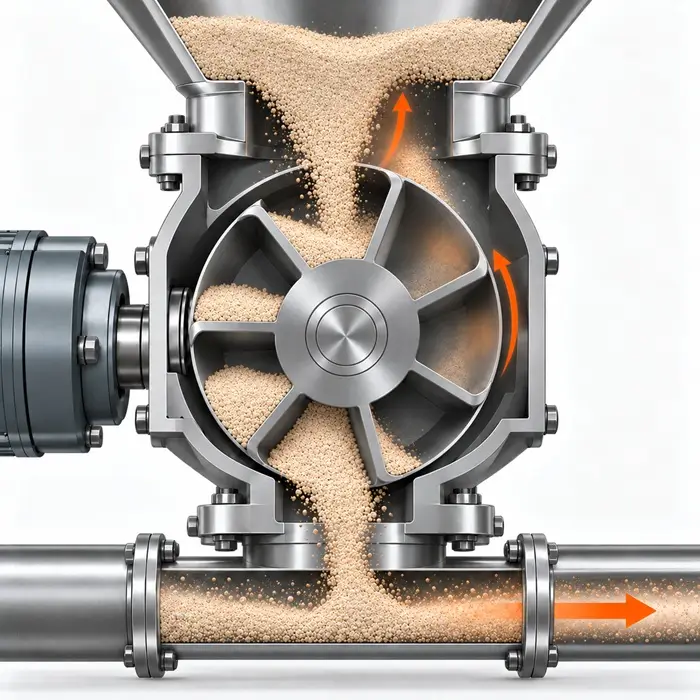
Upstream of the nozzle, the powder still has to be delivered at a consistent rate. Thayalan and Landers (2006) showed that the low powder flow rates used in laser-based manufacturing and the material transport delay between metering and delivery complicate mass-flow control in gravity-fed powder feeders.
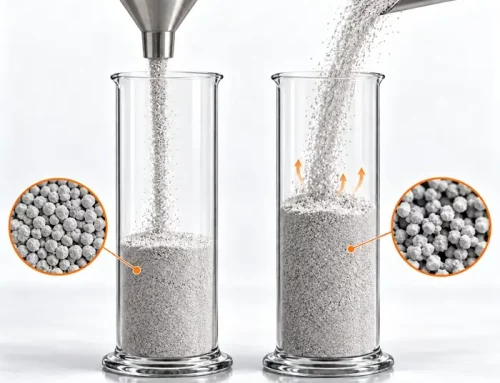
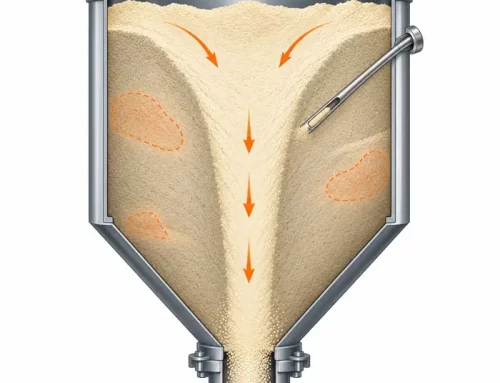
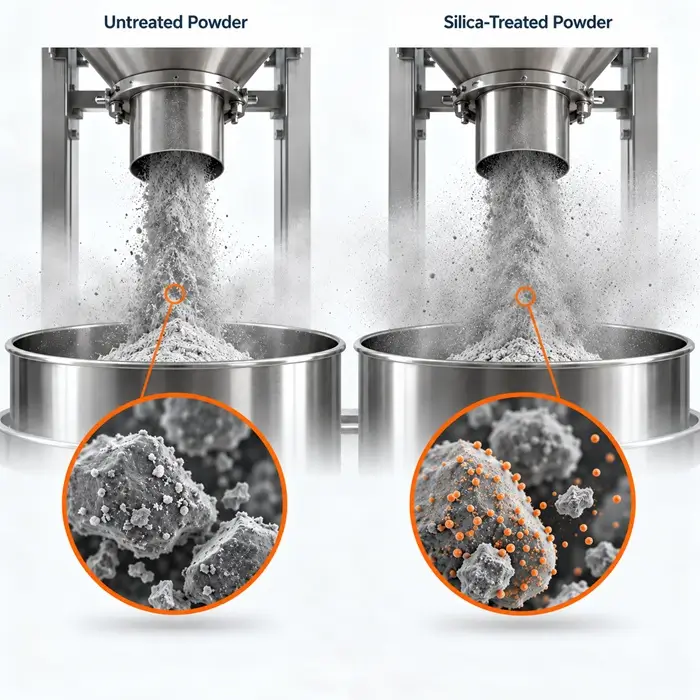
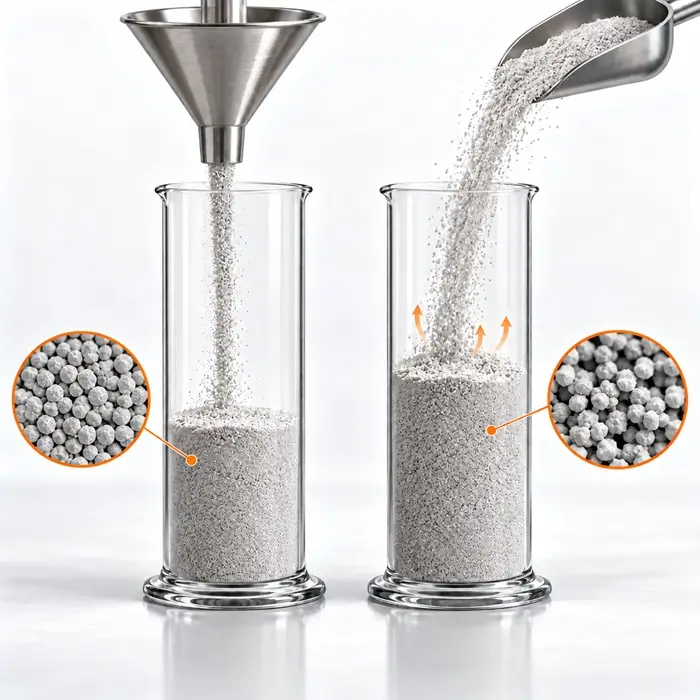
Powder condition introduces a separate source of variation. Changes in bulk density, cohesion, particle shape, or packing state can alter hopper discharge and metering behavior. Powder condition can also shift through moisture uptake during storage or handling and through reuse-related changes in morphology, agglomeration, particle size distribution, or surface condition. If actual nozzle-exit mass flow is fluctuating, these properties therefore need to be considered alongside feeder mechanics and the condition of the delivery line.
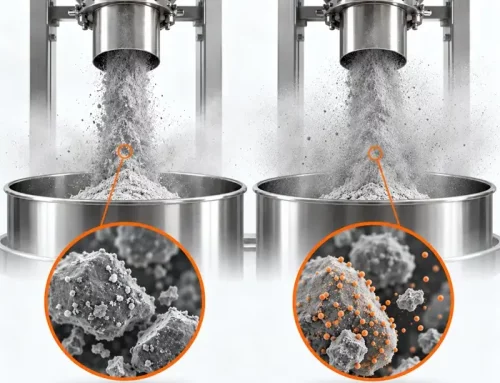
Standard flowability characterization can help identify this upstream contribution, but it does not predict catchment efficiency. Hausner ratio and Carr index testing provides a coarse screen for packing and cohesion-related behavior, while dynamic and aerated flow energy testing can reveal sensitivity to aeration and dynamic flow conditions that static indices may miss.
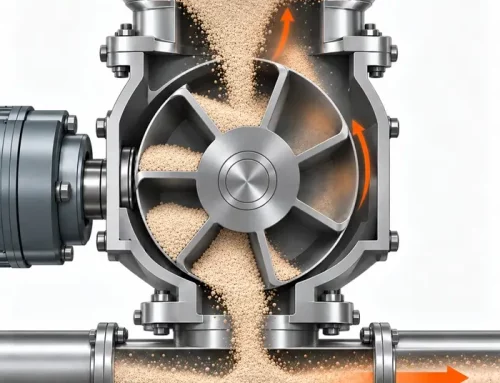
Screw feeder dosing systems demonstrate the broader principle that powder packing and flow behavior can influence dosing stability. The quantitative behavior of a screw feeder should not be transferred directly to a cladding feeder, but the underlying diagnostic question is the same: establish whether actual powder delivery is stable before attributing deposition variation to downstream catchment.
Catchment Depends on More Than Stream Geometry
Geometric overlap determines how much powder reaches the interaction zone, but not every particle that arrives there becomes part of the deposit. Particles also have to interact with a melt pool capable of capturing and incorporating them. Melt-pool dimensions and thermal state therefore influence effective catchment alongside powder-stream geometry.
Changes in laser power, travel speed, thermal accumulation, or optical condition can alter the melt pool without changing feeder output or PSD. A deposition problem can therefore remain downstream even when powder-stream alignment appears unchanged.
Nozzle condition should also be checked before changing the powder specification. Wear, erosion, adhered spatter, or partial obstruction can change powder-stream behavior while feeder settings remain unchanged. DeWitte et al. (2022) found a progressive decline in catchment efficiency as axial nozzle-tip wear increased to 1 mm, together with an increase in powder-stream diameter.
For troubleshooting purposes, stable powder delivery therefore rules out only one part of the chain. It does not establish that powder-stream geometry, nozzle condition, standoff distance, or melt-pool capture has remained stable.
Separate Delivery Drift From Catchment Drift
When deposition varies, first establish whether the powder mass flow itself is changing.
Collect the complete powder stream discharged from the nozzle over a fixed interval with the laser and deposition process inactive. Use the same feeder and carrier-gas settings used during production. Allow powder flow to reach steady state before starting the timed collection, and use a vented bottle, funnel-fed receiver, or other enclosed arrangement positioned to capture the full powder cone without restricting the gas discharge. Keep the collection geometry and nozzle position identical between measurements.
Make at least three repeat measurements. The collection interval should be long enough that the collected mass is comfortably above the resolution limit of the balance. Calculate the mean and coefficient of variation, and compare the repeatability with the feeder manufacturer’s specification or, preferably, a validated baseline established for the same feeder, powder, gas settings, and delivery-line configuration.
Variation at this point indicates a problem upstream of the melt pool, such as feeder behavior, powder condition, transport through the delivery line, or nozzle obstruction. A restriction or partial blockage can reduce nozzle-exit mass flow and therefore appears in this delivery test. Nozzle wear or geometric damage can instead alter powder-stream focus while total mass flow remains stable, placing it on the catchment side of the diagnosis.
If nozzle-exit mass flow is stable, determine whether catchment has changed under controlled deposition conditions. Catchment efficiency is obtained by comparing deposited powder mass with the powder mass delivered over the same interval. Direct weighing is preferable where the deposited mass change is large enough for the balance to resolve reliably. Deposited mass can also be estimated from measured deposit geometry and material density, but this method assumes an appropriate effective density. If porosity is itself one of the symptoms under investigation, using fully dense material density will overestimate deposited mass and therefore overestimate calculated catchment efficiency.
The result separates four diagnostic outcomes:
Nozzle-exit mass flow drifts: investigate powder condition, feeder mechanics, transport line, and nozzle obstruction.
Nozzle-exit mass flow is stable but catchment changes: investigate standoff distance, powder-stream focus and alignment, nozzle wear or damage, gas settings, and melt-pool behavior.
Both nozzle-exit mass flow and catchment change: treat delivery instability and catchment variation as separate contributors rather than trying to correct both through the powder specification.
Powder delivery and catchment are stable but bead geometry or deposit quality still varies: investigate laser power delivery, optics condition, traverse speed, substrate condition, thermal accumulation, and the measurement used to define the defect.
A Different Feedstock Problem Than Powder Bed Fusion Recoating
Powder-fed laser cladding presents a different feedstock problem from powder bed fusion. In PBF, the powder is spread as a static layer, and recoater blade or roller interaction with cohesion, particle shape, and spreadability produces layer-level defects, as covered in what recoater interaction reveals about layer defects. In powder-fed laser cladding, the powder is never spread into a bed; it is a continuously entrained gas-particle stream, and the failure mode shows up as bead height variation, lack of fusion, or porosity rather than a layer defect.
Both processes are sensitive to particle size distribution and shape, but the mechanism linking powder behavior to the defect is different in each case, which is why a feedstock qualified for PBF cannot be assumed to behave the same way through a cladding nozzle. General feedstock quality considerations for metal AM powders, including how PSD interpretation connects to process decisions, are discussed in metal powder feedstock quality in additive manufacturing, but catchment efficiency and stream divergence are cladding-specific additions to that picture.
Technical Sources
- Ancalmo, C., & Narra, S. P. (2025). Prediction of the powder catchment efficiency and melt track height in laser directed energy deposition. Journal of Manufacturing Processes, 137, 207–220. DOI: 10.1016/j.jmapro.2025.01.039.
- Wang, K., et al. (2024). Powder stream performance of a novel annular laser direct metal deposition with inside-laser coaxial powder feeding nozzle: Simulation and experimental perspectives. Optics & Laser Technology, 175, 110723. DOI: 10.1016/j.optlastec.2024.110723.
- Donadello, S., Furlan, V., Demir, A. G., & Previtali, B. (2022). Interplay between powder catchment efficiency and layer height in self-stabilized laser metal deposition. Optics and Lasers in Engineering, 149, 106817. DOI: 10.1016/j.optlaseng.2021.106817.
- DeWitte, L., Saldana, C., Kurfess, T., & Fu, K. (2022). Effect of coaxial nozzle wear on catchment efficiency in direct energy deposition built components. Journal of Manufacturing Systems, 63, 524–538. DOI: 10.1016/j.jmsy.2022.05.004.
- Thayalan, V., & Landers, R. G. (2006). Regulation of Powder Mass Flow Rate in Gravity-Fed Powder Feeder Systems. Journal of Manufacturing Processes, 8(2), 121–132. DOI: 10.1016/S1526-6125(06)80007-1.