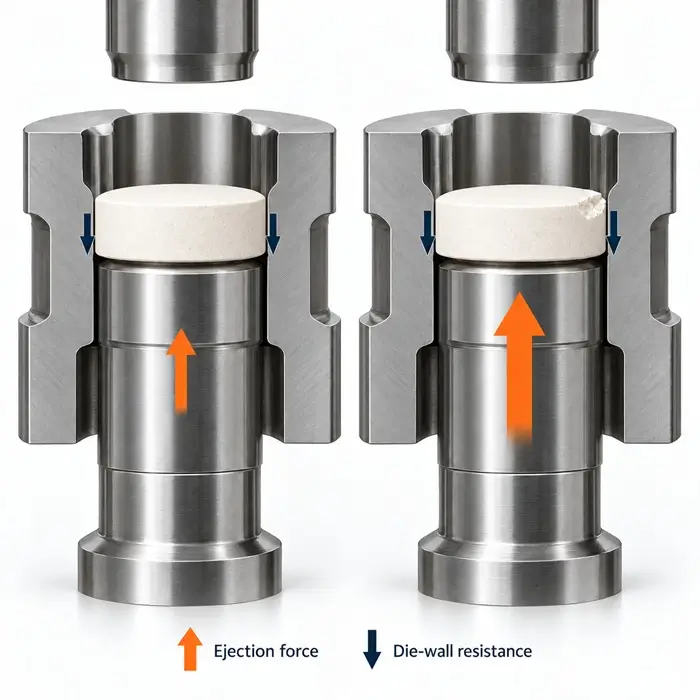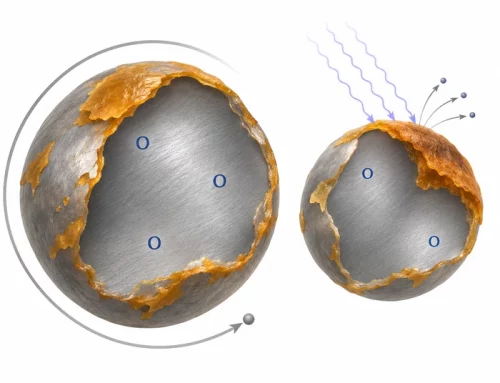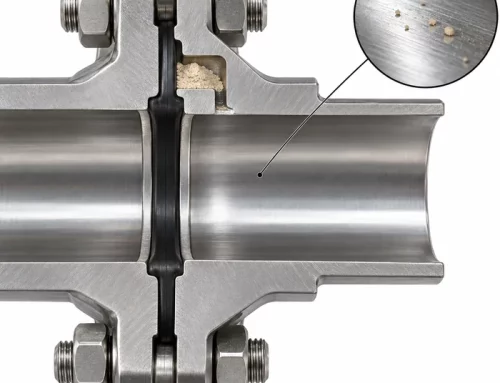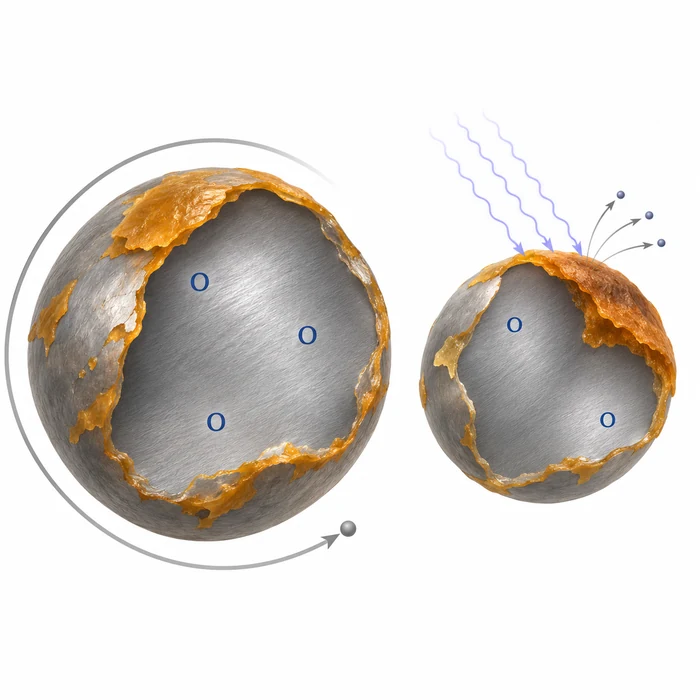
Tablet compression can increase density while cracks develop during unloading and ejection. Illustrative image; not experimental data from the cited studies.
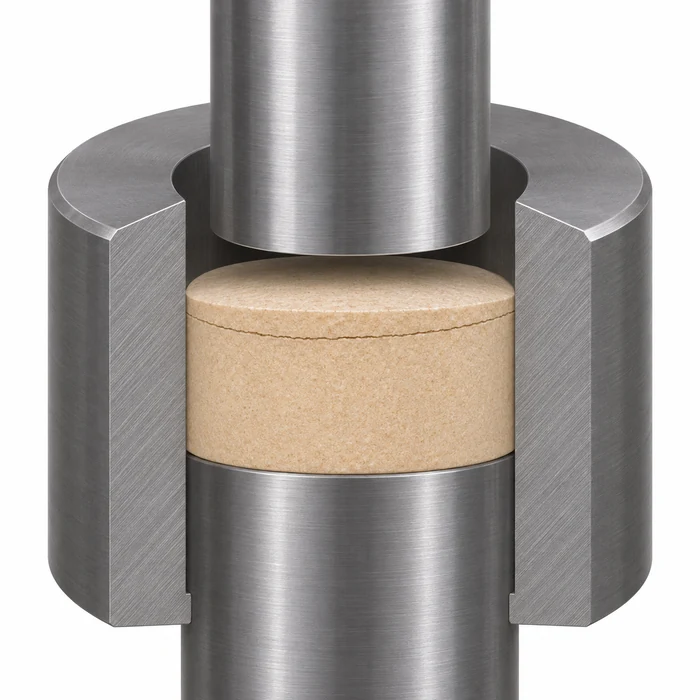
A pressure increase produces thinner tablets at the same mass, yet more tablets lose a cap. The press has achieved greater overall densification, but the compact has become less reliable during release or subsequent handling. Increasing pressure again may repeat the problem.
Tooling geometry also changes the pressure at which failure becomes likely. In one published study, increasing tablet diameter from 8 to 12 mm, at nearly identical band thickness and the same curvature ratio, lowered the compression pressure associated with 50% capping from 140 to 58 MPa.
The explanation lies partly in what happens after peak compression. Particle bonding, internal stress, and elastic recovery respond differently to the loading and release cycle. Consequently, a tablet can become denser without becoming more resistant to fracture. The practical question is whether the higher pressure should be retained or whether another part of the compression cycle needs attention.
Density and integrity answer different questions
Densification increases the solid fraction of a compact by reducing its porosity. Integrity concerns whether the resulting structure survives the stresses it experiences. During compression, particles rearrange, deform, and form interparticle bonds. However, some deformation remains recoverable, while nonuniform consolidation can leave regions with different densities and mechanical properties.
As the axial punch load decreases during unloading, the compact begins to recover while the die wall still restricts radial expansion. When the tablet emerges during ejection, that constraint decreases, changing the internal stress distribution again. These transitions can generate or extend cracks even when additional compression has increased bonding.
Garner and colleagues demonstrated this mechanism in microcrystalline cellulose compacts. Using X-ray tomography, microscopy, and numerical modeling, they identified internal microcracks developing during unloading inside the die. Some subsequently grew as the compact emerged during ejection. Their findings establish that damage can begin before a cap becomes visible.
The competition is therefore between the strength gained through particle bonding and the local stresses experienced during release. Greater average density does not guarantee sufficient strength across a potential fracture plane. PTI’s explanation of powder deformation under pressure provides additional background on recoverable and permanent deformation.
What the experiments establish
Sarkar and colleagues investigated capping in an acetaminophen-starch formulation using a tablet press equipped with an air compensator above the precompression roll. They identified the rate of force application as a major contributor to capping. Rapid loading promoted air entrapment, uneven force distribution, stratified densification, and viscoelastic recovery.
Their most effective intervention combined extended dwell at low precompression force with subsequent main compression. The longer initial consolidation period allowed particle rearrangement and air escape before stronger interparticle bonds formed. This demonstrates why changing compression timing can be more useful than increasing peak force alone.
Meynard and colleagues approached the problem from the unloading side. Using a compaction simulator, they detected capping within milliseconds after unloading through die-wall pressure measurements. A two-step unloading profile reduced capping when the loss of contact between punches and tablet was slowed.
The result is particularly instructive: modifying unloading also produced significant changes in tablet density, yet residual die-wall pressure and tablet strength showed no clear trends. In this experiment, changing the release trajectory improved tablet integrity without a straightforward relationship to conventional strength measurements.
Together, the studies show that loading rate, consolidation time, and unloading dynamics can influence capping independently of the peak compression setting.
Make the pressure comparison interpretable
Before changing the formulation or compression setting, establish whether the higher pressure reproducibly increases capping.
Compare portions of the same conditioned blend, maintaining consistent granulation, moisture, lubrication history, tablet mass, and tooling. Record the actual compression-force and displacement profiles, rather than relying solely on machine settings. Convert force to nominal compression pressure using the relevant punch-face area, and correct instrumented displacement for machine compliance where necessary.
Measure thickness, solid fraction, and elastic recovery alongside capping frequency. Inspect representative tablets under consistent handling conditions, both immediately after ejection and at defined later intervals. Record the separation morphology, distinguishing cap detachment from edge chipping or other defects.
The first visible separation does not necessarily identify when the initial crack developed. Internal damage may originate during unloading and become apparent only during ejection or handling.
Compare the observed differences with measurement precision and sampling variability. The forming and densification diagnostic route provides a framework for connecting defect timing with compression history, recovery, and possible air retention.
Choose the next trial from the failure mechanism
The next adjustment should address the part of the process most closely associated with the defect, rather than simply reducing or increasing compression pressure.
When unloading is implicated, compare release profiles at matched peak compression conditions where the equipment allows. Independent unloading control is primarily available on compaction simulators.
On a rotary press, the punch-head flat determines dwell time under the compression roll, while the adjoining head radius influences how the punch enters and leaves roll contact. Together with turret speed, these features shape the loading and unloading profile. Punch-head design therefore provides a practical way to influence the compression cycle without relying exclusively on changes in peak force.
When rapid loading or inadequate consolidation is suspected, investigate precompression force, dwell time, and turret speed. Precompression can provide additional opportunity for rearrangement and air escape. However, a turret-speed change affects several parts of the compression cycle simultaneously, so any improvement must be interpreted as the result of a combined intervention.
When cracking develops or propagates during ejection, examine die-wall interaction, ejection force, and tooling geometry.
Garner and colleagues found smaller crack openings and higher axial strength in compacts produced using tapered rather than straight dies. The result demonstrates that die geometry can influence damage during release, although the benefit must be established for the particular material and tooling configuration.
Punch-tip geometry also deserves attention. Mazel and colleagues systematically investigated biconvex tablets and found that larger tablet diameters, thinner bands, and greater face curvature increased capping susceptibility in their model formulation. These effects also interacted, demonstrating why tooling dimensions should be considered together rather than independently.
Their experimental comparison illustrates the scale of the effect. With nearly identical band thickness and the same curvature ratio, the larger-diameter tablet had a substantially lower P50, the pressure at which half the tested tablets exhibited capping. This was a comparison between tooling geometries, not a pressure-increase trial on unchanged tooling.
For production engineers, this makes punch selection and die geometry practical considerations alongside compression force and cycle timing. They are not universal remedies, but they can change the mechanical conditions responsible for failure.
Track ejection force and inspect the defect location when evaluating these interventions. PTI’s discussion of ejection force and tablet hardness explains why a satisfactory breaking-force result cannot represent every stress encountered during release from the die.
Finally, repeat the most informative intervention against the original baseline. Retain the combination of pressure, cycle timing, and tooling conditions that reproducibly meets tablet integrity, strength, disintegration, and other applicable product-quality requirements.
The objective is not maximum densification. It is a compact that remains mechanically reliable after the compression load has been removed.