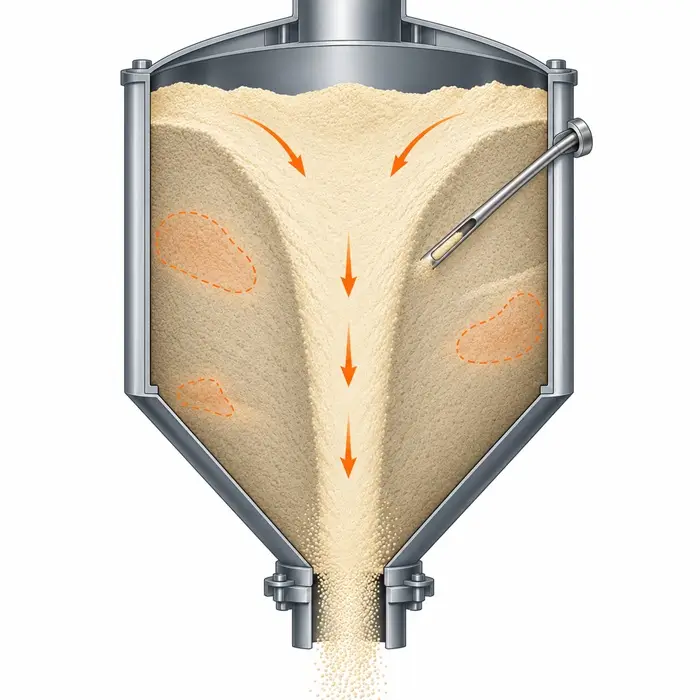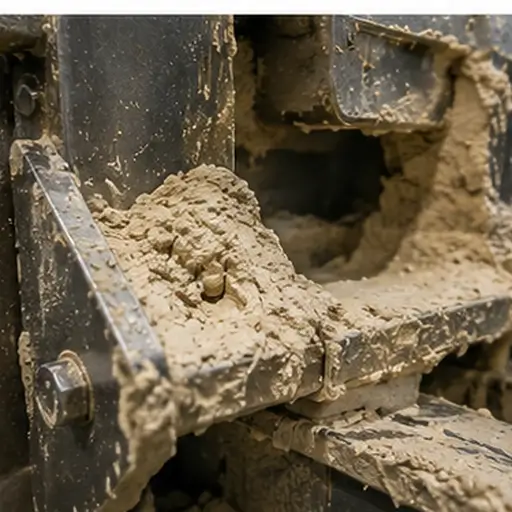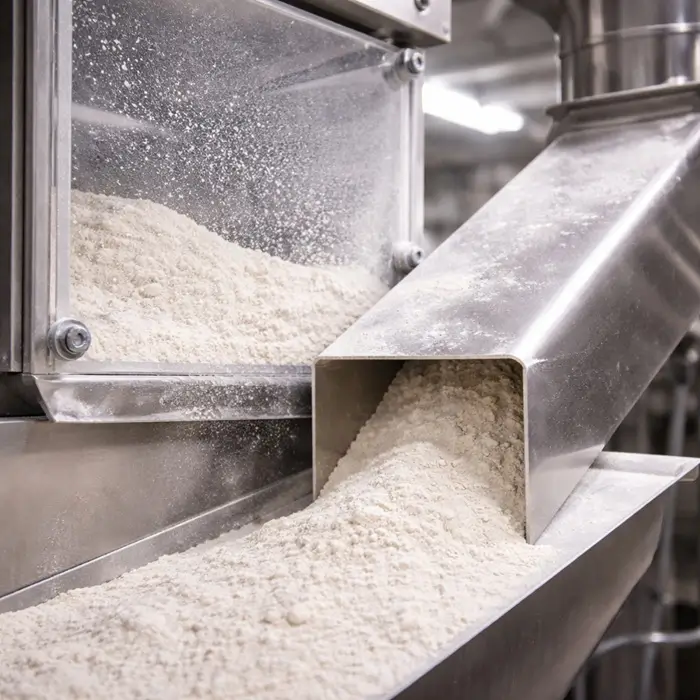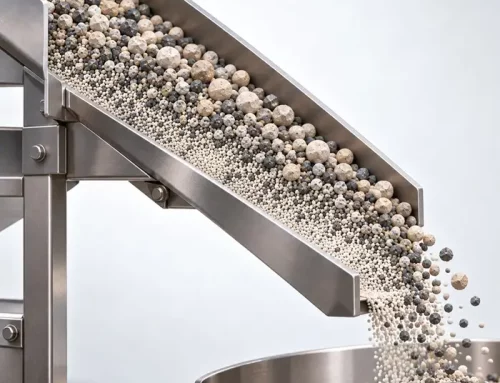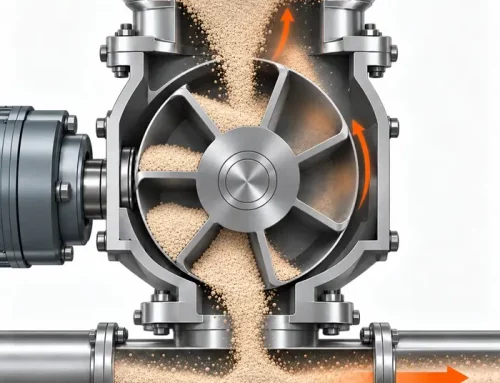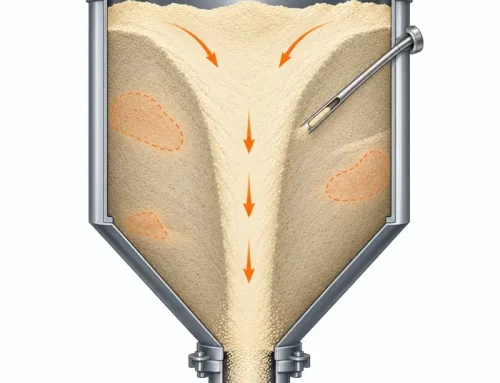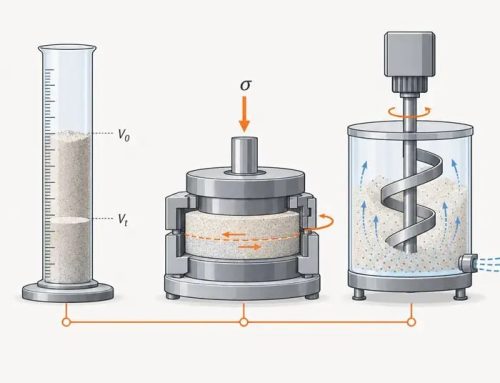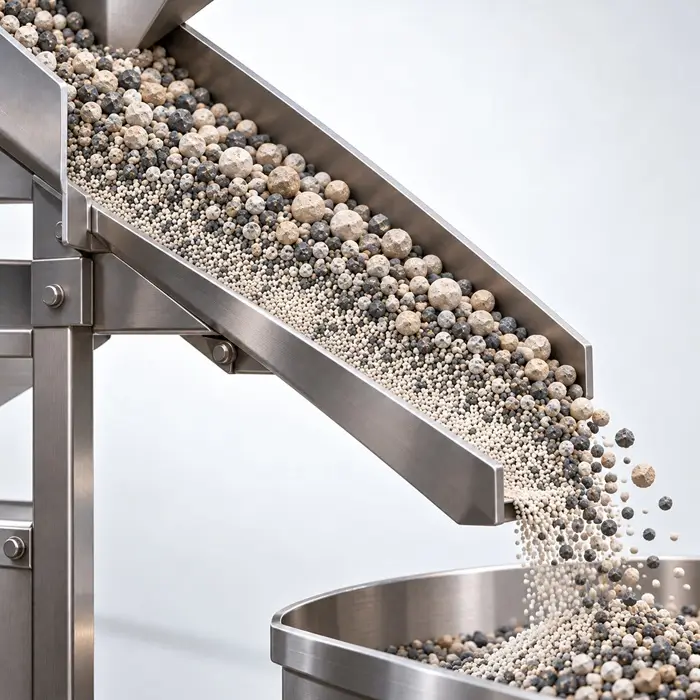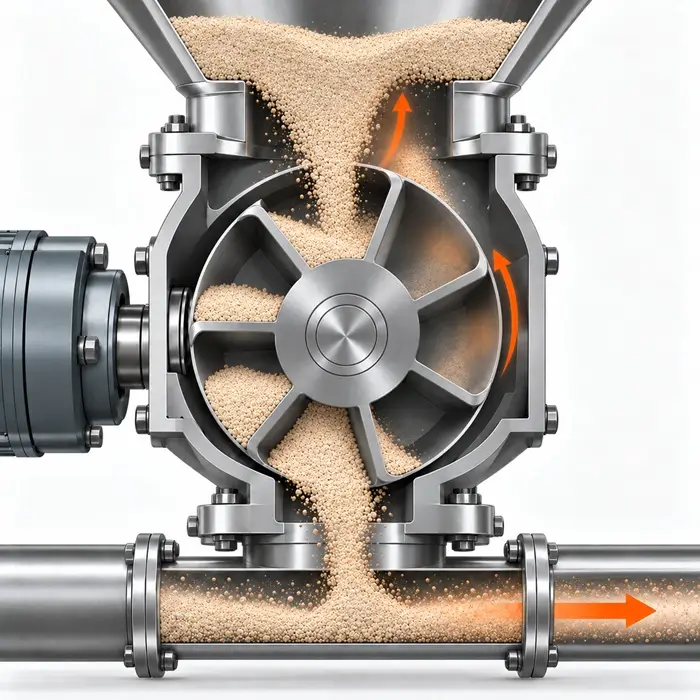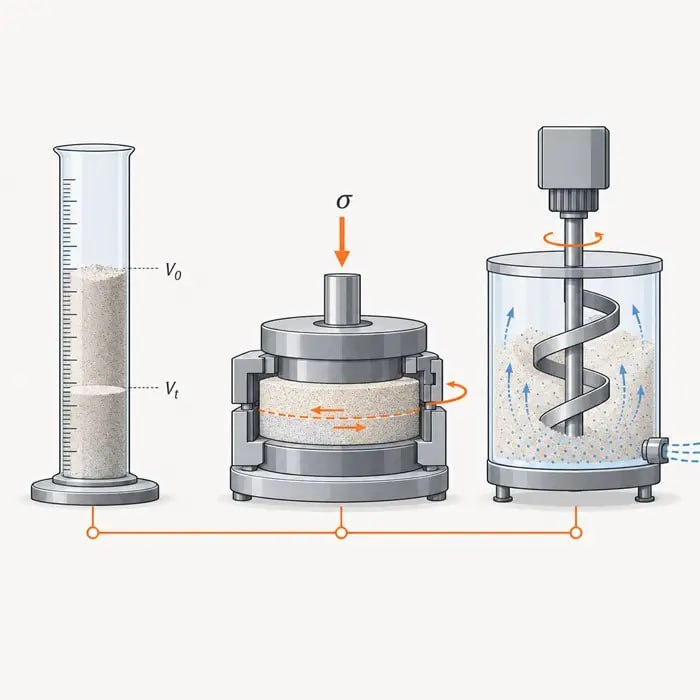
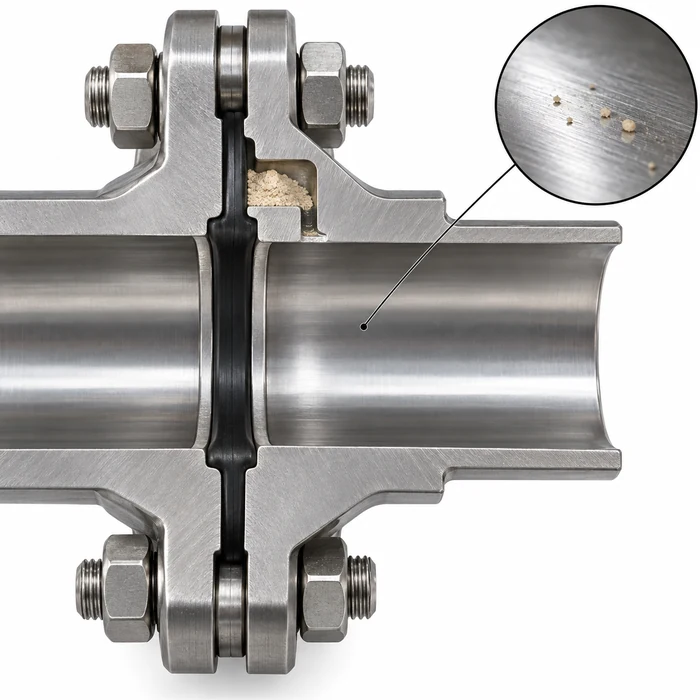
Sparse attachment on exposed steel and one trapped gasket pocket with an open route to the bore illustrate different cleaning and sampling challenges. Schematic illustration; particle sizes and the recess opening are exaggerated.
The changeover record is complete, and the equipment looks clean. Then the next batch carries a trace of what ran before it. Comparing where you sample with when the contaminant shows up can help focus the search.
This is a different question from contamination distributed within a powder lot. Here, the suspected reservoir sits somewhere in the equipment itself, and the goal is to find it before the next changeover erases the evidence.
Match Sampling Timing to the Reservoir
Restart changes the forces acting on retained material. Moving components, airflow surges, incoming powder impacts, and vibration can dislodge an attached deposit or empty a trapped pocket that cleaning never reached. The timing of a contamination signal can help prioritize where to look, but does not identify the reservoir by itself.
| Observed pattern | Hypothesis to investigate | Useful comparison |
|---|---|---|
| Previous-product signal appears in the first discharge | Accessible heel or residue near the discharge path | Targeted surface samples and separately analyzed startup fractions |
| Signal appears after a valve movement or filter pulse | A reservoir connected to that operating event | Event-timed fractions and inspection of the implicated assembly |
| Smooth-wall checks pass but carryover persists | Uncovered cavity, different surface, or poor sampling recovery | Disassembly findings and recovery studies on the relevant material |
Preserve fraction identity and log elapsed time or cumulative discharged mass against each operating event, rather than combining startup and later material into a single composite that dilutes a brief contamination peak. Representative stream sampling matters within each fraction: confirm the contaminant against both the previous product and the incoming material before calling it carryover.
Why Dry-Cleaning Physics Matters
Nelson and colleagues showed the gap between appearance and residue directly, in a laboratory coupon study. They electrostatically coated stainless-steel coupons with Salmonella-inoculated flour, then brushed them to visibly clean. The coupons still carried 3.84 ± 0.15 log CFU/cm² [s7]. Visibly clean described the eye’s assessment, not the organism count.
Both this study and Klug and colleagues’ flour-adhesion work examine laboratory approaches relevant to dry cleaning in low-moisture food processing [s7, s6]. For mechanical dry cleaning, removal depends on whether the cleaning action reaches retained material and supplies enough force to detach and collect it.
An exposed particle stays attached when particle-wall adhesion, whether van der Waals attraction, electrostatics, or a residual moisture bridge, exceeds the force the cleaning action applies. A pocket behind a gasket or inside a valve cavity persists for a different reason: the brush, vacuum, or airflow never reaches it. No amount of surface scrubbing empties an inaccessible cavity.
Klug and colleagues tested flour on electropolished 304 stainless steel across a controlled humidity range. Charge increased adhesion for the coarser 60–80 mesh fraction at 20% and 40% relative humidity; it made no significant difference for the finer 80–100 mesh fraction [s6]. This conditional, size-dependent result is why humidity-dependent triboelectric charging cannot supply a single blanket rule for cleaning or handling.
The same study also compared vacuum nozzle angles. At 60% relative humidity, a 90° angle relative to the surface, meaning perpendicular, left significantly less ATP-indicated residue than a 0° angle, for both the 60–80 mesh fraction (p=0.031) and the 80–100 mesh fraction (p=0.043) [s6]. This supports testing perpendicular vacuum nozzle orientation against the current setup under relevant material and humidity conditions, with residue verification.
Inspect blade undersides, gasket recesses, valve cavities, filter housings, and transfer connections with this distinction in mind. Attachment forces and restricted access can each contribute to residue remaining after a visibly clean changeover.
Verify the Residue and the Sampling Method
Fix the analytical endpoint first: previous-product ingredient, allergen marker, cleaning agent, or microorganism. ATP indicates organic residue; it does not identify an allergen or confirm pathogen inactivation.
Health Canada’s pharmaceutical cleaning-validation guide describes visual inspection as qualitative and says spiking studies may be required to determine product- and surface-specific visual detection thresholds, particularly for products with a lower health-based exposure limit [s5]. A detection threshold describes what inspectors can see; it is not an acceptable residue limit. Assess that capability against independently justified acceptance limits. An uncharacterized visual pass establishes neither a quantified residue level nor compliance with those limits.
FDA’s cleaning-validation guidance also emphasizes sampling limitations. Rinse sampling alone is not sufficient, because the rinse solvent may not remove the residue or contaminant; direct surface measurement should also be used where feasible [s4]. These sources are pharmaceutical GMP guidance, not food-specific regulation. Their sampling principles offer a useful basis for designing a food-powder investigation: confirm recovery and sample difficult locations, while justifying the methods for the actual equipment and target residue.
For the next investigation, pick one implicated changeover and map its plausible reservoirs before cleaning destroys the evidence. Fix the target analyte and acceptance basis, confirm recovery on the relevant surfaces, then pair targeted equipment samples with separately retained, time-stamped restart fractions. Use the combined sampling and inspection findings to decide whether to improve access, change the cleaning action, or investigate another contamination source.
Technical Basis / Sources
- Nelson, Kasey, Ian Klug, Michael James, Teresa M. Bergholz, Bradley Marks, and Sanghyup Jeong. (2024). UV-C Dry Sanitation of Visibly-Cleaned Salmonella-Inoculated Stainless Steel Surfaces. IAFP Annual Meeting Abstracts, technical abstract T2-12, pp. 41–42. International Association for Food Protection.
- Klug, Ian, Bradley Marks, Teresa Bergholz, and Sanghyup Jeong. (2024). Factors Affecting the Adhesion of Flour Particles to Stainless Steel Surfaces and Vacuum Dry-Cleaning. IAFP Annual Meeting Abstracts, technical abstract T2-05, pp. 39–40. International Association for Food Protection.
- Health Canada. (2021). Cleaning validation guide (GUI-0028), V5. June 29, 2021. Catalogue H139-6/2021E-PDF. ISBN 978-0-660-33544-5.
- U.S. Food and Drug Administration. (2015). Questions and Answers on Current Good Manufacturing Practice Requirements | Equipment. Question 12, dated June 8, 2015. Page content current as of November 16, 2022.