
Powder property
Dispersion
Useful dispersion requires wetting, deagglomeration, and stabilization
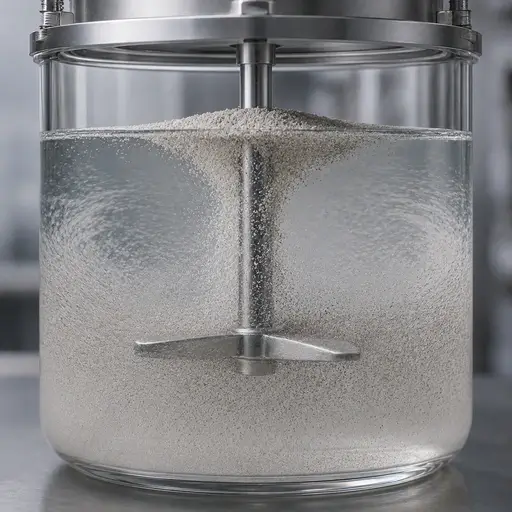
Dispersion is the process and resulting state in which particles are distributed through a continuous phase. Good dispersion requires the powder to wet, agglomerates to break under available energy, particles to distribute throughout the liquid, and the resulting population to remain acceptably stable against reaggregation, settling, creaming, or phase separation.
Powder property
Dispersion
Useful dispersion requires wetting, deagglomeration,
and stabilization
Dispersion is the process and resulting state in which particles are distributed
through a continuous phase. Good dispersion requires the powder to wet,
agglomerates to break under available energy, particles to distribute throughout
the liquid, and the resulting population to remain acceptably stable against
reaggregation, settling, creaming, or phase separation.




Core concept
A visually uniform liquid may still be poorly dispersed
A powder can disappear from view while strong agglomerates remain. It can also reach a fine particle state under high shear and then reaggregate when the energy stops or the chemistry changes. The measured particle size therefore depends on preparation history, solids loading, liquid chemistry, dispersant dose, temperature, and the stress applied by the measurement itself. Over-dispersion can destroy process-relevant structures, while under-dispersion can leave agglomerates in the measured size distribution.
What controls it
Six groups of variables govern dispersion
Dispersion quality reflects the balance between attractive forces, stabilizing interactions, agglomerate strength, and the hydrodynamic stress available to separate particles.
States and interpretation
Dispersion state changes with energy, chemistry, and time
Evaluate breakup, stabilization, and reaggregation separately instead of relying on appearance alone.
| Dispersion state | Observed behavior | Controlling issue | Useful confirmation |
|---|---|---|---|
| Poorly wetted | Floating powder, dry cores, and persistent fisheyes | Liquid contact and trapped air | Wetting time and cross-sectioned clumps |
| Under-dispersed | Large agglomerates remain after mixing | Insufficient stress or excessive bond strength | PSD versus controlled energy input |
| Temporarily dispersed | Fine state forms but rapidly reaggregates | Inadequate electrostatic or steric stabilization | Time-resolved PSD and zeta potential |
| Over-processed | Primary particles, coatings, polymers, or product structure are damaged | Excess energy, heat, or duration | Energy titration with morphology and function |
How to measure it
Choose dispersion measurements by the failure stage
Pair particle-state measurements with chemistry, rheology, stability, and controlled preparation history.
Where it matters
Dispersion becomes a uniformity and function constraint
The required state depends on whether the process needs transport, reaction, coating, optical performance, or stable storage.
Go deeper
Three practical routes into powder dispersion
Explore the complete preparation and interpretation workflow, laboratory dispersion practice, and an applied coating failure that composition checks alone could not explain.


Need the measurement, not just the guidance?
If the remaining uncertainty concerns dispersion preparation, agglomerate breakup, zeta potential, rheology, stability, energy titration, or process-scale mixing response, select the measurement around the material state and process decision. PowderTechnology.info can help define the test sequence, sample conditions, and interpretation route. For laboratory support, explore our Delft Solids Solutions partner page or visit Delft Solids Solutions directly.