
Powder property
Agglomeration
Particle clusters can be useful products or uncontrolled process structures
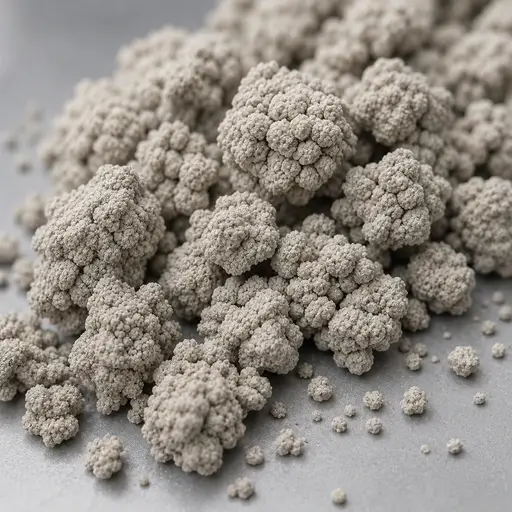
Agglomeration is the formation of larger structures from primary particles, fines, droplets, or smaller granules. It may be deliberately engineered to improve handling and performance, or arise unintentionally through moisture, electrostatics, softening, pressure, or reaction, and persist when dispersion is insufficient.
Powder property
Agglomeration
Particle clusters can be useful products
or uncontrolled process structures
Agglomeration is the formation of larger structures from primary particles,
fines, droplets, or smaller granules. It may be deliberately engineered to
improve handling and performance, or arise unintentionally through moisture,
electrostatics, softening, pressure, or reaction, and persist when dispersion
is insufficient.




Core concept
Agglomeration is a structure-formation mechanism
Particles can form loose clusters through weak surface forces or develop strong granules through liquid bridges, binders, crystallization, sintering, pressure, or chemical transformation. The same apparent size can therefore conceal very different internal structures and strengths. Intended agglomeration aims to create a controlled size, density, porosity, strength, and redispersion response. Unintended agglomeration creates variable clusters that may bridge, segregate, dissolve slowly, block screens, or break unpredictably. Characterize both the structure and the force holding it together. A size measurement alone cannot distinguish a useful granule from a fragile cluster or a hardened process deposit.
What controls it
Six groups of variables govern agglomeration
Agglomerate formation reflects the balance between collision, capture, bond formation, consolidation, breakage, and drying or curing.
States and interpretation
Similar apparent sizes can conceal different agglomerate structures
Identify the bonding regime and internal structure before interpreting size or selecting a breakup method.
| Structure state | Dominant bond | Likely behavior | Useful confirmation |
|---|---|---|---|
| Loose cluster | Weak dry attraction or electrostatics | Breaks during sampling, dispersion, or gentle handling | Size under staged dispersion energy |
| Wet agglomerate | Liquid bridges, binder solution, or capillary suction | Deforms, coalesces, or grows before drying | Moisture state, microscopy, and wet strength |
| Dried granule | Solid binder, crystallized solute, or mechanical interlocking | Retains shape but may abrade or fragment | Strength distribution, porosity, and dissolution |
| Sintered or reacted structure | Neck growth, fusion, or chemical bonding | High persistence and difficult redispersion | Thermal, phase, and microstructural analysis |
How to measure it
Choose measurements by formation and breakup behavior
Combine population size with structure, strength, and dispersion response to distinguish agglomeration mechanisms.
Where it matters
Agglomeration becomes a size, strength, and performance constraint
Control agglomeration wherever particles intentionally assemble or unwanted clusters alter downstream behavior.
Go deeper
Three practical routes into agglomerate formation
Explore the causes of uncontrolled clustering, the methods used to characterize agglomerates, and the kinetics of initial formation.

Need the measurement, not just the guidance?
If the remaining uncertainty concerns agglomerate formation, granule strength, binder distribution, redispersion, internal porosity, or unintended cluster growth, select the measurement around the material state and process decision. PowderTechnology.info can help define the test sequence, sample conditions, and interpretation route. For laboratory support, explore our Delft Solids Solutions partner page or visit Delft Solids Solutions directly.