
Powder property
Viscosity
Resistance to flow depends on shear rate, time, and material structure
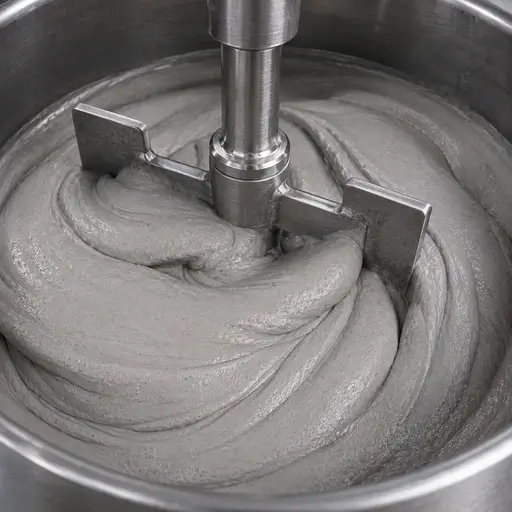
Viscosity describes a fluid or suspension's resistance to deformation and flow under defined conditions. In particle-containing systems, concentration, size, shape, interactions, aggregation, continuous-phase chemistry, shear history, temperature, and time can produce Newtonian or strongly shear-dependent behavior.
Powder property
Viscosity
Resistance to flow depends on shear rate, time,
and material structure
Viscosity describes a fluid or suspension’s resistance to deformation and flow
under defined conditions. In particle-containing systems, concentration, size,
shape, interactions, aggregation, continuous-phase chemistry, shear history,
temperature, and time can produce Newtonian or strongly shear-dependent
behavior.




Core concept
Viscosity depends on the applied deformation conditions
A Newtonian liquid has a constant viscosity at a defined temperature, independent of shear rate. Particle suspensions often shear-thin, shear-thicken, yield, rebuild at rest, or change irreversibly because flow rearranges or damages their internal structure. Apparent viscosity is therefore tied to a specific shear rate and history. Two instruments can produce different values if their geometries, gaps, loading, wall slip, settling, temperature control, or measurement sequences differ. Measure across the deformation range relevant to storage and processing. A low-shear stability problem and a high-shear pumping decision may require different parts of the same rheological response.
What controls it
Six groups of variables govern viscosity
Suspension viscosity reflects the continuous phase and the particle network that forms, breaks, aligns, crowds, or rebuilds during deformation.
States and interpretation
One viscosity value can conceal different flow behaviors
Use a flow curve and controlled history to distinguish rate dependence, yielding, and structural recovery.
| Rheological response | Observed behavior | Process implication | Useful confirmation |
|---|---|---|---|
| Newtonian | Viscosity remains constant across the tested shear-rate range | Pressure drop scales predictably with flow rate | Repeated flow curve at controlled temperature |
| Shear-thinning | Apparent viscosity decreases as shear rate increases | Easy pumping may coexist with strong low-shear structure | Wide-range flow curve with low-shear resolution |
| Yield-stress behavior | Flow begins only after a critical applied stress | Supports suspension but can hinder startup and emptying | Stress ramp, creep, and vane measurement |
| Thixotropic or time-dependent | Viscosity changes with duration and recovers after rest | Mixing and transfer history alter filling and application | Controlled breakdown and recovery sequence |
How to measure it
Choose a rheological test by the process deformation
Select geometry and sequence that cover the relevant shear, stress, time, and temperature window without measurement artifacts.
Where it matters
Viscosity becomes a transport and application constraint
Different operations expose the same formulation to different shear, stress, temperature, and residence-time conditions.
Go deeper
Three practical routes into suspension viscosity
Explore the fundamentals of viscosity, the preparation of particle dispersions, and why application behavior can fail despite acceptable composition checks.

Need the measurement, not just the guidance?
If the remaining uncertainty concerns flow curves, yield stress, thixotropy, temperature dependence, suspension stability, process-rate viscosity, or application failure, select the measurement around the material state and process decision. PowderTechnology.info can help define the test sequence, sample conditions, and interpretation route. For laboratory support, explore our Delft Solids Solutions partner page or visit Delft Solids Solutions directly.