
Powder property
Sedimentation
Settling reflects particle, liquid, concentration, and interaction effects together
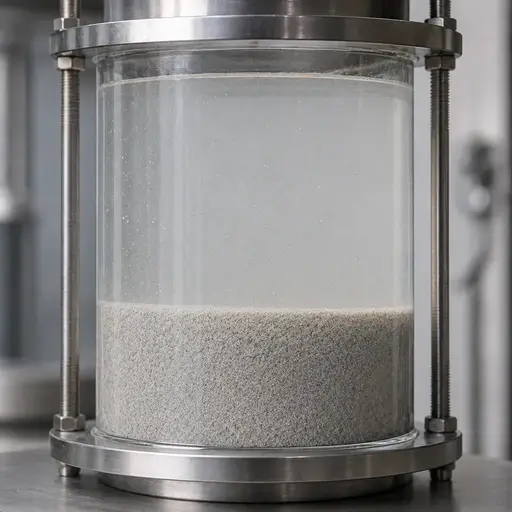
Sedimentation is the movement and accumulation of particles through a surrounding fluid under gravity, centrifugal acceleration, or another body force. Settling rate and final structure depend on particle size, density, shape, liquid viscosity, concentration, aggregation, surface chemistry, and hydrodynamic interaction.
Powder property
Sedimentation
Settling reflects particle, liquid, concentration, and interaction effects together
Sedimentation is the movement and accumulation of particles through a surrounding fluid under gravity, centrifugal acceleration, or another body force. Settling rate and final structure depend on particle size, density, shape, liquid viscosity, concentration, aggregation, surface chemistry, and hydrodynamic interaction.




Core concept
Sedimentation is a particle-fluid response, not size alone
An isolated spherical particle settles according to its size, density contrast, liquid viscosity, and flow regime. Real suspensions contain distributions of irregular particles that interact hydrodynamically and through surface forces. At low concentration, particles may settle independently. At higher concentration, displaced liquid must move through the particle network, producing hindered settling. Attractive particles can form flocs that settle rapidly but create open sediments, while stable fine dispersions may settle slowly and form dense layers over time. Interpret the moving interface, supernatant, particle distribution, and final sediment together. One settling time cannot describe both separation kinetics and sediment recoverability.
What controls it
Six groups of variables govern sedimentation
Settling behavior emerges from the driving force, hydrodynamic resistance, particle interactions, and the evolving concentration field.
States and interpretation
Different settling regimes produce different suspension outcomes
Identify the regime before using settling rate to infer particle size, stability, or separability.
| Settling regime | Observed behavior | Controlling feature | Useful confirmation |
|---|---|---|---|
| Free settling | Particles descend largely independently at low concentration | Individual size, density, shape, and fluid drag | Dilution series and particle tracking |
| Hindered settling | A distinct interface moves as a concentrated suspension zone | Crowding and counterflow of displaced liquid | Interface-height curve at controlled concentration |
| Flocculated settling | Large structures settle rapidly into an open sediment | Attractive interactions and floc strength | Microscopy, zeta potential, and redispersion |
| Compression and consolidation | Sediment height decreases slowly after initial settling | Particle-network stress and liquid drainage | Long-duration height and solids-profile measurement |
How to measure it
Choose a method by the settling question
Separate particle-sizing applications from suspension-stability, clarification, and sediment-structure decisions.
Where it matters
Sedimentation becomes a stability and separation constraint
Settling can be desirable for clarification and recovery or harmful when a product must remain uniform during use.
Go deeper
Three practical routes into particle settling
Explore centrifugal size analysis, the preparation and interpretation of stable dispersions, and the effect of chemistry on particle separation.


Need the measurement, not just the guidance?
If the remaining uncertainty concerns settling rate, suspension stability, flocculation, centrifugal analysis, sediment consolidation, or redispersion behavior, select the measurement around the material state and process decision. PowderTechnology.info can help define the test sequence, sample conditions, and interpretation route. For laboratory support, explore our Delft Solids Solutions partner page or visit Delft Solids Solutions directly.